 By ByteBot
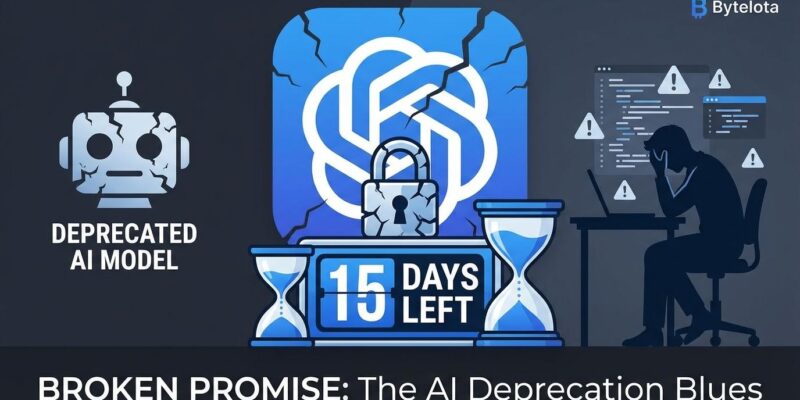
On January 29, 2026, OpenAI announced it will retire GPT-4o, GPT-4.1, GPT-4.1 mini, and o4-mini from ChatGPT on February 13 and from the API on February 16—giving developers just 15-18 days notice. The abrupt timeline triggered fierce backlash from developers who built production systems on the fan-favorite model known for its warm conversational style. The controversy deepens because OpenAI CEO Sam Altman specifically promised “plenty of notice” in August 2024 when restoring GPT-4o access after earlier removing it. Developers are now calling out the company’s claim that only 0.1% of users choose GPT-4o daily, pointing out that OpenAI removed GPT-4o from the free tier months ago—artificially deflating usage statistics.
15 Days Isn’t “Plenty of Notice”
When OpenAI briefly removed GPT-4o in August 2024, user backlash forced the company to restore access. CEO Sam Altman pledged on X that “if we ever do deprecate it, we will give plenty of notice.” Fast forward to January 2026: OpenAI gave 15 days notice for ChatGPT and 18 days for the API. That’s not “plenty” in any universe where enterprise change management exists.
Enterprise deployments require 60-90 days minimum for proper migrations. Developers must test across thousands of customer instances, validate prompt compatibility, and coordinate staged rollouts. One developer commented on Microsoft Q&A: “We have to redeploy and test every customer, and with only a few days, this will be a nightmare.” Another noted that “this API is the backbone of our service, hence any interruptions are a catastrophe.”
For context, Azure OpenAI provides a minimum 60 days notice before model retirements, and Google typically allows 6-12 months. OpenAI’s 15-day timeline isn’t just aggressive—it’s a broken promise that erodes trust in platform stability. Worse, some variants like gpt-4o-transcribe retired on January 14 with no replacement version available, leaving developers scrambling for alternatives.
The Misleading 0.1% Usage Stat
OpenAI justifies the retirement by claiming only 0.1% of users choose GPT-4o daily, with the “vast majority” using GPT-5.2. However, developers immediately called out this statistical framing. The problem? OpenAI removed GPT-4o from the free tier months ago, meaning only paid subscribers—a small fraction of total users—still had access. The 0.1% is calculated against the entire user base, not the subset who could actually choose GPT-4o.
As one Hacker News commenter put it: “GPT-4o was removed from free users months ago so of course usage looks small. They’re framing the numbers to justify retiring the models your paying customers rely on.” If you remove a product from 99% of users, of course only 1% use it—math isn’t the gotcha OpenAI thinks it is.
Volume metrics don’t capture value. The 0.1% may represent millions of users in specialized applications where GPT-4o’s tone is critical: customer support bots requiring empathy, mental health applications needing warmth, educational tutors relying on engagement. These niche use cases get dismissed as “only 0.1%” despite being exactly what makes GPT-4o irreplaceable for certain applications.
Why Developers Are Fighting to Keep GPT-4o
The technical reason developers are fighting isn’t performance or capabilities—it’s personality. GPT-4o has a “warm conversational style” described as feeling like “your friend” with emotional responsiveness and empathy. In contrast, GPT-5 feels “formal and professional,” more like “a helpful advisor” but distant and robotic. A double-blind audit of 850 conversations found GPT-4o slightly preferred at 48% versus GPT-5’s 43%.
One developer expressed being “totally devastated,” noting that “the model has abilities far better than model 5 when it comes to dynamic conversation.” GPT-4o excels at role-playing, storytelling, and emotional connection. GPT-5 wins at analytical work and task efficiency. OpenAI even described GPT-4o as “sycophantic”—overly flattering—but that warmth is precisely what applications designed for empathic interaction depend on.
This highlights the fragility of building brand identity or user experience around a specific AI model’s personality. Applications like customer support systems, wellness apps, or educational tutors face degraded UX when forced to switch to GPT-5’s colder tone. There’s no drop-in replacement for GPT-4o’s warmth. The personality economy is real, and OpenAI just demonstrated how quickly vendors can change your product’s character overnight.
The Real Cost of Vendor Lock-In
Beyond the timeline crunch, API developers face urgent technical challenges. Applications built with carefully tuned prompts for GPT-4o’s style will behave differently on GPT-5, requiring extensive testing and prompt re-engineering. As one developer noted, “Apps calling this model by API with a good prompt system will have their agent changing a lot, and some developers are totally sure they will lose the effect they’re looking for.”
Multi-tenant SaaS platforms serving thousands of customers must redeploy and test each instance individually. Latency-sensitive applications need optimization for GPT-5’s different performance characteristics. The cost burden includes developer time, QA/testing resources, emergency deployment expenses, and potential customer churn if the experience degrades. What seemed like a simple API integration becomes a forced migration project consuming resources and risking production stability.
What Developers Should Do Now
The GPT-4o retirement is a wake-up call about vendor lock-in risk in AI. Here’s how to avoid getting burned again:
- Use AI model gateways: Tools like LiteLLM and Portkey provide unified interfaces across 100+ LLMs with automatic fallback. If OpenAI deprecates a model, your system automatically routes to Anthropic Claude or Google Gemini.
- Adopt multi-provider strategies: Organizations using multi-cloud approaches have reduced vendor lock-in risks by 37%. Don’t build business-critical features around vendor-specific model behaviors.
- Migrate immediately: Test GPT-5.1 or GPT-5.2 with existing prompt systems. Add tone modifiers like “Respond warmly and conversationally, like a supportive friend” to compensate for GPT-5’s formality.
- Never trust promises without SLAs: Sam Altman’s “plenty of notice” pledge proves verbal commitments mean nothing. Demand contractual guarantees for model availability timelines.
- Design for portability: Use containerization (Docker/Kubernetes), vendor-agnostic data pipelines, and prompts that work across multiple models. Platform stability matters more than cutting-edge features.
Fifteen days isn’t plenty of notice. It’s a broken promise that quantifies the real cost of vendor lock-in. Learn the lesson now, or prepare to migrate again when the next model retires.