 By ByteBot
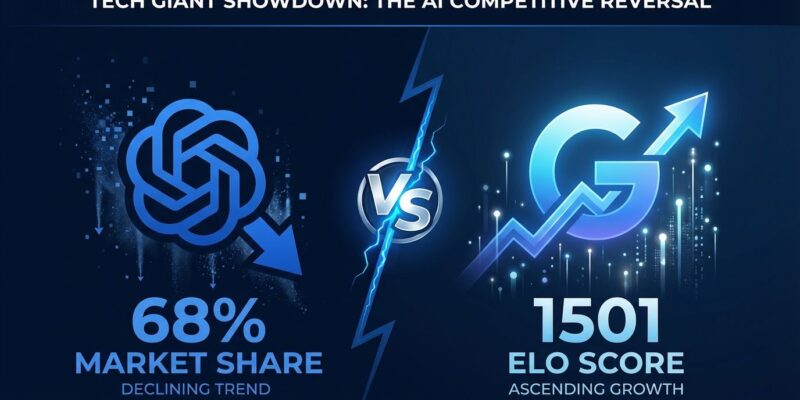
On December 2, 2025, OpenAI CEO Sam Altman issued an internal “code red,” ordering teams to pause product launches and focus all resources on improving ChatGPT. The catalyst: Google’s Gemini 3, released November 18, overtook ChatGPT atop the LMArena leaderboard with a record 1501 Elo score—the first AI model ever to break 1500. In response, OpenAI indefinitely delayed its advertising platform, personal assistant “Pulse,” shopping agents, and health AI tools. The message is clear: quality defense matters more than revenue expansion when your competitive moat is eroding.
This isn’t just corporate drama. ChatGPT’s market share dropped from 87.2% in January 2025 to 68% in January 2026 while Gemini surged from 5.4% to 18.2%, according to Similarweb analysis. For developers and enterprises betting on AI platforms, Altman’s “code red” reveals uncomfortable truths about platform risk, benchmark wars, and why distribution advantage often trumps technical superiority.
The Historic Irony: Three Years, Full Circle
Here’s the twist: In December 2022, Google CEO Sundar Pichai declared a “code red” when ChatGPT launched, viewing it as an existential threat to Google Search. He reorganized teams, accelerated Gemini development, and rushed AI prototypes to market by May 2023. Three years later, Sam Altman used the exact same phrase as Google’s Gemini 3 reclaimed benchmark leadership, Fortune reported.
The role reversal is striking. Google went from panicked incumbent scrambling to catch up, to confident challenger crushing benchmarks and sending its stock to record highs. OpenAI transformed from scrappy disruptor to defensive market leader warning employees of “rough vibes” and “temporary economic headwinds.”
This isn’t just ironic—it’s instructive. What took OpenAI years to build (brand dominance, developer trust, ecosystem lock-in) eroded in months when Google closed the capability gap. For enterprises making long-term AI platform bets, the lesson is stark: today’s market leader may not hold that position tomorrow. Vendor lock-in carries real risk when competitive dynamics shift this fast.
What Got Sacrificed (And Why It Signals Trouble)
OpenAI didn’t delay minor features—it postponed four major revenue initiatives. The advertising platform, which had been testing ads during shopping queries, got shelved indefinitely. Altman’s reasoning, per The Information: “Introducing ads could push users to other chatbots.” That’s not caution—that’s recognition that user loyalty is fragile when competitors offer comparable quality.
The personal assistant “Pulse,” designed to deliver individualized reports and proactive assistance, was also postponed. So were shopping AI agents and health AI tools, despite growing enterprise demand for domain-specific AI. These aren’t side projects—they represent OpenAI’s roadmap beyond subscriptions.
When a market leader sacrifices revenue to defend product quality, it signals genuine vulnerability. This isn’t prudent caution; it’s pragmatic survival. Google’s distribution advantage—2 billion Workspace users with built-in Gemini access—combined with benchmark wins means OpenAI’s window to monetize before losing more market share is narrowing fast.
Benchmark Dominance vs. Real-World Fragmentation
Gemini 3 Pro’s benchmark victories are concrete: 1501 Elo on LMArena, 91.9% on GPQA Diamond, 95% on AIME 2025 without tools, Tom’s Guide documented. These scores beat ChatGPT/GPT-5.2 across most tests. But here’s the nuance: the AI market isn’t converging on a single winner anymore—it’s fragmenting into task-specific excellence.
Claude Opus 4.5 leads coding with 77.2% on SWE-bench Verified. GPT-5.2 excels at reasoning and balanced general use. Gemini dominates multimodal tasks and search. As one analyst put it: “The era where a single model dominated all rankings is over. We’re witnessing a fragmentation of excellence.” No vendor can claim universal superiority anymore.
For developers, this changes platform selection criteria. GitHub Copilot’s December 2025 launch of multi-model support—offering Claude, GPT-5.2, and Gemini side-by-side—proves developers want task-specific model selection, not vendor loyalty. Benchmarks matter less than which model solves your specific problem best.
Market Share Collapse Reveals Distribution Is Destiny
ChatGPT’s market share fell 19.2 percentage points in 12 months (87.2% to 68%), while Gemini grew 237% (5.4% to 18.2%). Yet OpenAI’s revenue climbed to $10 billion ARR by June 2025, and 800 million users access ChatGPT weekly. This disconnect reveals the power of distribution over standalone quality.
Google’s 2 billion Workspace users get Gemini natively in Gmail, Docs, Sheets, and Drive. No app download, no subscription friction, no workflow disruption. Microsoft Copilot provides OpenAI some distribution through Office and Windows, but it’s not exclusive—Microsoft offers multiple models too.
OpenAI lacks owned distribution channels like Google Search or Microsoft Office defaults. Its standalone app model creates adoption friction that competitors with ecosystem integration don’t face. As market share data shows, when technical capabilities approach parity, distribution advantage wins. That’s why OpenAI’s “code red” focuses on speed, reliability, and personalization—features that might retain users already invested in the ChatGPT workflow.
The Multi-Model Future Is Already Here
The biggest strategic takeaway isn’t which model “wins”—it’s that single-vendor platform lock-in is now unacceptable. GitHub Copilot’s multi-model support launched in December 2025 for this exact reason: developers want choice based on task requirements, not vendor contracts.
Anthropic’s Model Context Protocol (MCP), donated to the Linux Foundation’s Agentic AI Foundation on December 9, 2025, standardizes agent interoperability. Founding members include OpenAI, Google, Microsoft, AWS, and Cloudflare. This isn’t collaboration—it’s competitive necessity. When no vendor can maintain technical superiority across all use cases, standardization reduces switching costs and makes multi-vendor strategies viable.
Smart enterprises are already building multi-cloud AI architectures: Gemini for Workspace integration and search tasks, Claude for software engineering, ChatGPT for reasoning and general use. LangChain and LlamaIndex enable model-agnostic application development. Platform risk mitigation requires abstraction layers that allow model swapping without rewriting applications.
What Happens Next
OpenAI’s “code red” historically lasts 6-8 weeks, suggesting improvements should arrive by late January 2026. Expect faster response times (Light/Standard reasoning modes), better personalization (tone presets already rolling out), improved reliability, and enhanced image generation. These are defensive moves—matching Gemini’s perceived advantages rather than pioneering new capabilities.
Whether these improvements reclaim market share depends on execution and whether they arrive before more users default to Gemini through Workspace integration. But the larger trend is clear: competitive gaps narrow fast in AI, distribution channels matter more than benchmarks, and the smart strategy is hedging across multiple vendors rather than betting on one.
For developers: abstract model dependencies now. Test multiple providers. Prepare for a world where task-specific model selection becomes standard practice. The era of ChatGPT as the default AI choice is ending—not because it’s failing, but because viable alternatives with different strengths now exist.