 By ByteBot
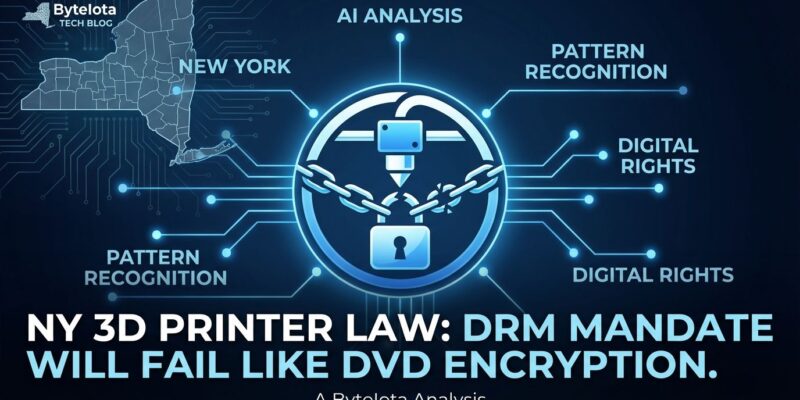
New York wants every 3D printer sold in the state to include “blocking technology” that detects and prevents printing firearm components. Governor Kathy Hochul’s budget proposal, announced January 15, aims to stop “ghost guns” by mandating firmware-level DRM in all consumer and commercial printers. It’s security theater disguised as public safety – technically unenforceable, easily bypassed, and destined to fail for the same reasons DVD encryption cracked in 1999.
How the Blocking Technology Would Work
The proposed law requires 3D printers to scan incoming print jobs for firearm-like geometries and block them before printing starts. Companies like Print&Go have built systems that do exactly this. Their “3D GUN’T” software uses AI and pattern matching to recognize suspicious 3D models and block output. The system maintains a database of known weapon components, analyzes STL files before they reach the print head, and integrates at the firmware level so it remains active even offline.
In theory, every printer sold in New York would ship with this blocking software baked into the firmware. Print a coffee cup holder? No problem. Print something that resembles a trigger guard? Blocked. The system is designed to stop ghost guns – unserialized firearms increasingly seized by police – before they’re manufactured.
There’s just one problem: it can’t work.
Why Detection is Impossible
STL files are triangulated surfaces with no semantic meaning. They’re just clouds of X, Y, Z coordinates describing shapes. Asking AI to detect “firearm-ness” in geometry is like asking spell-check to detect terrorism in text files. The software doesn’t know if you’re printing a gun receiver or a cosplay prop – it only sees triangles.
Pattern matching fails in two directions. False positives ban legitimate prints: brackets, mechanical enclosures, D&D miniatures, and prototypes get flagged because they share geometric features with firearm components. Tubes are tubes. Curved surfaces are curved surfaces. False negatives let modified designs slip through: change a few angles, add cosmetic features, or split a prohibited shape into innocent-looking parts, and the AI misses it entirely.
The technical community understands this immediately. On Hacker News, where the New York proposal drew 428 points and 480 comments, the consensus was swift: unenforceable security theater. One commenter summed it up: “This is DRM for hand tools. It failed for DVDs, it failed for game consoles, it failed for printer ink. Why would it work for 3D printers?”
DRM Always Gets Bypassed
Hardware DRM has a perfect track record of failure. DVD CSS, the encryption system Hollywood deployed in 1996 to prevent piracy, was cracked in 1999 when Norwegian programmer Jon Lech Johansen released DeCSS. The encryption used a 40-bit key – weak even then – and once one copy of the bypass code hit the internet, it spread globally within days. DVDs still play on unauthorized devices today.
HD DVD and Blu-ray tried again with AACS, an “industrial-grade” system launched in 2006. Hackers published the process key within weeks, enabling unrestricted access to protected content. Every game console generation gets modded despite signed firmware and boot sector verification. HP and Brother tried locking printer ink cartridges to block third-party refills; users downgraded firmware or bought chip resetters within days.
The 3D printing community has already run this playbook. In 2024-2025, Bambu Lab pushed a firmware update that blocked third-party software from controlling its printers. The community revolted. Within days, users extracted X.509 certificates and private keys, restoring full control over hardware they’d purchased. When EMI abandoned music DRM in 2007, the company admitted “the costs of DRM do not measure up to the results.” That lesson applies here.
Open-source firmware makes this even easier. Marlin and Klipper, the two dominant 3D printer firmwares, have 16,000+ GitHub stars and active development communities. Users routinely recompile firmware to add custom features – linear advance, pressure control, mesh bed leveling. Stripping out blocking code would take ten minutes. If someone is willing to commit a felony by manufacturing an illegal firearm, they’re not going to balk at flashing custom firmware.
Legitimate Users Pay the Price
DRM schemes always harm paying customers while leaving criminals unaffected. Hobbyists printing cosplay armor, replacement parts for appliances, or Dungeons & Dragons miniatures will see prints blocked because a curved bracket triggered a false positive. STEM educators face compliance headaches and liability concerns – will a high school robotics team’s prototype gripper look too much like a trigger mechanism? Makerspaces at universities and libraries must audit every print job or risk penalties.
Meanwhile, criminals ignore the law entirely. They’ll buy printers out of state, build DIY kits from open-source designs, or flash custom firmware. The people this law targets – those manufacturing illegal firearms – are already breaking the law. Adding DRM to printers creates a new compliance burden for legitimate users without addressing the actual problem.
Governor Hochul’s announcement positioned the law as a public safety measure with 74% support among New Yorkers. That support likely comes from people who don’t understand the technical reality: this won’t stop ghost guns. It will create a compliance theater that punishes hobbyists while criminals work around it in minutes.
The Precedent Problem
If New York’s law passes, the logic extends to every tool capable of manufacturing firearm components. CNC machines mill metal receivers more effectively than FDM 3D printers – should they scan G-code for prohibited shapes? Laser cutters can cut metal sheets into receiver blanks. Manual mills and lathes have been used to manufacture firearms for over a century. Do legislators plan to retrofit DRM into hand tools?
This is regulatory creep in action. Once DRM is mandated in one category of maker tool, legislators see it as a template. The maker community built itself on open-source hardware and the right to modify tools. Prusa Research, one of the industry’s most respected manufacturers, explicitly states: “Makers and hackers have complete freedom to use, modify, and share.” Locking down 3D printers with DRM fundamentally contradicts that ethos – and it’s why the community will resist.
What Should Happen Instead
The ghost gun problem is real. The ATF reports increasing seizures of unserialized firearms, and 3D printed designs like the FGC-9 circulate on encrypted channels. But mandating DRM in consumer hardware isn’t the solution.
Enforce existing laws. Manufacturing unserialized firearms is already illegal in many states. Target distribution networks that host firearm STL files, not the tools people use for legitimate purposes. Implement serial number requirements for 80% receiver kits, which account for more ghost guns than fully 3D printed firearms. Focus enforcement on actual illegal manufacturing, not pre-crime monitoring of print jobs.
Performative legislation wastes resources that could address real enforcement gaps. This law will pass because politicians don’t understand the technology, manufacturers will comply by adding checks that users bypass immediately, and the problem it claims to solve will remain unsolved. We’ve seen this movie before. The ending doesn’t change.