 By ByteBot
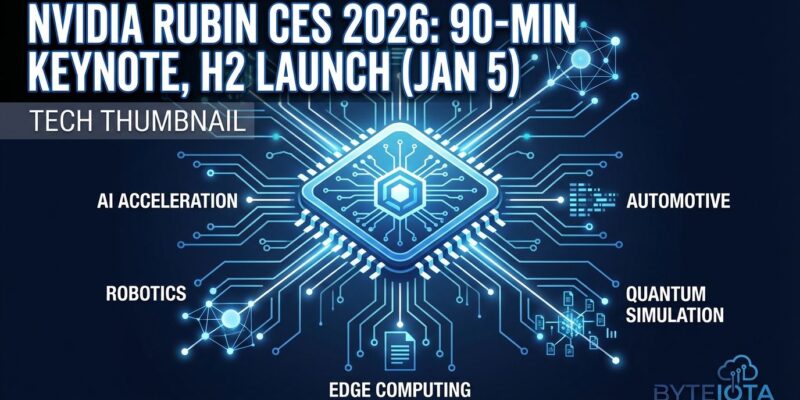
Jensen Huang takes the CES 2026 stage on January 5 for a 90-minute keynote—unusually long for a GPU announcement. NVIDIA’s expected Rubin architecture reveal isn’t shipping until H2 2026, yet the company is dedicating massive airtime to a product six months out. The timing and duration tell a story beyond chip specs: This is about managing expectations after Blackwell’s troubled rollout and locking enterprises into 2026 purchasing decisions before budgets close.
Blackwell’s Shadow: Why the Early Announcement
The early announcement isn’t random—it’s damage control. Blackwell slipped from Q3 2024 to Q2 2025 through multiple delays, suffered design flaws TSMC caught mid-development, and faced overheating issues when deployed in rack configurations. Major customers like Microsoft switched to older Hopper chips rather than wait for Blackwell fixes, canceling a 50,000-chip order for OpenAI infrastructure. Meta, Amazon, and Google scaled back their Blackwell purchases.
Announcing Rubin now—with “already in fab” messaging—is NVIDIA’s preemptive credibility restoration. Enterprises planning infrastructure for 2027 need confidence that NVIDIA can hit delivery windows. The H2 2026 timeline may be a conservative buffer, learned from Blackwell’s serial failures. Trust in NVIDIA roadmaps took a hit. This announcement aims to rebuild it.
What Takes 90 Minutes to Announce?
Typical GPU keynotes run 60 minutes. Apple product launches stretch to 90-120 minutes because they’re unveiling multiple products. Jensen Huang’s 90-minute CES slot suggests this isn’t just Rubin specs. Expect Cosmos platform updates (foundation models for AI development), rack-scale infrastructure architecture details, developer ecosystem announcements, and customer case studies. The duration signals NVIDIA is selling a platform, not just silicon.
Analysts predict heavy focus on data centers, physical AI, robotics, and autonomous technology—calling 2026 “critical” for NVIDIA’s AI strategy. But here’s the skeptical read: Will 90 minutes deliver substantive technical depth, or marketing theater? The keynote’s value for developers hinges on whether NVIDIA commits to day-one CUDA support, TensorRT optimizations, and NVLink-C2C programming models—or punts those details to later documentation releases.
Rack-Scale Infrastructure: The Hidden Cost
Rubin’s headline number—3.6 exaFLOPS FP4 in the NVL144 configuration—represents a 10x performance jump over Blackwell’s B300. But that performance comes with infrastructure requirements most enterprises aren’t prepared for. The rack, not the server, is now the atomic compute unit. This changes everything.
Deploying Rubin means 100+ kW power per rack, compared to 5-15 kW for traditional server racks. Liquid cooling isn’t optional—air cooling is obsolete for this density. High-voltage power distribution infrastructure is required. NVLink throughput doubles to 260 TB/s, and memory bandwidth jumps from 8 TB/s to 13 TB/s. These aren’t incremental upgrades. They’re facility-level infrastructure overhauls.
The CES announcement gives enterprises six months to plan these changes—critical lead time for data center ops teams unfamiliar with rack-scale architectures. If you want Rubin in Q3 2026, facility planning must start now in Q1 2026. Data centers built for traditional racks can’t support Rubin without expensive retrofits. That’s the hidden cost NVIDIA won’t emphasize during the keynote.
The Enterprise Budget Trap
H2 2026 delivery creates a dilemma for enterprises setting fiscal 2027 budgets this quarter. Buy Blackwell now (available, but with known issues) or commit budget for Rubin (H2 2026, unproven at scale)? NVIDIA’s $500 billion order backlog for Blackwell and Rubin combined suggests many are betting on future delivery—but Blackwell’s delays prove orders don’t guarantee timelines.
Infrastructure teams face an “upgrade twice” scenario: buy Blackwell now and migrate to Rubin later, or skip Blackwell entirely and wait. Budget commitments lock teams into NVIDIA’s ecosystem, where switching costs to AMD or Intel alternatives are prohibitive. The CES announcement forces purchasing decisions six months early, before competitive alternatives from AMD Helios or custom silicon mature.
Is the $500 billion backlog real demand, or are enterprises gaming the allocation system by over-ordering to guarantee supply? Blackwell’s delays suggest some orders will cancel if Rubin repeats the pattern. NVIDIA is using CES to lock commitments before that uncertainty manifests.
NVIDIA’s Luxury Timeline
The same week NVIDIA announces Rubin (six months out), Intel launches Panther Lake (available immediately) and AMD is expected to reveal Ryzen updates. NVIDIA can afford long lead times because of its 85-90% AI chip market share. Competitors are forced to compete on immediate availability because they lack ecosystem dominance.
AMD’s Helios platform delivers 2.9 exaFLOPS compared to Rubin’s 3.6 exaFLOPS—a 24% performance gap. HPE partnerships position Helios as a credible alternative, but developer mindshare favors NVIDIA. CUDA-trained talent, mature frameworks, and years of ecosystem lock-in mean enterprises default to NVIDIA unless economics force a switch. Intel’s Gaudi remains a niche player with limited enterprise traction.
NVIDIA’s dominance lets them announce early, manage expectations, and still capture orders. That’s a luxury competitors don’t have. But market consolidation is predicted for 2026, and custom silicon from Google (TPUs) and Amazon (Trainium) represents a growing threat to NVIDIA’s data center monopoly. Can they sustain 85% share through 2027? The CES keynote will signal whether NVIDIA sees competition as credible or dismissible.
What to Watch January 5
The keynote starts at 1PM PT and streams live on NVIDIA’s website. Beyond Rubin specs, watch for Cosmos platform commitments, rack-scale deployment partnerships, and developer tool availability timelines. Does NVIDIA provide concrete facility planning guidance, or hand-wave infrastructure requirements? Do they acknowledge Blackwell’s issues, or pretend the delays didn’t happen?
For enterprises making 2026 GPU purchasing decisions, this keynote matters less for the hardware specs than for the strategic signals. Can NVIDIA rebuild credibility after Blackwell? Is rack-scale architecture adoption realistic for mainstream data centers, or only hyperscalers? And critically: Does NVIDIA’s six-month lead time reflect confidence or caution?
Answers come January 5. Until then, infrastructure teams have budgets to finalize and decisions to make—exactly what NVIDIA wants.