 By ByteBot
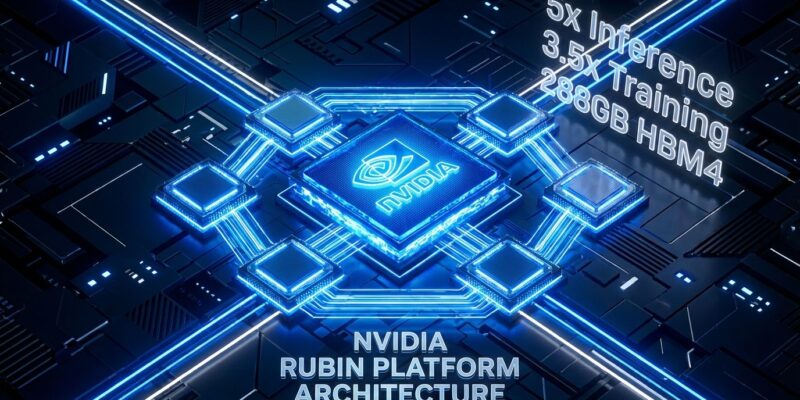
NVIDIA CEO Jensen Huang announced at CES 2026 (January 6-9, Las Vegas) that the Rubin platform is “in full production.” This isn’t another GPU refresh—it’s NVIDIA’s first “extreme-codesigned” six-chip AI platform. Performance claims: 5x faster inference, 3.5x faster training vs Blackwell, 50 petaflops, 288GB HBM4 per GPU, 22 TB/s bandwidth, and 10x lower cost per token. Cloud providers (AWS, Google Cloud, Microsoft, OCI) deploy in H2 2026. For developers: faster time to market and viable real-time AI applications. The catch: will promised cost savings reach your budget?
What 5x Inference and 3.5x Training Actually Mean
Rubin delivers 50 petaflops NVFP4 inference (vs ~10 on Blackwell)—a genuine 5x improvement. Training hits 35 petaflops (3.5x speedup). Hardware foundation: 336 billion transistors (1.6x more than Blackwell), 288GB HBM4, 22 TB/s memory bandwidth (2.8x improvement).
Practically, 3.5x training speed shrinks model development cycles. Days become hours, weeks become days. Jensen Huang: “The faster you train AI models, the faster you can get the next frontier out to the world. This is your time to market.” For organizations iterating on LLMs or mixture-of-experts models, this shifts quarterly releases to monthly.
The 5x inference boost enables real-time AI applications too expensive on Blackwell. Long-context RAG, agentic workflows, and production deployments become viable. NVIDIA claims you can train large MoE models in one-quarter the GPUs—75% hardware reduction. The Vera Rubin NVL72 rack delivers 5x higher tokens/second for long-context inference.
Six Chips, One Platform: Raising the Complexity Bar
Rubin isn’t a GPU upgrade—it’s a complete platform redesign. The six-chip architecture includes Rubin GPU (R200), Vera CPU (optimized for agentic processing), NVLink 6 (3.6 TB/s bidirectional per GPU, 50% improvement), ConnectX-9 SuperNIC, BlueField-4 DPU, and Spectrum-6 Ethernet Switch.
“Extreme codesign” means all six chips engineered together, eliminating bottlenecks across compute, networking, storage, and software. This raises the competitive bar significantly. AMD or Intel can’t just build a faster GPU—they need a cohesive ecosystem. NVIDIA’s CUDA dominance already makes switching painful. The six-chip platform makes it nearly impossible.
Pricing Reality Check: Will Cloud Providers Pass Savings?
Rubin promises 10x lower cost per token and 10x more throughput per watt. However, the same month NVIDIA announced Rubin, AWS raised GPU prices 15%. The p5e.48xlarge instance (eight H200s) jumped from $34.61 to $39.80/hour.
Cloud providers choose: pass efficiency gains to customers, or pocket them as margin. AWS’s January increase suggests the latter. Current H100 pricing: ~$3.90/GPU (AWS), ~$3.00/GPU (Google Cloud). Analysts predict H100 falls below $2/GPU by mid-2026, but providers aren’t cutting prices.
If Blackwell achieves 2.8x inference improvement with TensorRT-LLM updates (no hardware upgrade), and AWS raises prices anyway, why would Rubin change dynamics? It might not—at least not immediately.
Elon Musk’s reality check: “It will take another 9 months or so before the hardware is operational at scale and the software works well.” That pushes real readiness from H2 2026 to Q4 2026 or Q1 2027. QumulusAI’s guidance: “Existing Blackwell-class systems are likely to remain the more practical and cost-effective option in 2026.”
The Annual Refresh Treadmill: Innovation or Obsolescence?
Jensen Huang: “We’re on a one-year rhythm.” NVIDIA’s GPU cadence shrank from ~30-month cycles to 24 months (Hopper) to 12 months (Rubin). Blackwell launched March 2024; Rubin arrived January 2026 (~10 months).
Engineering risks escalate with 12-month cadences. Less validation time means higher defect probability. One analyst warned: “One missed cycle or major bug opens the door for competitors.”
Customer fatigue is real. Annual upgrades force 1-2 year infrastructure lifespans. Rubin’s 336 billion transistors and 2.1M metric tons CO2e annually raise environmental concerns. NVIDIA only reports facility energy, not full semiconductor manufacturing footprint.
The gamble: NVIDIA’s moat depends on staying ahead yearly. Competitors are 18-24 months behind. Nevertheless, this works until it doesn’t. For cloud providers, annual refreshes are manageable. For enterprises buying on-premise, it’s painful.
What Should You Actually Do?
Running Blackwell? Don’t panic. TensorRT-LLM updates deliver gains without hardware upgrades. Need infrastructure now? Buy Blackwell—it’s excellent and available today. Waiting means Q4 2026 realistically, plus debugging early deployment issues.
Can wait with budget flexibility? Monitor cloud pricing through mid-2026. H100 falling toward $2/GPU, and Rubin might accelerate this. However, don’t assume efficiency equals lower costs. AWS’s 15% increase is a warning.
Long-term: annual refresh is the new normal. Plan for faster depreciation. Favor cloud deployments—Rubin’s six-chip complexity strongly favors cloud providers over enterprise data centers.
Key Takeaways
- Performance gains are real: NVIDIA Rubin delivers 5x inference, 3.5x training vs Blackwell with 288GB HBM4 and 22 TB/s bandwidth. Available H2 2026 (likely Q4 realistically) from AWS, Google Cloud, Microsoft, and OCI.
- Cost savings questionable: The promised 10x cost reduction may not reach your budget. Cloud providers could pocket efficiency gains as margin improvements, as AWS’s 15% price increase the same month suggests.
- Six-chip platform raises bar: The extreme-codesigned architecture includes Rubin GPU, Vera CPU, NVLink 6, ConnectX-9, BlueField-4, and Spectrum-6. This complexity makes it nearly impossible for AMD or Intel to catch up.
- Annual refresh is permanent: NVIDIA’s one-year cadence forces faster infrastructure depreciation (1-2 year lifespans). Plan accordingly and favor cloud deployments over on-premise purchases.
- Blackwell remains strong: For immediate needs, Blackwell is excellent and available today. Software optimizations (TensorRT-LLM) continue extracting performance gains without hardware upgrades.