 By ByteBot
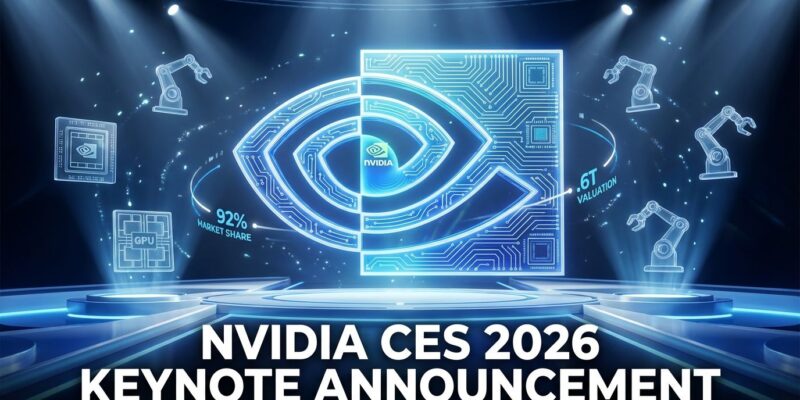
Jensen Huang takes the CES 2026 stage TODAY at 1pm PT, delivering Nvidia’s most anticipated keynote as the world’s most valuable company at $4.6 trillion. The 90-minute presentation sets the AI and machine learning development roadmap for the next 12-18 months, with Vera Rubin GPUs arriving second half of 2026 and a major push into physical AI and robotics. For developers and infrastructure teams, this isn’t hype—Nvidia commands 92% of the AI chip market, and today’s announcements determine cloud costs, GPU availability, and what’s possible in AI development through 2027.
Wedbush analysts are calling 2026 a “critical year for Nvidia’s AI strategy,” focusing on data centers, physical AI, and autonomous technology. Moreover, with over 20 demos planned throughout CES week and revenue visibility of $500 billion through the end of 2026, Nvidia’s roadmap directly impacts every developer working with AI infrastructure.
Vera Rubin GPU: 2.5x Performance Leap Arrives H2 2026
Nvidia’s next-generation Rubin architecture launches in the second half of 2026, delivering 50 petaflops of FP4 performance—a 2.5x jump from Blackwell’s 20 petaflops. Manufactured on TSMC’s advanced 3nm N3P process with HBM4 memory, Vera Rubin represents a significant leap in both raw compute power and power efficiency. Furthermore, the roadmap extends to Rubin Ultra in 2027, which doubles performance again to 100 petaflops.
For developers, this timeline creates a critical decision point. Blackwell systems are available today in data centers, with liquid-cooled RTX PRO 6000 Blackwell Server Edition units arriving in the first half of 2026. However, waiting six months for Rubin could cut cloud AI costs significantly with that 2.5x performance improvement. Infrastructure teams need to decide now: lock in Blackwell capacity or hold out for Rubin’s efficiency gains.
The competition isn’t close. AMD and Intel combined hold roughly 3% of the GPU market. Consequently, AMD’s MI300X and Intel’s Gaudi accelerators face an uphill battle not just in hardware but in matching Nvidia’s CUDA software ecosystem, which has over a decade of developer tools, libraries, and institutional knowledge. Rubin widens that gap even further.
Physical AI and Robotics Platform Strategy
Nvidia is betting big on “physical AI”—AI systems operating in the real world beyond data centers. The company’s three-computer robotics architecture spans the entire development cycle: DGX AI supercomputers for training, Omniverse and Cosmos on RTX PRO Servers for physics-based simulation, and Jetson AGX Thor for on-robot inference.
The strategy is working. Major robotics firms including Agility Robotics, Boston Dynamics, and Figure AI have adopted Nvidia’s Isaac platform. Additionally, Cosmos World Foundation Models have been downloaded over 3 million times, and the new Cosmos Reason—a 7-billion-parameter vision-language model—enables robots to reason using physics understanding and common sense.
CES 2026 will showcase this push aggressively. Industry analysts predict an “overabundance” of humanoid robots at the show, with robotics becoming the dominant theme. However, here’s the reality check: how many of these showcase robots will actually ship? Physical AI is genuine innovation, but the gap between CES demos and production deployments remains massive. Nvidia’s “sim-first” approach with Omniverse helps, allowing developers to train and validate robots in digital twins before expensive real-world testing, but don’t expect humanoid robots in every warehouse by year-end.
The 92% Market Share Monopoly Problem
Nvidia’s 92% share of the AI chip market is unprecedented and unhealthy for the industry. The company’s CUDA ecosystem is so entrenched that developers face genuine lock-in—switching to AMD or Intel means rewriting codebases and losing access to mature tooling. One analyst noted bluntly: “Nvidia remains essentially a monopoly for critical tech, and it has pricing (and margin) power.”
The real competitive threat isn’t coming from AMD or Intel. Instead, hyperscalers like Amazon, Google, and Microsoft are building custom inference chips (Trainium, TPU, Maia) specifically to reduce dependence on Nvidia for high-volume workloads. These won’t match Nvidia for training, but for inference they’re closing the gap fast.
Meanwhile, Nvidia faces supply headwinds. The company plans potential GPU supply cuts of up to 40% in 2026 due to memory shortages, even as demand explodes. Moreover, Hacker News discussions from the past month reveal developer frustration: “GPU Price Hikes Coming in 2026,” “Nvidia plans heavy cuts to GPU supply,” and perhaps most telling, “What if Nvidia abandons PC gaming?” The developer community feels the squeeze—rising prices, constrained availability, and enterprise customers getting priority.
Is 92% market share sustainable? No. Is it healthy? Absolutely not. But until AMD and Intel deliver competitive alternatives with robust software ecosystems, or hyperscalers make their custom chips broadly available, developers are stuck with the monopoly.
AI Infrastructure Spending Boom: $600B to $3T
Capital spending on AI infrastructure is exploding from $600 billion in 2026 to a projected $3 trillion by 2030—a five-fold increase in four years. Nvidia just announced a partnership with OpenAI where it will invest up to $100 billion progressively, with the first gigawatt of Nvidia systems deploying in the second half of 2026 on the Vera Rubin platform.
These numbers signal either sustained AI transformation or the biggest bubble in tech history. The $4.6 trillion valuation—making Nvidia the first company to close above $4 trillion—reflects massive confidence in AI infrastructure demand. Furthermore, Nvidia’s claim of $500 billion in revenue visibility through 2026 from Blackwell and Rubin alone suggests they’re not worried about demand drying up.
For developers, this boom means opportunity. AI infrastructure jobs aren’t going anywhere soon. Consequently, GPU-accelerated data centers promise “dramatically lower costs” compared to CPU-only architectures, though whether efficiency gains offset massive demand growth remains to be seen. Cloud pricing for AI workloads might not drop as fast as the hardware improves.
What Developers Should Watch at CES 2026
CES 2026 continues through January 9 with over 20 Nvidia demos covering robotics, gaming, content creation, and data center technologies. The key questions: Will Nvidia provide concrete Rubin specifications and availability timelines? How will AMD’s CES keynote position its competition? Most importantly, will the company address supply constraint concerns directly or continue the convenient “shortage” narrative while demand soars?
For infrastructure planning, the calculus is straightforward. If you need GPUs immediately, Blackwell is available now. However, if you can wait six months, Rubin’s 2.5x performance leap might be worth it, especially for large-scale deployments where that efficiency compounds. For inference workloads, consider whether your cloud provider’s custom chips (if on AWS, GCP, or Azure) can handle your needs at lower cost.
The physical AI opportunity is real for robotics developers. Isaac platform adoption by major players proves the tech works, and the “sim-first” development workflow Nvidia enables through Omniverse significantly reduces real-world testing costs. Nevertheless, just don’t believe every humanoid robot demo you see this week—production deployment timelines will be longer than CES hype suggests.