 By ByteBot
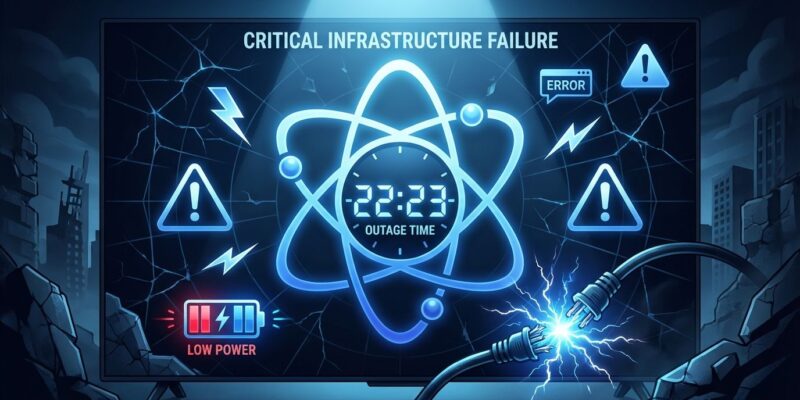
NIST’s Boulder time servers went dark on December 17, 2025, after high winds triggered wildfire prevention power shutdowns across Colorado. The cascading failure exposed a critical vulnerability: utility power failed, the backup generator failed, and now hydrogen maser atomic clocks are running on battery with no repair timeline. The affected servers—time-a-b.nist.gov through time-e-b.nist.gov—distribute the official U.S. time standard to millions of systems worldwide. NIST staff couldn’t access the site initially due to safety lockdowns.
Your production systems probably depend on this. Network Time Protocol synchronizes clocks across the internet, and when time goes wrong, security breaks. TLS certificate validation fails when expiry dates drift. Authentication tokens become invalid—SAML requires precise time windows. Security logs lose forensic value when timestamps can’t be trusted. The U.S. Naval Observatory learned this in 2012 when two NTP servers jumped back 12 years, crashing Active Directory authentication and routers. Eurex Exchange postponed its market opening in 2013 after a time synchronization glitch threatened high-frequency trading accuracy.
The Cascading Failure
The timeline started December 17 at 22:23 UTC. Wind gusts hit 125 MPH in Boulder, forcing Xcel Energy to shut down power lines preemptively—a standard wildfire mitigation strategy now common across utilities. NIST’s backup systems kicked in, but one crucial generator failed. The atomic ensemble time scale went offline, cutting access to the reference clock. Hydrogen maser atomic clocks—two-thirds of NIST’s timekeeping infrastructure—switched to battery backup.
However, staff couldn’t access the facility. Power outages and safety protocols locked them out. NIST’s Time and Frequency Division director had recently quit, and emergency management staffing was at least 50 percent vacant, according to discussions on the NANOG mailing list and Hacker News. The disaster plan didn’t account for “we can’t get to the building.”
So much for redundancy. Critical infrastructure with backup generators still has single points of failure.
Limited Impact, But Check Your Config
Most properly configured systems weathered this outage without issue. Time synchronization engineers design for exactly this scenario. As one Hacker News commenter put it: “Time engineers are very paranoid. I expect large problems can’t occur due to a single provider misbehaving.” The disaster plan distributes stratum 1 servers worldwide—NIST operates facilities in Gaithersburg, Maryland and Hawaii. The WWVB station in Fort Collins remains operational. GPS satellites provide independent atomic clock references. Commercial providers like Google, AWS, and Microsoft maintain their own time infrastructure.
Systems following RFC 8633 best practices—using multiple geographically diverse NTP sources—experienced no disruption. But not every system follows best practices. Legacy infrastructure with hardcoded single-server configurations is vulnerable. Financial exchanges requiring NIST-traceable timestamps face compliance issues. Scientific experiments needing primary reference clock accuracy lost precision.
The question is: Does your production environment use multiple diverse time sources, or is it pointing at time-a-b.nist.gov and hoping for the best?
Centralized vs Distributed Time Infrastructure
The outage raises a bigger question: Should critical internet infrastructure depend on centralized government sources? The NTP pool (pool.ntp.org) operates 3,423 active servers on IPv4 and 1,905 on IPv6 as of June 2025, serving hundreds of millions of systems. It’s the default time server for most Linux distributions. Moreover, when a server in the pool fails, it’s automatically dropped and replaced. Geographic distribution minimizes single points of failure.
Compare that to a single facility in Boulder with a broken generator and a skeleton crew. The irony: A distributed time pool maintained by volunteers proved more resilient than the official U.S. time standard.
Centralized sources have advantages—legal compliance, authoritative accuracy, stratum 1 direct links to atomic clocks. But resilience isn’t one of them. Distributed beats centralized when redundancy actually matters.
What Developers Should Do Now
Audit your NTP configuration. Check /etc/ntp.conf or /etc/chrony.conf. Verify you’re using multiple—minimum four—geographically diverse time sources. Remove single hardcoded servers, especially those tied to a single facility.
Use NTP pools: pool.ntp.org provides automatic redundancy through regional pools (0.pool.ntp.org, 1.pool.ntp.org). For cloud workloads, leverage cloud provider time services—AWS Time Sync Service, Azure Time Service, Google Public NTP—which offer geographic distribution and SLAs.
Follow RFC 8633 best practices: monitor for clock drift, implement alerts for synchronization failures, and consider GPS-disciplined oscillators for critical systems that can’t tolerate any time deviation.
Here’s a simple comparison:
# BAD: Single source, single facility
server time-a-b.nist.gov iburst

# GOOD: Multiple diverse sources
pool 0.pool.ntp.org iburst
pool 1.pool.ntp.org iburst
server time.google.com iburst
server time.cloudflare.com iburst
Key Takeaways
Backup systems aren’t bulletproof. NIST Boulder had redundancy—UPS systems, backup generators—and still experienced cascading failure when one generator quit and staff access was blocked. Critical infrastructure assumptions don’t hold under real-world stress.
Time synchronization is foundational for security and distributed systems. TLS, authentication, consensus algorithms, database replication, transaction ordering, and forensic logging all depend on accurate time. When clocks drift, systems fail in subtle, dangerous ways.
Distributed infrastructure beats centralized for resilience. The NTP pool’s 3,423 servers worldwide handled this outage effortlessly. A single building in Boulder with a broken generator did not. If your systems point to one authoritative source and nothing else, you’re one power outage away from problems.
Check your configuration now. Verify multiple diverse time sources. Use pools, not single servers. And don’t assume “critical infrastructure” means “actually redundant.”