 By ByteBot
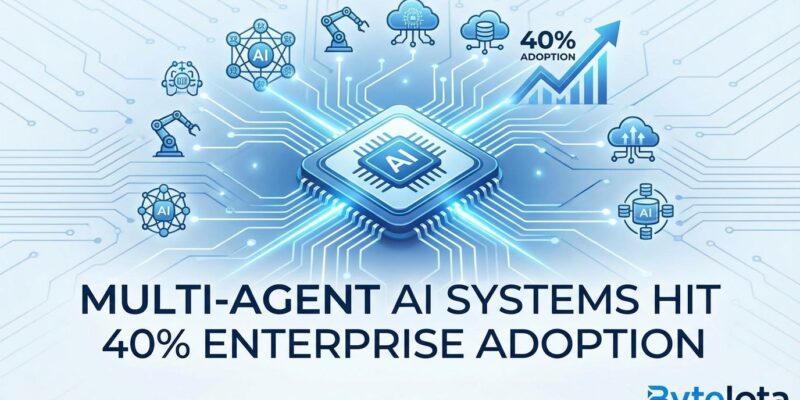
2026 marks the enterprise shift from single AI agents to coordinated multi-agent systems. Gartner predicts 40% of enterprise applications will feature task-specific AI agents by year-end, up from less than 5% in 2025, and IDC expects 80% workplace integration. But there’s a massive disconnect: only 2% of organizations have deployed agents at full scale. Three protocols emerged to bridge this gap—Anthropic’s Model Context Protocol (MCP), Google’s Agent-to-Agent (A2A), and IBM’s Agent Communication Protocol (ACP)—providing the shared language agents need to collaborate across vendors and frameworks.
The business case is compelling. Organizations report 171% average ROI within 12-18 months, 30% cost reductions, and 35% productivity gains. Multi-agent systems deliver 45% faster problem resolution and 60% more accurate outcomes compared to single-agent approaches. Yet Gartner warns that 40%+ of agentic AI projects will fail by 2027 due to escalating costs, unclear business value, or insufficient risk controls. The winners won’t be those with the most sophisticated AI models—they’ll be the organizations willing to redesign workflows rather than simply layering agents onto legacy processes.
The Implementation Gap: 40% Adoption Target Meets 2% Reality
Despite widespread experimentation—65% of organizations are testing AI agents—and ambitious adoption forecasts, only 2% have achieved full-scale deployment. This isn’t a pipeline problem; it’s a production readiness crisis. Companies successfully run pilots, demonstrate value in controlled environments, then hit walls when attempting enterprise rollouts.
The timeline and investment requirements explain part of the disconnect. Complex enterprise implementations require 6-18 months, not weeks. Investment ranges from $500K to $2M for platform licensing, integration work, and team training. Yet 24% of organizations have scaled to production, suggesting the path exists—full deployment just demands more organizational change than most anticipate.
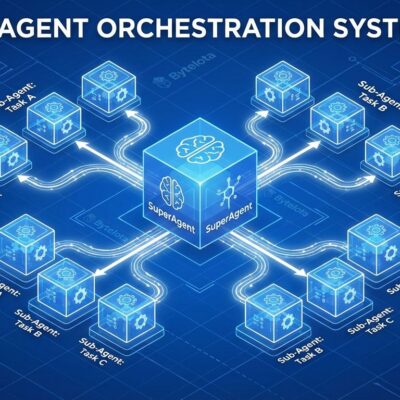
RTInsights captured the moment: “If 2025 was the year of AI agents, 2026 will be the year of multi-agent systems.” The distinction matters. Single agents handle tasks individually. Multi-agent systems coordinate specialized agents with defined roles—one diagnoses, another remediates, a third validates, a fourth documents. This specialization delivers measurable advantages, but orchestrating these teams at scale introduces complexity most organizations underestimate during pilot phases.
Three Protocols Enable Multi-Agent Coordination: MCP, A2A, ACP
Three open protocols emerged in 2025-2026 to solve the interoperability problem that plagued early multi-agent deployments. Anthropic’s Model Context Protocol (MCP), Google’s Agent-to-Agent protocol (A2A), and IBM’s Agent Communication Protocol (ACP) each address different coordination challenges, and together they form the foundation for multi-vendor agent collaboration.
MCP standardizes how agents access tools and data sources. Donated to the Agentic AI Foundation under the Linux Foundation in December 2025, MCP gained rapid adoption—97M+ monthly SDK downloads across Python and TypeScript. OpenAI, Google DeepMind, Microsoft, AWS, Cloudflare, and Bloomberg all implemented MCP support. The protocol solves a simple problem: without a standard way to connect agents to databases, APIs, and file systems, every integration becomes custom plumbing.
A2A handles agent-to-agent peer collaboration. Launched by Google in April 2025 with 50+ technology partners including Atlassian, Box, Cohere, PayPal, Salesforce, SAP, and ServiceNow, A2A enables agents to negotiate, share findings, and coordinate without central oversight. Built on HTTP, SSE, and JSON-RPC, A2A integrates easily with existing IT stacks. Google donated A2A to the Linux Foundation for open governance, ensuring no single vendor controls the standard.
ACP, IBM’s contribution, focuses on governance and compliance. Lightweight and REST-based, ACP complements MCP (agent-to-tool) and A2A (agent-to-agent) with frameworks for security, audit trails, and regulatory compliance. For enterprises in regulated industries—finance, healthcare, government—ACP provides the control structures needed to deploy autonomous agents without violating compliance requirements.
These aren’t competing standards. MCP connects agents to their tools, A2A connects agents to each other, and ACP ensures both happen within governance boundaries. Developers building multi-agent systems should verify framework support for all three protocols to avoid future lock-in.
Why 40% of Multi-Agent Projects Will Fail by 2027
Gartner’s prediction isn’t fear-mongering—it’s based on current deployment patterns and failure modes. The barriers are well-documented: 65% of organizations cite system complexity as their top challenge, 33% flag quality and reliability issues, 46% struggle with integration, and 24.9% of large enterprises identify security as a major concern.
System complexity manifests as disconnected agents, duplicate logic, and extensive busywork as departments spin up specialized agents without integration plans. Organizations deploy agents faster than they can secure them, creating attack surfaces and compliance risks. Most CISOs express deep concern, but only a handful have mature safeguards in place.
Quality issues remain the primary blocker for production deployment. For enterprises with 10,000+ employees, hallucinations and consistency of outputs are the biggest challenges. One-third of survey respondents cite quality as their primary barrier—not cost, not integration difficulty, but fundamental reliability concerns. Data pipeline failures are among the most prevalent causes of agents operating incorrectly in production environments.
Integration with legacy systems extends timelines and budgets. Proprietary interfaces, inconsistent data formats, and decades-old architectures weren’t designed for autonomous agents making real-time decisions. The organizations succeeding at scale are those implementing central architecture reviews, adopting shared protocols (MCP, A2A, ACP), deploying unified observability platforms, and budgeting realistically for 6-18 month implementations.
Computer Weekly identified the real differentiator: “The key isn’t the sophistication of AI models, but the willingness to redesign workflows rather than simply layering agents onto legacy processes.” Organizations treating multi-agent deployment as a technology project rather than a workflow transformation project are the ones appearing in Gartner’s 40% failure prediction.
The Business Case: 171% ROI, Real Enterprise Results
Despite implementation challenges, the economics are proven. Organizations successfully deploying multi-agent systems report 171% average ROI within 12-18 months. Cost reductions average 30%, productivity gains hit 35%, and AI agents are projected to generate $450B in economic value by 2028.
Wells Fargo’s deployment demonstrates the impact at scale: 35,000 bankers now access 1,700 procedures in 30 seconds instead of 10 minutes. The multi-agent system coordinates policy lookup agents, compliance agents, and recommendation agents to deliver instant answers that previously required manual procedure searches. HCLTech achieved 40% faster case resolution and redeployed 30% of their workforce to higher-value activities through a triage-diagnostic-resolution-documentation agent team.
Performance metrics validate the architectural shift. Multi-agent systems deliver 45% faster problem resolution and 60% more accurate outcomes compared to single-agent approaches. The specialization advantage is real—agents focused on narrow domains outperform general-purpose agents handling diverse tasks.
Gartner projects that by 2029, 80% of standard customer service queries will be handled autonomously by AI agents, enabling up to 30% operating cost reductions. These aren’t pilot metrics or vendor claims—they’re based on enterprise deployments with documented ROI and measurable business outcomes.
LangGraph vs CrewAI vs AutoGen: Choosing Your Framework
Three frameworks dominate multi-agent development, and no single option wins universally. LangGraph excels at complex workflows with conditional logic and branching paths. CrewAI simplifies role-based team coordination with intuitive agent-crew-task structures. AutoGen focuses on conversational agents with dynamic role-playing capabilities.
LangGraph is battle-tested and production-ready. Multiple companies use it for persistent workflows requiring sophisticated orchestration with multiple decision points and parallel processing. The trade-off is a steep learning curve—developers must think in terms of graphs, nodes, and edges. LangGraph works best for complex workflows involving RAG pipelines or multiple tool integrations.
CrewAI is the easiest framework to start with, featuring clear documentation, extensive examples, and a solid community. It includes enterprise-grade observability and offers a paid control plane for production deployments. The weakness: logging inside Task objects is painful, making debugging difficult as systems grow complex.
AutoGen provides high control and extensibility with strong tooling support. It shines in scenarios requiring flexible, conversation-driven workflows where agents adapt roles based on context. Initial setup takes longer than CrewAI, and code readability degrades as the agentic network grows. AutoGen lacks DAG support, requiring developers to orchestrate agent interactions manually.
The decision criteria are straightforward: truly multi-role workflows benefit from CrewAI or AutoGen; single agents calling multiple tools work well with LangGraph or OpenAI Agents; complex conditional logic demands LangGraph. Regardless of choice, verify MCP and A2A protocol support to ensure future interoperability as the multi-agent ecosystem matures. DataCamp’s framework comparison provides detailed guidance for developers evaluating options.
Key Takeaways
- Multi-agent AI adoption is accelerating—40% of enterprise applications by year-end, 80% workplace integration—but only 2% have deployed at full scale, revealing a massive implementation gap between pilot success and production readiness.
- Three protocols enable multi-agent coordination: MCP (Anthropic) standardizes agent-to-tool connections with 97M+ monthly downloads, A2A (Google) handles peer collaboration with 50+ tech partners, and ACP (IBM) adds governance for regulated industries.
- Implementation challenges are severe—65% cite system complexity, 33% quality issues, 46% integration problems—and Gartner predicts 40%+ of projects will fail by 2027 due to escalating costs, unclear value, or insufficient risk controls.
- The business case is proven: organizations report 171% ROI in 12-18 months, 30% cost reductions, 35% productivity gains, with multi-agent systems delivering 45% faster resolution and 60% more accurate outcomes than single-agent approaches.
- Framework choice matters for production success: LangGraph for complex conditional workflows, CrewAI for role-based teams and quick prototyping, AutoGen for conversational agents with dynamic roles—verify MCP/A2A support regardless of selection.
The shift from single-agent to multi-agent systems isn’t hype—it’s happening now with measurable results. But success requires more than technology adoption. Organizations must redesign workflows, invest in proper integration and observability, and commit to 6-18 month implementation timelines with realistic budgets. The winners in 2026 won’t be those with the most advanced AI models; they’ll be the enterprises willing to rethink operations from the ground up.