 By ByteBot
Mozilla appointed Anthony Enzor-DeMeo as CEO today, December 16, 2025, replacing interim leader Laura Chambers after two years. The announcement includes a strategic pivot: Firefox will become an “AI browser” with “AI Mode” launching in 2026. The differentiator? Users choose their AI model—ChatGPT, Mistral, open-source options, or bring-your-own subscriptions—instead of being locked into Google Gemini (Chrome) or Microsoft Copilot (Edge).
This matters because Firefox holds just 3% global market share while Chrome dominates at 65-70%. Moreover, Mozilla depends on Google for 85% of its $420 million annual revenue. The multi-model AI strategy is their bet that developers and privacy-conscious users want choice over Big Tech’s AI control. However, they’re entering a crowded field—ChatGPT Atlas and Perplexity Comet both launched in October 2025.
Firefox AI Mode: Choose Your Own Model
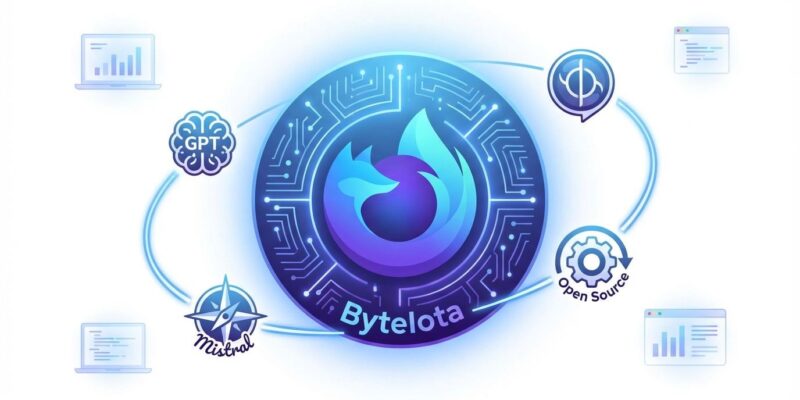
Firefox’s upcoming “AI Mode” will be the first major browser to let users select their AI provider instead of forcing a single vendor. Mozilla won’t train its own large language model or push specific services. As Enzor-DeMeo explained: “You won’t be locked into a single model like elsewhere. Bring your own ChatGPT subscription, choose Mistral, or pick open-source. Different models for work vs home.”
The comparison is stark. Chrome locks you into Google Gemini. Edge requires Microsoft Copilot. ChatGPT Atlas (launched October 2025, $20-200/month) only offers OpenAI models. Perplexity Comet (free as of October 2025) gives you Perplexity search AI only. In contrast, Firefox’s approach is provider-neutral—users can even run models on-device for privacy.
AI Mode will function as a third browsing window type alongside Classic and Private modes. Users who don’t want AI features can ignore them entirely. Firefox Classic remains the default experience. Furthermore, Mozilla calls it “user agency”—AI should always be optional, never mandatory.
Entering the AI Browser Battleground
Firefox isn’t just competing with traditional browsers anymore. Chrome embedded Gemini in September 2025. Meanwhile, Edge has Copilot built-in. OpenAI launched ChatGPT Atlas in October 2025 with “Agent Mode” for web tasks like research and purchases. Additionally, Perplexity pivoted from $200/month to free in October 2025, adding millions to their waitlist.
Enzor-DeMeo frames this as inevitable: “The browser is AI’s next battleground. It’s where people live their online lives and where the next era’s questions of trust, data use, and transparency will be decided.”
The market reality is brutal. Chrome holds 65-70% market share according to StatCounter data. Safari commands 13.9%. Edge sits at 13%. Firefox clings to 3%. However, Enzor-DeMeo’s track record as Firefox General Manager shows progress: 13% mobile growth year-over-year for two consecutive years, desktop usage stabilized after years of decline. Firefox shipped “Shake to Summarize” on iOS, earning a TIME’s Best Inventions 2025 special mention.
Related: AI Hype Correction 2025: MIT Study Shows 95% Failures
The Google Revenue Problem
Mozilla’s revenue structure exposes a critical vulnerability. Google provides 85% of Mozilla’s $420 million annual revenue through search deals. If those payments stop due to antitrust remedies, Firefox faces what Mozilla CFO Eric Muhlheim called a “downward spiral” in his May 2025 court testimony: major cuts across product engineering, fewer users, potentially shutting down Firefox entirely.
A September 2025 court ruling allows Google to continue paying Mozilla under non-exclusive deals. Nevertheless, the threat remains. When Mozilla tried switching from Google to Yahoo as the default search engine (2014-2017), users fled to Chrome. An internal test switching to Bing (2021-2022) showed drops in both engagement and revenue.
This AI pivot isn’t just about features—it’s about survival. Consequently, Mozilla’s three-year plan aims to diversify revenue from 85% Google dependency to below 50% by 2028. If multi-model AI doesn’t attract users and alternative revenue streams (subscriptions, partnerships), Firefox’s future is uncertain.
Who Is Anthony Enzor-DeMeo?
Enzor-DeMeo isn’t a traditional browser technology veteran. He joined Mozilla just one year ago in December 2024, became Firefox General Manager in August 2025, and now leads the entire company. His background spans fintech (Roofstock) and e-commerce (Wayfair)—product and business leadership, not deep browser engineering.
Laura Chambers, the outgoing interim CEO, described the transition in Mozilla’s official announcement: “We navigated AI’s emergence, antitrust litigation, and revenue diversification. We needed leadership to take Firefox forward technically.” Mozilla President Mark Surman was more direct: “We haven’t had the leadership for the last few years to advance Firefox’s technical capabilities.”
Enzor-DeMeo’s vision extends beyond browsing. He’s positioning Firefox as the “anchor” for a “trusted software portfolio”—Mozilla as the “world’s most trusted software company.” The three pillars: user agency (AI is optional and transparent), aligned business model (revenue from sources users value), and ecosystem expansion (Firefox plus additional products).
Can Choice Beat Chrome’s Dominance?
Mozilla is betting that trust and choice matter more than convenience. Firefox will offer provider-neutral AI, on-device privacy, and complete transparency about data use. As Enzor-DeMeo put it in Bloomberg’s coverage: “People want software that is fast, modern, but also honest about what it does.”
The challenge is market reality. Chrome’s convenience and ecosystem integration keep 65-70% of users locked in. Developers and privacy-conscious users represent a niche market. Therefore, the question remains: Will that niche sustain Firefox’s $420 million budget? Can neutrality compete against Google and Microsoft’s billions in AI infrastructure investment?
Firefox has until 2026 to answer these questions. The multi-model AI strategy is bold, but they’re entering late. ChatGPT Atlas and Perplexity Comet already captured early adopters in October 2025. Ultimately, Mozilla’s differentiator—choice and trust—needs to prove it’s enough to shift market share.
Key Takeaways
- Firefox AI Mode (launching 2026) offers multi-model choice instead of vendor lock-in—select ChatGPT, Mistral, open-source options, or bring your own subscriptions
- Mozilla appointed Anthony Enzor-DeMeo as CEO today (December 16, 2025), a product/business leader from fintech and e-commerce, not a traditional browser technology veteran
- Firefox holds 3% market share while Chrome dominates at 65-70%. Mozilla depends on Google for 85% of its $420M revenue, creating existential risk if antitrust actions cut those payments
- The AI browser war already started—Chrome has Gemini, Edge has Copilot, ChatGPT Atlas and Perplexity Comet launched in October 2025. Firefox is late but betting on neutrality
- Mozilla’s three-year strategy: diversify revenue below 50% Google dependency by 2028 and become the “world’s most trusted software company.” Whether choice and trust can compete with Chrome’s convenience remains uncertain