
 By ByteBot
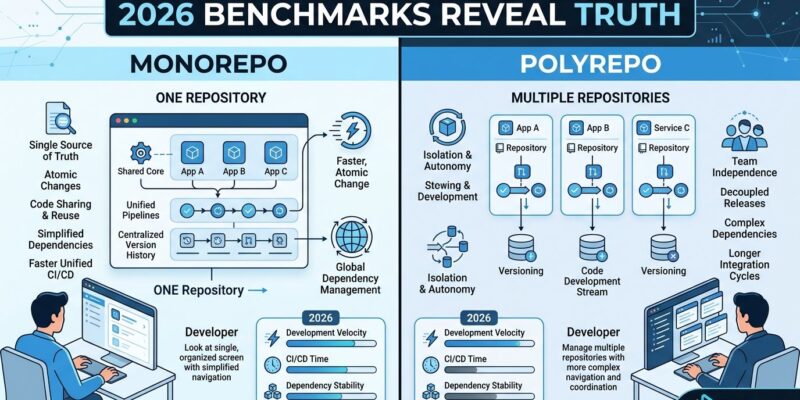
Faros AI’s analysis of 320 engineering teams over one full year reveals a startling benchmark: monorepos have a median PR cycle time of 19 hours, compared to just 2 hours for polyrepos—a 9.5x difference. Yet enterprises migrating to monorepos with Turborepo report 40-60% productivity gains and 70-85% faster builds. The contradiction isn’t a paradox. It’s proof that tooling investment separates monorepo success from failure.
The debate has raged for years, but fresh 2026 benchmarks finally show when monorepos win, when they lose, and what separates the two outcomes. The answer isn’t “monorepo vs polyrepo”—it’s “monorepo with proper tooling vs monorepo without it.”
The 19-Hour PR Cycle: When Monorepos Fail
Monorepos without proper build tooling impose coordination overhead that Faros AI benchmarks quantify precisely. However, the median PR cycle time hits 19 hours, with the 90th percentile exceeding 10 days. The culprits aren’t mysterious: multiple team approvals slowing reviews, expanded test suites running on every change, and merge queue bottlenecks when dozens of developers push simultaneously.
Moreover, the data identifies specific bottlenecks: review topology complexity across ownership domains, CI surface area expansion testing code you didn’t touch, and large cross-cutting changes requiring sign-off from five different teams. Without proper tooling, these coordination costs compound exponentially. Developers report waiting 30 minutes for CI runs that test everything, new hires overwhelmed by 10,000-file repositories they can’t navigate, and junior developers accidentally viewing proprietary algorithms because everyone sees everything by default.
Access control becomes a nightmare. Everyone gets repository access, meaning everyone can view—and potentially modify—every line of code. Consequently, security-sensitive sections, proprietary business logic, and experimental features all sit visible to the entire engineering organization.
Atomic Commits and AI Agents: When Monorepos Dominate
Monorepos with proper tooling deliver three compounding benefits that Augment Code’s analysis highlights: atomic commits that prevent breaking changes, unified dependency management that eliminates version conflicts, and AI coding agent advantages from 200,000-token context windows.
Atomic commits change the refactoring game. Update an API endpoint and all 10 consuming services in a single PR. Rename a function across 50 files with confidence. Refactor shared types and watch TypeScript verify every usage instantly. Furthermore, no versioning coordination, no “update package.json in five repos,” no breaking changes that require synchronized deployments. The change happens atomically or not at all.
Turborepo’s remote caching delivers measurable ROI: 400+ developer hours saved monthly for 50-person teams. Sub-second cache hits replace 5-minute builds. Incremental builds run 87% faster when modifying a single app. In fact, the Hedge Foundation’s migration achieved 60% faster builds and 40% productivity gains—numbers that reflect compounding benefits, not incremental improvements.
AI coding agents shift the calculus further toward monorepos. Large context windows (200,000 tokens) can “see both sides of the contract at once,” understanding API definitions and consumer implementations simultaneously. Therefore, cross-cutting changes that would require coordinating five polyrepos become single-PR operations where AI agents reason about dependencies automatically. As AI tools dominate development workflows, monorepos optimize for how agents understand code—unified graphs instead of fragmented repositories.
Turborepo, Nx, or Bazel: The Tooling Tax
Monorepo success depends on choosing the right tool for team size. Turborepo delivers 70-85% build improvements with simple configuration—the default choice for JavaScript/TypeScript teams between 10-50 developers. Nx provides more powerful affected detection and multi-language support for enterprise Angular/React shops with complex dependency graphs. Meanwhile, Bazel handles Google-scale operations (2 billion lines of code) but requires dedicated infrastructure teams most organizations don’t have.
The gap between tooling and no tooling is stark. Teams attempting “we’ll just use npm workspaces” hit the exact problems Faros AI quantified: 19-hour PR cycles, 30-minute builds testing code they didn’t modify, and coordination overhead that erodes productivity. Additionally, the 70-85% build time improvements aren’t marketing hype—they’re the difference between caching and no caching, incremental builds and full rebuilds, affected tests and entire test suites.
Remote caching turns monorepos from local optimization into team multipliers. One developer’s build populates the cache, saving identical build time for 49 colleagues. In other words, the 400+ hours saved monthly for 50-person teams translates to nearly two full-time developers worth of recovered productivity.
Decision Framework: Team Size and Code Sharing
The decision depends on three factors: team size, shared code percentage, and tooling investment capacity. Teams with 10-50 developers working on 10+ related applications hit the monorepo sweet spot. However, smaller teams (<10 developers) find polyrepo simpler, while larger organizations (50+ developers) require gradual phased migrations and dedicated tooling teams.
Shared code percentage drives the decision more than team size. If 30% or more of your codebase consists of shared utilities, components, or types, monorepos eliminate the publish-consume-version cycle that drains polyrepo productivity. Below 10% shared code, polyrepos maintain independence without significant duplication. Moreover, the coordination overhead test provides another threshold: spending 3+ hours weekly on dependency updates signals monorepo potential.
Deployment coupling reveals architectural fit. Applications that deploy together belong in monorepos—unified versioning reflects their actual coupling. Conversely, microservices with independent deployment cycles and different teams benefit from polyrepo autonomy. The benchmark data shows both approaches work—in contexts that match their strengths.
Why Both Benchmarks Are True
The 19-hour vs 40% productivity gain contradiction resolves when you recognize monorepos aren’t a single architecture—they’re a spectrum from “basic npm workspaces” to “Turborepo with remote caching” to “Google’s custom Piper VCS.” Faros AI measured teams across that spectrum, finding median PR cycles of 19 hours because most monorepos lack proper tooling. In contrast, Turborepo migrations report 40% gains because enterprises invest in caching, affected detection, and incremental builds.
The architecture doesn’t determine success. Tooling investment does. Teams adopting monorepos without Turborepo/Nx get coordination overhead without productivity gains. Nevertheless, teams investing in proper infrastructure get atomic commits, dependency unification, and AI agent advantages that compound into measurable wins.
Key Takeaways
The 2026 benchmark data settles the debate with evidence instead of anecdotes:
- Faros AI’s 19h vs 2h PR cycles show monorepo coordination overhead without proper tooling
- Turborepo migrations achieving 70-85% faster builds prove tooling investment delivers 40% productivity gains
- Team size matters: 10-50 developers + 10+ apps = monorepo sweet spot; <10 or >50 requires caution
- AI coding agents prefer monorepos: 200,000-token context windows make unified code graphs more valuable
- The decision framework: Evaluate team size, >30% code sharing, and tooling investment—not dogma
Let the benchmarks guide you, not religious debates.


