 By ByteBot
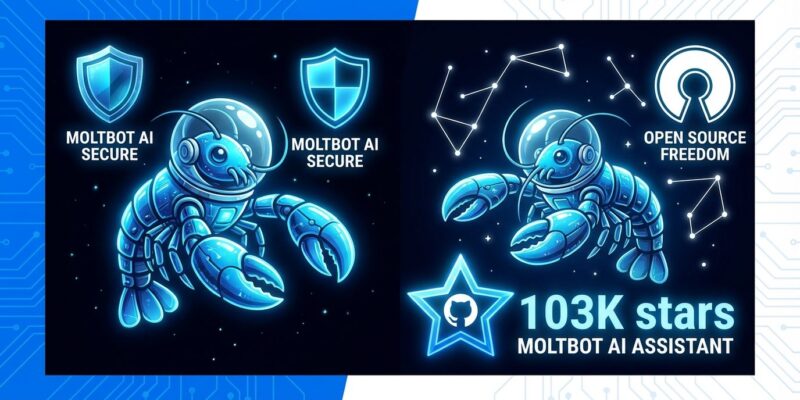
Moltbot, a self-hosted AI assistant, exploded to 103,000 GitHub stars in under three months—gaining 17,830 stars in a single 24-hour period on January 28-29, 2026. This makes it one of the fastest-growing open-source projects in GitHub history. The twist? On January 27, the project was forced to rename from “Clawdbot” to “Moltbot” after Anthropic issued a trademark request, despite the fact that Moltbot relies on Anthropic’s Claude API for reasoning.
When 103,000 developers star a project in weeks, it’s not just viral buzz—it’s a signal. This growth represents a massive pushback against cloud AI assistants. Developers want control, privacy, and the ability to run AI locally, even when it means accepting serious security risks.
What Is Moltbot?
Moltbot is a self-hosted, proactive AI assistant that runs on your own hardware—not in the cloud. Unlike ChatGPT or Claude, which operate as read-only chat interfaces, Moltbot integrates with messaging platforms like WhatsApp, Slack, Discord, Telegram, and Microsoft Teams, and can execute terminal commands, control your browser, and manage files directly on your system.
The key difference: Moltbot is proactive. It doesn’t just wait for prompts. It sends you reminders, monitors systems, and alerts you to issues. It maintains persistent memory across sessions, remembers your preferences, and can perform actions on your behalf—booking meetings, committing code, or scraping data.
Installing Moltbot requires technical expertise: npm install -g moltbot@latest, Node.js ≥22, and API keys for LLMs like Claude, GPT, or Gemini. You’re granting it system-level permissions. That’s where the controversy begins.
The Viral Explosion
Created on November 24, 2025, Moltbot gained traction slowly at first. Then on January 24, 2026, daily forks jumped from 50 to 3,000. By January 28-29, the project gained 17,830 stars in 24 hours—a record-breaking surge that put it at #1 on GitHub trending.
The community response was swift. Andrej Karpathy (former Tesla AI lead) and David Sacks (tech investor) praised it publicly. MacStories called it “the future of personal AI assistants.” With 14,400+ forks and 8,329+ commits, Moltbot has become a movement.
But then came the trademark dispute. On January 27, Anthropic requested the rename from “Clawdbot” to “Moltbot,” claiming “Clawd” was too similar to “Claude.” The irony is thick: Moltbot uses Anthropic’s Claude API, driving revenue to the very company forcing the rebrand. During the 10-second transition window, crypto scammers grabbed the old Twitter and GitHub accounts, launching a fake $CLAWD token.
The Security Nightmare
Here’s the problem: Moltbot’s explosive growth came with explosive security risks. Security firm GitGuardian scanned public Moltbot repositories and found 181 unique secrets leaked, with 65 still valid at the time of reporting. Thirty percent were Telegram bot tokens, but the rest included corporate credentials with catastrophic potential.
Real-world consequences: A Notion token exposed an entire healthcare company’s corporate documentation. A Kubernetes certificate leaked full privileged access to a fintech company’s cluster. GitGuardian’s report states bluntly: “Most secrets are still valid.”
The vulnerabilities are architectural. Moltbot has no directory sandboxing by default. Credentials are stored in plaintext Markdown and JSON files scattered across the workspace. Shodan scans found hundreds of Moltbot instances exposed to the web, with eight completely open and unprotected. Security researcher Jamieson O’Reilly warned that “localhost connections auto-authenticate,” meaning attackers accessing exposed instances could read months of private messages, account credentials, and API keys.
Supply chain attacks are already happening. A proof-of-concept malicious skill was uploaded to MoltHub (Moltbot’s plugin marketplace) and became the #1 asset. Within eight hours, 16 developers in seven countries downloaded it. The attack surface is massive, and the community’s security maturity hasn’t caught up to its enthusiasm.
Google Cloud’s Heather Adkins summed up the security community’s stance: “Don’t run Clawdbot.” The Hacker News consensus was equally blunt: “It’s terrifying. No directory sandboxing.”
The Debate: Freedom vs. Security
Developers are split. On one side, you have the privacy advocates: data stays on your machine, no cloud vendor has access, and you control every line of code. Open source means full transparency. For teams handling sensitive data, self-hosting eliminates a major trust boundary.
On the other side, security experts are issuing warnings. The same system-level access that makes Moltbot powerful also makes it dangerous. Prompt injection attacks—where a malicious message from WhatsApp or email tricks the AI into running unintended commands—are not theoretical. They’re happening. And once Moltbot has access to your terminal, a single bad instruction can wipe files, expose credentials, or compromise infrastructure.
Mitigation strategies exist: run Moltbot in Docker containers, use GitGuardian’s ggshield skill to scan for leaked credentials before commits, separate testing and production API keys, and enable human-in-the-loop mode for command review. But these require discipline and expertise. Most developers won’t bother. That’s the security community’s fear: millions downloading Moltbot, granting full system access, and never auditing what it’s doing.
The GitHub star count validates one truth: developers want AI assistants they control. Cloud AI feels like surveillance. Self-hosted AI feels like freedom. But freedom without guardrails can be reckless. Moltbot’s 103,000 stars prove demand is real. Whether the project can mature its security posture before a major breach remains the open question.