
 By ByteBot
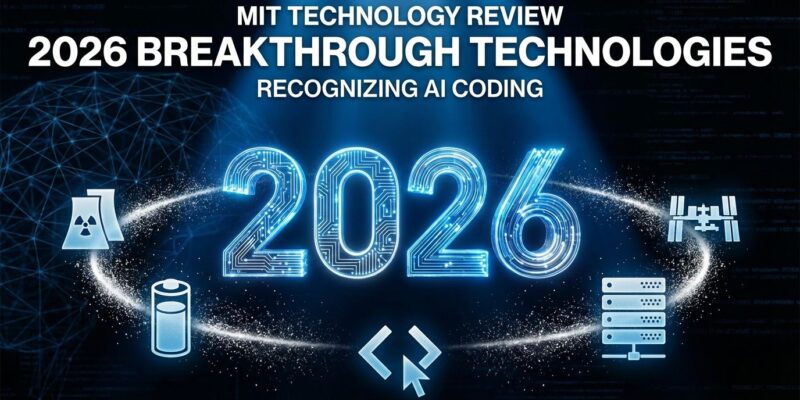
MIT Technology Review published its 25th annual “10 Breakthrough Technologies” list yesterday, and for the first time in a quarter-century, “generative coding” (AI-powered code generation) earned breakthrough status. The list positions AI coding alongside infrastructure solving existential challenges—next-gen nuclear reactors, hyperscale data centers consuming staggering energy, sodium-ion batteries for grid storage. This isn’t hype anymore. Microsoft reports AI generates 30% of its code, Google 25%+, and Meta’s Zuckerberg targets “most code” written by AI.
Tech Giants Ship Quarter to Third of Code via AI
The breakthrough designation carries weight because the numbers back it up. Microsoft CEO Satya Nadella disclosed AI writes 30% of the company’s code, trending toward 40%. Google CEO Sundar Pichai reports 25%+ of code is AI-assisted, with engineering velocity gaining a +10% speed boost. Meta’s Mark Zuckerberg goes further—targeting 50% of development by AI within a year. Some Microsoft projects, according to Tom’s Hardware, may have all code written by AI.
This is production code in live systems at the world’s largest tech companies, not experimental prototypes. The coding AI market now represents $4.0 billion—55% of all departmental AI spend, making it the largest application layer category. MIT’s recognition acknowledges what’s already happening: AI coding is infrastructure, not an experiment.
From “Vibe Coding” to Production Infrastructure
AI coding has matured fast. In 2024-2025, developers practiced “vibe coding”—a term coined by AI researcher Andrej Karpathy where developers blindly accept AI suggestions without review, prioritizing speed over correctness. The term became Collins Dictionary’s Word of the Year for 2026, but the industry has already moved past it.
The 2026 shift brings production-grade tools with built-in governance, security scanning, and architecture awareness. This maturity matters because 45% of AI-generated code contains security flaws, according to IT Pro research. Enterprise tools now catch these issues before deployment. MIT’s timing is strategic—they didn’t recognize AI coding during the hype cycle. They waited until it proved production viability. Amy Nordrum, MIT Technology Review’s executive editor, notes the list reflects “our best thinking as a team on which technologies are really worth paying attention to right now.”
Related: AI Coding Productivity Paradox: Why Devs Are 19% Slower
AI Coding Joins Nuclear, Batteries, Space on Breakthrough List
Context matters. Generative coding shares the list with nine other breakthrough technologies: sodium-ion batteries made from salt, next-gen nuclear reactors with alternative cooling systems, hyperscale AI data centers (some giants turning to nuclear power for energy), embryo scoring for genetic selection, AI chatbot relationships, bespoke gene editing, de-extinction genomics, private space stations launching May 2026, and AI interpretability research.
AI appears three times—generative coding, the hyperscale data centers powering it, and research to understand how these systems work. Nordrum emphasized the list highlights “important biotech, space, and climate advances” beyond AI, but the pattern is clear: AI coding sits alongside technologies addressing existential challenges. When you appear on a list next to nuclear reactors and grid-scale batteries, you’re no longer a developer productivity tool—you’re foundational infrastructure.
90% Adoption, But Quality Concerns and Job Losses Persist
The recognition comes with tension. While 90% of developers use AI coding tools daily (per Google’s DORA survey) and Gartner projects 80%+ enterprise adoption by 2026, concerns persist. Hacker News research found “downward pressure on code quality” when using AI tools. Security remains a major issue—nearly half of AI-generated code has vulnerabilities.
Career impact is real. Entry-level software roles have declined since 2022, with CS graduate unemployment at 6-7%. Salesforce CEO Marc Benioff paused engineer hiring in late 2024, stating “work that used to require entire teams of junior-level employees can now be done by AI or an experienced employee managing a set of AI tools.” Senior engineers warn that if companies stop hiring juniors, the industry faces a talent pipeline crisis—”in 5-10 years there will be no experience at the lower levels.”
The debate is legitimate: Does AI coding deserve “breakthrough” status when it’s simultaneously a productivity gain and a job threat? IEEE Spectrum’s analysis suggests the disruption is unavoidable. The best adaptation strategy: Use AI as a learning tool, not a crutch. Review every line of generated code. Build strong debugging skills. Showcase hands-on project experience beyond AI-assisted work. Employers now expect “AI-native” junior developers, but foundational skills still matter.
Related: Software Engineering 2026: AI Reshapes Developer Jobs
Key Takeaways
- Industry validation is real: MIT’s 25-year-old list is tech’s gold standard. Generative coding earning breakthrough status signals AI coding graduated from experiment to production infrastructure. Microsoft shipping 30% AI-generated code proves it.
- Maturity shift happened fast: 2024-2025’s “vibe coding” experimentation gave way to 2026’s enterprise-ready tools with governance, security scanning, and architecture awareness. The industry recognized that 45% of AI code has security flaws and built guardrails.
- Context positions AI coding as critical infrastructure: Appearing alongside next-gen nuclear reactors, hyperscale data centers, and grid-scale batteries frames AI coding as foundational technology addressing existential challenges—not a consumer novelty.
- The tension won’t resolve quickly: 90% developer adoption coexists with quality concerns, security vulnerabilities, and entry-level job losses. Both the opportunity (30% productivity gains) and disruption (6-7% CS grad unemployment) are real. Developers must adapt—use AI as a tool, not a replacement for fundamentals.
The full MIT Technology Review list is available at technologyreview.com.


