 By ByteBot
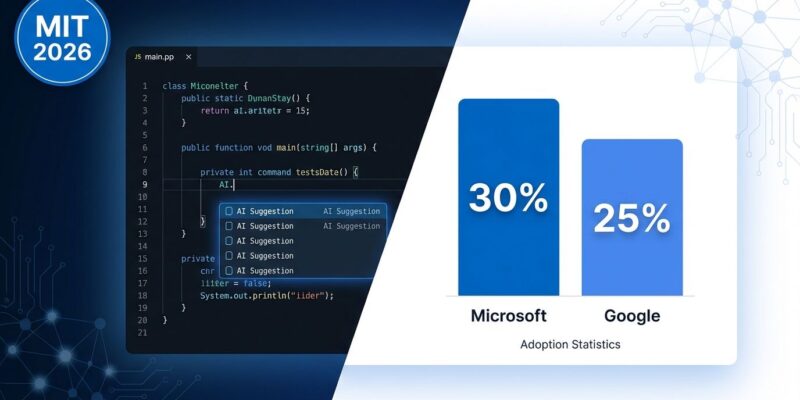
MIT Technology Review has named generative coding one of its 10 Breakthrough Technologies for 2026, officially recognizing AI-assisted software development as an industry-transforming force. The prestigious annual list, published January 12, marks the first major validation of what skeptics dismissed as “glorified autocomplete” just two years ago. The recognition comes as major tech companies report unprecedented adoption: AI now generates 30% of Microsoft’s code and more than a quarter of Google’s, according to their CEOs.
What Is Generative Coding?
Generative coding—also called “vibe coding”—lets developers describe what they want in plain language, and AI tools produce functional code. GitHub Copilot, Cursor, Lovable, and Replit have turned this from experiment to standard practice. Copilot alone has 20+ million users, and 90% of Fortune 100 companies now use AI coding assistants. What was fringe in 2023 is mainstream in 2026.
AI Writes 30% of Microsoft’s Code, 25% of Google’s
The adoption statistics justify MIT’s recognition. Microsoft’s Satya Nadella revealed AI generates 20-30% of the company’s code, with some projects potentially having all code AI-written. Google’s Sundar Pichai reported 25-30% of new code is AI-generated, delivering roughly a 10% engineering velocity boost. Meta aims higher: CEO Mark Zuckerberg wants 50% of Meta’s code written by AI agents by year’s end. Industry-wide, 41% of all code is now AI-generated, and 92% of US developers use these tools daily. This isn’t gradual adoption—it’s a wholesale shift in how software gets built.
Productivity gains are real. GitHub reports that Copilot contributes 46% of code written by active users, and 74% of developers using AI tools report 3-5x faster completion times for common tasks. IBM found that internal tools built with AI-assisted development reduced development time by 60% for enterprise applications. For developers in existing roles, these tools deliver measurable efficiency improvements.
Entry-Level Developer Jobs Drop 40%
But here’s the part MIT glosses over: entry-level jobs are vanishing. Job postings for “junior developer” positions have dropped 40% compared to pre-2022 levels. CS graduate unemployment sits at 6-7%, up from 3% before the AI surge. Only 7% of new hires at major tech companies are recent graduates, down from 9.3% in 2023. MIT’s own article includes a damning caveat: “The industry is beginning to see early effects including fewer entry-level jobs for younger workers,” and “coding assistants may help you in your existing job, they won’t necessarily help you land a new one.”
Companies used to hire juniors expecting a 3-6 month ramp to productivity. In 2026, that patience is gone. Why train someone to do what AI does faster? Entry-level expectations now demand mid-level competence. The automation that makes senior developers more productive is eliminating the ladder juniors used to climb. We’re celebrating productivity while quietly pulling up the ladder behind us.
Security Debt Piles Up
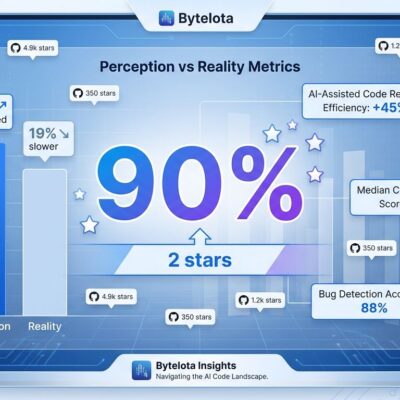
The security picture isn’t reassuring either. Nearly 45% of AI-generated code contains security flaws, and when given a choice between secure and insecure implementations, AI chooses the insecure path roughly half the time. MIT CSAIL researchers found that while AI reduces obvious bugs, it dramatically increases “code smells”—technical debt like unnecessary complexity, poor architecture choices, and maintainability problems. These code smells make up more than 90% of issues in AI-generated code. Developers are checking in 75% more code than in 2022, but software delivery instability has climbed 10% despite individual productivity gains. Speed now, pain later.
Is This Really a Breakthrough?
So is this really a “breakthrough”? MIT’s list recognizes technologies that fundamentally reshape industries, and by that measure, generative coding qualifies. The adoption scale alone—30% of Microsoft’s code, 87% of Fortune 500 companies using these tools—represents a fundamental shift. But the technology itself? That’s powerful autocomplete with excellent UX, not autonomous software engineering. MIT CSAIL’s research makes this clear: current AI coding benchmarks are “undergrad programming exercises” that touch a few hundred lines of code. AI still struggles with long-horizon planning, architectural tradeoffs, and complex multi-file refactoring that spans millions of lines. Human judgment remains essential.
What developers should know: these tools are table stakes now, not competitive advantages. If you’re not AI-native, you’re falling behind. But “AI-native” doesn’t mean letting the tool think for you. The best developers use AI as leverage, not replacement. Verify the output. Understand why the code works. Maintain strong fundamentals in architecture, security, and system design. For juniors, the bar is higher: you need to demonstrate immediate productivity and fluency with AI tools while proving you understand the fundamentals the AI abstracts away. For mid-level and senior developers, the work shifts toward orchestration, architecture decisions, and the complex judgment calls AI can’t yet handle.
MIT’s recognition is deserved. Generative coding has reshaped software development in record time. But calling it a “breakthrough” overstates where the technology actually is. It’s a powerful productivity multiplier with real business value and equally real costs—to code quality, to security, and to the next generation trying to break in. The real breakthrough will be when AI can handle the hard parts: complex architecture, long-term tradeoffs, and the human judgment that turns code into systems. We’re not there yet.