 By ByteBot
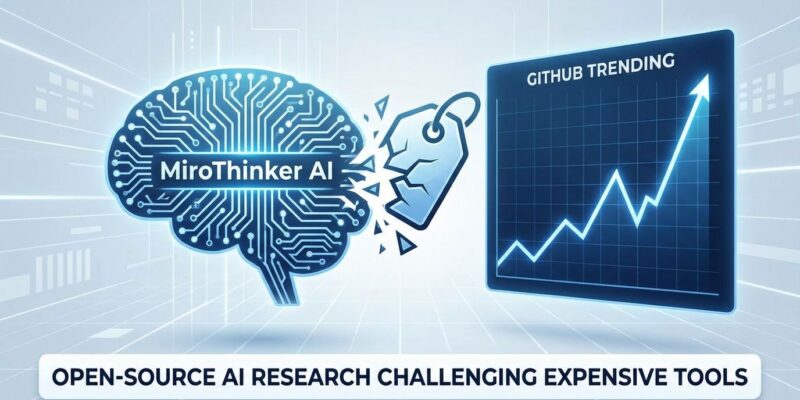
MiroThinker v1.5 rocketed to #3 on GitHub Trending TODAY after gaining 803 stars in 24 hours. The open-source AI research agent directly challenges OpenAI Deep Research ($200/month) and Google Gemini Deep Research ($20/month) by delivering state-of-the-art performance at 1/20th the cost. Released January 5, it’s already proving open-source can beat trillion-parameter proprietary models while running on 30 billion parameters.
This isn’t another “ChatGPT wrapper.” MiroThinker matches the deep research capabilities that OpenAI and Google lock behind subscriptions, but it’s free to download, self-host, and modify. For developers tired of paying $200 monthly or accepting vendor lock-in, it’s a genuine alternative.
The Cost Math That Changes Everything
OpenAI charges $200 per month for ChatGPT Pro, which includes Deep Research limited to 100 queries—about $2 per research call. Google offers Gemini Deep Research at $20 monthly through Gemini Advanced. However, MiroThinker costs $0.07 per call if you use cloud hosting, or exactly zero if you self-host.
Run the numbers on 1,000 research queries: OpenAI hits $2,000. MiroThinker on cloud infrastructure costs $70. Self-hosted means only GPU compute costs. That 20x price difference isn’t marginal—it’s the gap between “we can’t afford AI research at scale” and “let’s automate our entire research pipeline.”
Moreover, the implications hit hardest for startups, academic researchers, and independent developers. OpenAI’s $200/month with query caps forces rationing. MiroThinker removes the meter. Run 10 queries or 10,000—the cost scales linearly, not logarithmically.
Performance That Beats the Giants
MiroThinker-v1.5-30B achieved 69.8% on BrowseComp and 71.5% on BrowseComp-ZH (Chinese browsing benchmarks), setting world-leading performance in its class. It outperformed Kimi-K2-Thinking, a model with 1 trillion parameters, while using 1/30th the model size. Additionally, on GAIA-Val-165, it scored 80.8%.
The v1.0 release (72B parameters) hit 81.9% on GAIA, beating MiniMax-M2 by 6.2 percentage points and surpassing proprietary GPT-5-high by 2.5 points on HLE (Humanity’s Last Exam) using identical tools.
Furthermore, MiroMindAI introduced “interactive scaling” as a third dimension for AI improvement. Traditional models scale through bigger parameter counts or longer context windows. MiroThinker trains models to execute more tool calls and handle deeper agent-environment interactions—up to 600 tool calls per task with a 256K context window. Consequently, it achieves better performance through smarter reasoning patterns, not brute-force scale.
Part of the AI Agent Infrastructure Boom
MiroThinker isn’t alone on today’s trending list. Chrome-devtools-mcp gained 315 stars (browser control for AI agents), claude-mem added 800 (context management), and claude-code picked up 671 (agentic coding). This cluster signals a pattern: developers are building open infrastructure for autonomous AI systems.
The shift from chatbots to multi-step reasoning agents needs supporting infrastructure. Specifically, MiroThinker provides the research layer. Chrome-devtools-mcp handles browser automation. Claude-mem manages context persistence. Together, they form an ecosystem where developers control costs, customize behavior, and avoid proprietary lock-in.
This is developers voting with their GitHub stars. They’re rejecting $200 monthly subscriptions in favor of self-hosted alternatives they can audit, modify, and scale without permission.
Complete Ecosystem, Not Just a Model
MiroThinker ships as a four-component system: the core model (available in 8B, 30B, 72B, and 235B variants), MiroFlow agent framework, MiroVerse training dataset (147k samples), and MiroTrain/MiroRL training infrastructure. You’re not getting a black-box API—you’re getting the full toolchain to build, customize, and train research agents.
Compare to OpenAI Deep Research: zero customization, US-only availability, hard query limits, and opaque processing. Or Google Gemini Deep Research: limited tweaking, Google Workspace dependency, and no visibility into reasoning chains. In contrast, MiroThinker gives you source code, training data, and infrastructure. Build domain-specific research agents for legal analysis, medical literature review, or competitive intelligence. Train on proprietary data. Deploy behind your firewall.
The choice matters. When OpenAI costs $2 per query and offers no customization, alternatives stop being “nice to have” and become strategic necessities. When you need 10,000 research calls monthly, self-hosting MiroThinker at GPU costs beats $20,000 in OpenAI fees.
What This Means for Developers
Three options now exist for AI-powered research. OpenAI Deep Research delivers graduate-level analysis in 15-30 minutes at $200 monthly. Google Gemini Deep Research produces faster results (5-6 minutes) with undergraduate-level depth at $20 monthly. MiroThinker offers state-of-the-art benchmarks with full customization at $0.07 per call or free if self-hosted.
Choose OpenAI if budget isn’t constrained and you need absolute highest quality without technical overhead. Choose Google if speed matters and Google Workspace integration adds value. Alternatively, choose MiroThinker if cost matters at scale, customization is required, or you prefer owning your infrastructure.
For most developers, especially those running high-volume research tasks, MiroThinker changes the calculation. The 20x cost reduction isn’t a rounding error—it’s the difference between viable and unaffordable. The open-source ecosystem provides what proprietary APIs can’t: transparency, control, and cost predictability.
Key Takeaways
- MiroThinker delivers state-of-the-art AI research at 1/20th OpenAI’s cost
- Open-source beats trillion-parameter proprietary models on key benchmarks
- Part of broader AI agent infrastructure explosion on GitHub
- Complete ecosystem enables customization beyond black-box APIs
- Self-hosting option eliminates subscription fees entirely