
 By ByteBot
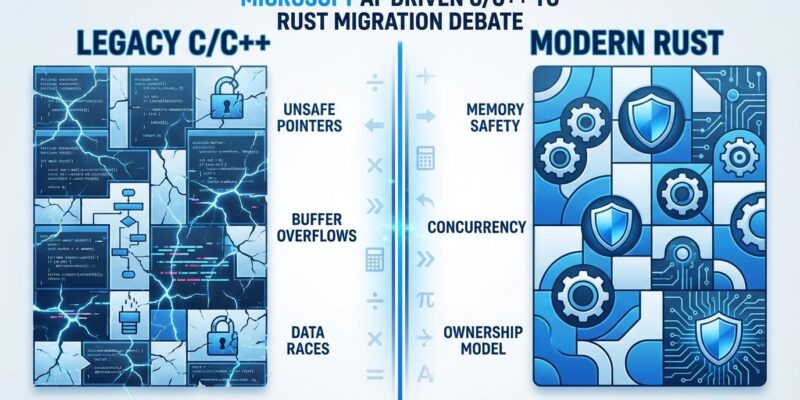
Microsoft Distinguished Engineer Galen Hunt announced yesterday on LinkedIn his goal to “eliminate every line of C and C++ from Microsoft by 2030” using AI agents. The bold productivity claim: “1 engineer, 1 month, 1 million lines of code.” However, Microsoft clarified today this is a “research project,” not an official company commitment. When you do the math on that productivity claim, it falls apart completely.
The Math Doesn’t Add Up
Let’s break down what “1 engineer, 1 month, 1 million lines of code” actually means. That’s 50,000 lines per day, or 6,250 lines per hour, or roughly 1.7 lines per second for eight hours straight, every workday, for a month. Consequently, there’s no time for code review, testing, debugging, or understanding what the code actually does.
Microsoft’s C/C++ codebase spans more than 100 million lines—Windows alone accounts for over 50 million. At this claimed productivity rate with perfect execution, you’re looking at 100+ months, which translates to over eight years. Moreover, this assumes zero failures, no regressions, and no rewrites—a fantasy in any real-world migration.
Compare this to Google’s actual experience with LLM-assisted code migration. Their 2025 study across 39 migrations showed that AI tools delivered roughly 50% time savings. Microsoft’s claim implies 100x productivity gains. The gap between 50% and 10,000% should raise eyebrows.
AI Code Quality Is Getting Worse, Not Better
Recent studies paint a troubling picture of AI-generated code quality. CodeRabbit’s December 2025 analysis of 470 open source pull requests found that AI-coauthored code contains 1.7 times more issues than human-written code, with logic and correctness errors jumping 75%.
Furthermore, Apiiro’s September 2025 research showed that while trivial syntax errors dropped 76% with AI assistance, deep architectural flaws surged. AI-assisted developers exposed Azure credentials nearly twice as often as their non-AI peers. Additionally, GitClear’s analysis of 211 million changed lines revealed that code refactoring plummeted from 25% in 2021 to just 10% in 2024, while copy-pasted code rose from 8.3% to 12.3%. AI isn’t promoting thoughtful engineering—it’s enabling shortcuts.
If AI struggles to maintain code quality in small projects, how will it handle the Windows kernel’s 30 years of accumulated complexity, platform-specific workarounds, and undocumented behaviors? More importantly: who maintains AI-generated Rust code that no human engineer wrote or understands?
Microsoft Has Tried This Before—And Failed
The Longhorn/Vista disaster offers a cautionary tale about ambitious rewrites. Development began in May 2001 with a planned October 2003 release. However, by January 2004, Jim Allchin’s internal memo warned: “LH is a pig, and I don’t see any solution to this problem.” In July 2004, Allchin contacted Bill Gates directly: Longhorn was “terribly behind schedule” and wouldn’t make it.
Microsoft hit the reset button in August 2004, scrapping everything and starting over on the Windows Server 2003 SP1 codebase. Vista finally shipped in November 2006—three years late with major features cut. The three planned “pillars” (WinFS, Avalon, Indigo) never made it. As a result, the product was widely criticized as bloated and slow.
If Microsoft couldn’t execute a large-scale rewrite with human engineers who understood the code they wrote, how will AI agents—which lack context, business logic understanding, and knowledge of historical “why” decisions—do better?
What Microsoft Should Actually Do
The frustrating part is that Microsoft is already making smart progress with Rust. David Weston’s team rewrote 36,000 lines of the Windows kernel in Rust with zero performance degradation. They completed a 152,000-line proof of concept for the DirectWrite Core library with all tests passing. In 2023, Azure CTO Mark Russinovich mandated that new projects use Rust instead of C/C++.
This gradual approach makes sense. Seventy percent of Microsoft’s security vulnerabilities stem from memory safety bugs—out-of-bounds reads, use-after-free errors, null pointer dereferences. Rust eliminates these entire categories of bugs. Google’s Android team proved this works: memory safety vulnerabilities dropped from 223 in 2019 to fewer than 50 in 2024 after Rust adoption.
The realistic roadmap looks like this: write new security-critical code in Rust, gradually rewrite high-risk components like kernel networking and cryptography, use AI tools to assist human engineers (achieving that realistic 50% speedup), and maintain existing C/C++ rather than rewriting everything. By 2030, maybe 30-40% Rust adoption across new code—not 100% migration.
The Real Story: Research Project or PR Stunt?
Microsoft’s December 24 clarification matters: this is a “research project,” not a shipping commitment. It’s a recruitment tool to attract top Rust talent, a PR generator for headlines about Microsoft’s security focus, and an exploration of AI-assisted migration tool limits. Therefore, it’s a vision statement, not a hard deadline.
Hacker News reactions captured the skepticism well: “Misleading title—not an official Microsoft plan, just one engineer’s goal.” The pattern is familiar. By 2028, expect “significant progress” claims with vague numbers. By 2030, “Rust adoption at 30-40% of new code”—not the promised 100%. The hard deadline will quietly fade, like WinFS and other Microsoft moonshots.
Microsoft is right to adopt Rust for security. AI tools can genuinely help, delivering that proven 50% productivity boost. But the 2030 complete elimination claim is marketing theater, not engineering reality. Watch for actual progress reports with specific metrics, not just ambitious announcements.


