 By ByteBot
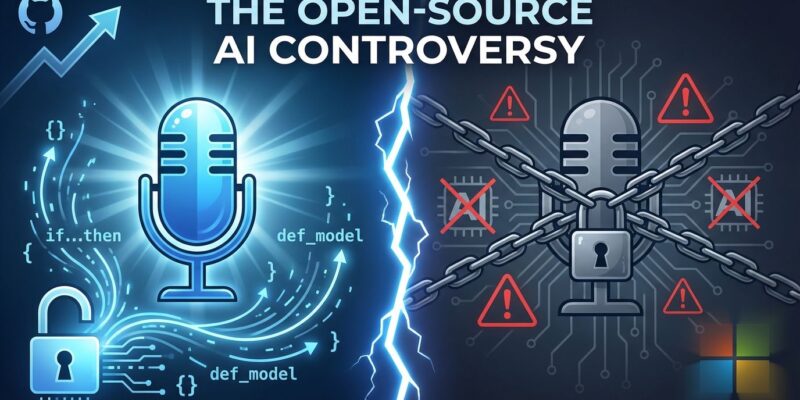
Microsoft released VibeVoice in August 2025—an open-source voice AI capable of synthesizing 90 minutes of speech with four distinct speakers, a feat that crushed the typical 1-2 minute, single-speaker limits of existing TTS systems. Then, in September, Microsoft pulled the code from GitHub after discovering misuse inconsistent with “responsible AI principles.” Today, despite the code removal, VibeVoice is trending #2 on GitHub with 3,863 stars gained. This is the open-source AI paradox: once released, AI models don’t go back in the bottle.
Microsoft Tried to Take It Back. It Didn’t Work.
Microsoft’s code removal was decisive but ineffective. The official repository now contains only documentation—no TTS implementation. Yet the model remains fully accessible. Model weights sit on Hugging Face (VibeVoice-1.5B and VibeVoice-7B), the community fork vibevoice-community/VibeVoice has 8,000+ stars and preserves the original code, and VibeVoice-ASR (speech recognition) was integrated into Hugging Face Transformers in March 2026. Removing code after distributing model weights is security theater.
Microsoft’s official statement acknowledged the failure: “After release, instances were discovered where the tool was used in ways inconsistent with the stated intent.” The company cited responsible AI principles but offered no specifics on the misuse. The vagueness suggests Microsoft faced legal pressure or internal safety escalations—not just isolated incidents.
The community reaction was predictable. Hacker News commenters called the move “pointless when forks exist” and noted that Microsoft “removed the original repo and created a new one with stars under 200″—an apparent attempt to reset public visibility metrics. It didn’t work. Today’s #2 trending status proves developers want this technology regardless of corporate gatekeeping.
What Makes VibeVoice Different: 7.5 Hz Tokenization
The technical innovation here is real, not hype. VibeVoice uses continuous speech tokenizers operating at an ultra-low 7.5 Hz frame rate—acoustic tokenizers for audio fidelity and semantic tokenizers for linguistic meaning. This compresses what would be 270,000 tokens (at typical 50 Hz rates) down to 40,500 tokens for a 90-minute synthesis. The result: a 7-13x computational efficiency gain that makes long-form generation economically viable.
The architecture combines a Large Language Model for dialogue flow and contextual understanding with a diffusion head for acoustic detail generation. This “next-token diffusion framework” enables context-aware expression, spontaneous emotion generation, cross-lingual synthesis (Mandarin ↔ English), and natural turn-taking across up to four distinct speakers. Most open-source TTS models (Coqui, Kokoro) cap out at 1-5 minutes due to computational constraints. VibeVoice’s 90-minute capability isn’t just incrementally better—it’s a different category of tool.
For developers, this means you can now generate full podcast episodes, complete audiobook chapters, or extended training content at near-zero marginal cost. Commercial alternatives like ElevenLabs charge $0.18-0.30 per 1,000 characters ($22-330/month subscriptions), making 90-minute content expensive. VibeVoice requires GPU compute (24GB VRAM for the 1.5B model) but eliminates licensing fees entirely. The economics shift dramatically for high-volume use cases.
Why Microsoft Pulled It: The Voice Cloning Threat
Microsoft didn’t specify what misuse triggered the code removal, but voice AI’s primary risk is obvious: deepfakes for fraud, impersonation, and disinformation. VibeVoice can clone a voice from 3-10 seconds of audio. That’s enough to impersonate a CEO for wire transfer approval, a family member for emergency scams, or a public figure for scalable disinformation campaigns.
The threat is not theoretical. Resemble AI reported that 1 in 4 Americans received an AI-generated deepfake voice call in the past year. CEO fraud schemes use voice cloning to impersonate executives and authorize fraudulent transfers. Voice phishing (vishing) attacks leverage cloned voices to bypass phone-based security measures. These attacks work because detection isn’t deployed widely enough.
Microsoft embedded safety features—an audible “generated by AI” disclaimer and an imperceptible watermark for provenance verification. Both are circumventable with basic audio editing. The disclaimer can be cut out. The watermark degrades under compression or adversarial processing. Microsoft knew this when they released VibeVoice. The safety features were compliance theater, not actual protection.
Related: OkCupid Gave 3M Photos to Facial Recognition Firm: FTC
What likely happened: Microsoft released VibeVoice assuming developers would self-regulate. When misuse cases emerged—likely reported by security researchers, law enforcement, or media—the company faced liability exposure and pulled the code. The model weights remain because removing them from Hugging Face would be even more futile: anyone who downloaded them already has local copies.
Can Frontier AI Be Open-Sourced Safely?
VibeVoice crystallizes a debate the AI industry hasn’t resolved: should powerful frontier models be open-sourced if they carry misuse risks? Three camps have emerged, and none has a satisfying answer.
The open-source advocates argue that restricting access is futile and counterproductive. “Code wants to be free,” they say. Detection and legal deterrence should be the focus, not gatekeeping. Open-source AI accelerates beneficial innovation—medical diagnostics, accessibility tools, scientific research—at rates closed systems can’t match. Restricting access punishes legitimate developers to prevent bad actors who will find workarounds anyway.
The safety-first camp counters that companies have a responsibility to prevent foreseeable misuse. We don’t open-source bioweapon designs or nuclear enrichment protocols, even if they could have beneficial applications. Voice cloning at scale enables fraud and disinformation that existing legal systems can’t deter fast enough. Microsoft was right to pull VibeVoice once misuse patterns emerged. Better to over-restrict than under-regulate frontier AI.
The pragmatists see Microsoft’s move as well-intentioned but ineffective. Removing code after distribution doesn’t work when model weights are already distributed and forks preserve the implementation. The horse has left the barn. The only viable path forward is improving detection tools (Resemble DETECT-2B achieves 94-98% accuracy), establishing legal frameworks for voice AI misuse (EU AI Act, US state deepfake laws), and educating users to verify voice communications through secondary channels.
ByteIota’s stance: detection beats gatekeeping. Microsoft’s code removal didn’t stop misuse—it just forced developers to use community forks or write their own inference code. The real opportunity is in building detection, attribution, and verification tools. Companies like Resemble AI (audio deepfake detection), C2PA (cryptographic content provenance), and Truepic (media verification) are solving the actual problem: not preventing generation, but identifying and attributing synthetic content reliably.
Fork Early, Build Responsibly
Developers should draw two lessons from VibeVoice: fork valuable open-source AI immediately, and build responsibly or face ecosystem-wide restrictions.
Microsoft demonstrated that companies can retract access even after open-sourcing. If you need frontier AI for legitimate use cases, fork it immediately. Model weights on Hugging Face are more stable than GitHub repos, but even those can be delisted under legal pressure. The VibeVoice community fork preserves the original implementation—8,000+ stars suggest many developers took this lesson seriously.
But forking isn’t enough. If developers enable fraud and disinformation at scale, regulators will impose restrictions that hurt everyone. Build responsibly: implement usage policies, integrate detection tools, require consent for voice cloning, disclose AI-generated content. The EU AI Act and US state laws are already increasing liability for AI misuse. Developers who ignore this will face legal exposure or watch open-source AI access disappear entirely.
The better path: focus on detection opportunities. Generation is becoming commoditized—VibeVoice, ElevenLabs, Coqui, Kokoro all offer high-quality TTS. Detection is undersupplied. Resemble DETECT-2B, C2PA verification, audio watermarking, and voice biometric authentication are growth markets. Companies solving “how do we verify this is real?” will outlast those solving “how do we generate more convincingly?”
Key Takeaways
- Microsoft’s code removal failed. Model weights remain on Hugging Face, community forks preserve the code, and VibeVoice is trending #2 on GitHub today. You can’t un-open-source AI once it’s released.
- 7.5 Hz tokenization is a genuine breakthrough. Ultra-low frame rates enable 90-minute, 4-speaker synthesis at 7-13x lower computational cost than typical TTS systems. This makes long-form content generation economically viable for developers.
- The deepfake threat is real and escalating. 1 in 4 Americans hit by AI voice scams in the past year. CEO fraud, vishing, and disinformation campaigns leverage voice cloning from 3-10 seconds of audio. Embedded disclaimers and watermarks are circumventable.
- Detection beats gatekeeping. Restricting access post-release doesn’t work. The future is detection tools (Resemble, C2PA), legal deterrence, and user education—not trying to put the AI genie back in the bottle.
- Developers: fork early, build responsibly. Fork valuable AI before companies retract access. But build responsibly or face regulatory crackdowns. The opportunity is in detection, attribution, and verification—not just generation.