
 By
By Microsoft Acquires Osmos: The Race to Own Autonomous Data Engineering
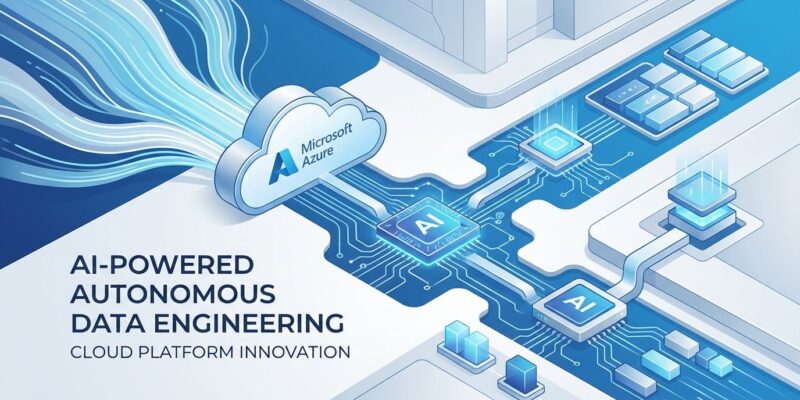
Microsoft acquired Seattle-based Osmos on January 5, 2026, to accelerate “autonomous data engineering” in its Fabric platform—positioning the tech giant in direct competition with Databricks for the $12.91 billion data fabric market.
The Category Land Grab
Osmos specializes in agentic AI that generates production-ready PySpark code automatically. Instead of data engineers spending weeks writing ETL pipelines, Osmos AI agents analyze incoming data, understand business logic, and deploy working code in hours. Customers report 50% reductions in dev and maintenance efforts, with data preparation cycles compressed from weeks to hours.
This matters because the entire data engineering profession is shifting. Databricks reports that 80% of new databases on its platform are now launched by AI agents, not human engineers. Data engineers currently burn 15-20% of their time on routine pipeline maintenance—exactly the kind of repetitive work AI excels at eliminating.
Microsoft is betting that “autonomous data engineering” becomes the defining category of the late 2020s. Osmos gives Microsoft the technology and talent to compete.
Microsoft vs Databricks: The Azure Battlefield
Here’s where the competitive dynamics get interesting. Osmos worked with both Microsoft Fabric and Databricks—but now Microsoft owns Osmos, and the Databricks integrations are being sunset immediately.
This is Microsoft playing defense on Azure. Databricks holds 15.19% of the big data analytics market and serves over 10,000 organizations. If Databricks wins data engineering on Azure, Microsoft loses enterprise customers to a competitor on its own cloud infrastructure.
Databricks strengths: Multi-cloud availability, mature ecosystem, advanced data science capabilities.
Microsoft Fabric strengths: Deep Azure integration, unified Microsoft ecosystem (Power BI, Synapse, Data Factory), low-code/no-code accessibility.
By integrating Osmos’ AI agents into Fabric, Microsoft gains automated code generation capabilities that match Databricks’ automation while leveraging Microsoft’s ecosystem lock-in.
What Osmos Actually Does
Osmos treats data engineering as a code generation problem, not a drag-and-drop UI problem. The Osmos AI Data Engineer analyzes your goals, designs processing strategies, and generates Fabric-native PySpark notebooks that teams can own, debug, and extend.
Key capabilities: Schema evolution that handles data structure changes without breaking pipelines. External data ingestion that automates messy third-party data. Self-healing pipelines that auto-detect anomalies and trigger corrective actions.
The differentiator is ownable code. Traditional ETL tools give you black-box transformations. Osmos generates actual PySpark notebooks that execute on your Spark pools and integrate with OneLake and Power BI.
Will AI Replace Data Engineers?
The nuanced answer: Data engineers aren’t disappearing—they’re leveling up.
AI handles the 80% of routine work: pipeline creation, schema mapping, error handling. What remains is the 20% requiring human judgment: architecture decisions, governance policies, compliance, complex business logic.
Instead of spending their days maintaining pipelines, data engineering teams are increasingly supervising intelligent agents and focusing on higher-level architecture and governance. The role shifts from “write ETL code” to “design autonomous data systems.”
But here’s the uncomfortable truth for junior data engineers: The entry-level pipeline plumbing work that once trained new hires is being automated away. According to industry trends, future data engineers will need to start with architecture thinking, not months of debugging Airflow DAGs.
Customer Impact and Product Sunset
Osmos products—Uploaders, Pipelines, Datasets, and Databricks Data Agents—begin sunsetting in January 2026. Customers must migrate to Microsoft Fabric or switch to competitors like Fivetran, Airbyte, or Hevo Data.
For Databricks, this is a strategic loss. Osmos’ Databricks integrations gave Azure customers a path to use Databricks tooling while staying in Microsoft’s ecosystem. That bridge is now burned.
What’s Next
Watch for Microsoft Fabric to announce integrated AI agent capabilities—likely at Microsoft Build or Ignite 2026. Databricks won’t sit still. Expect competitive responses: enhanced automation features, potential acquisitions, or deeper integrations with AWS and GCP.
The broader trend is clear: Autonomous data engineering is transitioning from hype to reality. By 2027, AI-generated pipelines will be table stakes, not differentiators.
Data engineers, take note: Your role isn’t disappearing, but it is transforming. Learn to supervise AI agents, architect self-managing systems, and focus on the strategic decisions machines can’t make.


