
 By ByteBot
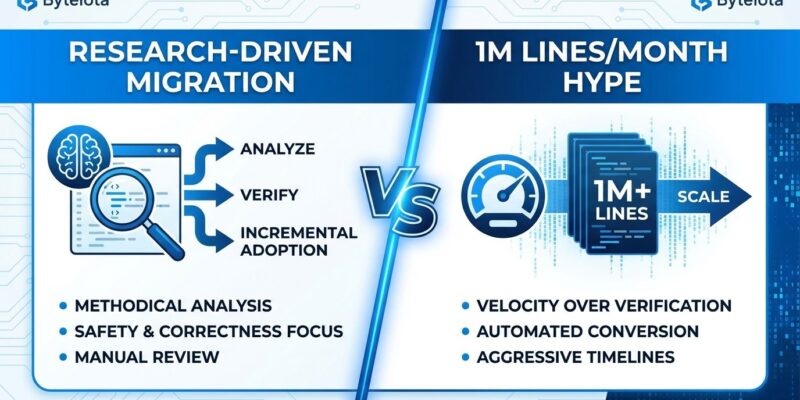
Microsoft Distinguished Engineer Galen Hunt made headlines December 24 with an ambitious LinkedIn post: eliminate “every line of C and C++” from Microsoft by 2030 using AI, achieving “1 engineer, 1 month, 1 million lines of code.” Within 48 hours, Hunt posted a clarification that flipped the narrative: Windows is NOT being rewritten in Rust with AI. It’s a research project exploring migration technology, not a production commitment. The gap between the bold headline and the reality reveals how quickly AI narratives spiral into hype.
What Microsoft Is Actually Building
Hunt’s clarification cut through the noise: “The intent of my post was to find like-minded engineers to join us on the next stage of this multi-year endeavor—not to set a new strategy for Windows 11+ or to imply that Rust is an endpoint.” His team works in Microsoft CoreAI’s Future of Scalable Software Engineering group with a mission to “eliminate technical debt at scale.” They’re building language-to-language migration technology—research infrastructure, not a Windows rewrite.
The proof this isn’t vaporware? Check your Windows System32 folder. You’ll find win32kbase_rs.sys, Rust code running in your kernel right now. Microsoft is using Rust incrementally where it makes sense. The $139,900 to $274,800 job posting in Redmond for this team is real. But “eliminate every line” by 2030 is an aspiration, not a deadline.
Can AI Really Migrate Millions of Lines Per Month?
Automated C++ to Rust translation tools have matured significantly in 2025. They combine static analysis with machine learning to create idiomatic Rust code from C++ source. Microsoft’s approach builds a “scalable graph over source code” where AI agents, guided by algorithms, make modifications at scale.
But here’s the reality: no tool creates perfect Rust code without human oversight. Migration time drops from years to months, not to days. C++ templates, operator overloading, inline assembly, and undefined behavior assumptions don’t map cleanly to Rust’s type system. ABI compatibility often requires human-designed shims. Research prototypes show promise on small-to-medium codebases, but whole-system translation hasn’t been proven at the “1 million lines per month” scale Hunt mentioned.
That metric is a research goal, not a proven capability. And that’s fine—ambitious research should aim high. The problem is when the goal gets reported as current reality.
The Security Imperative Driving Rust Adoption
Microsoft has concrete data: 70% of their security vulnerabilities originated from unsafe memory usage in C and C++ code. Rust’s ownership and borrowing system eliminates entire classes of memory safety bugs at compile time. That’s why Microsoft, Google, Amazon, and others are betting on Rust for critical infrastructure.
But Rust isn’t magic. In October 2025, Check Point Research discovered the first publicly disclosed vulnerability in Microsoft’s Rust-based kernel module: win32kbase_rs.sys. An out-of-bounds array access in region-to-path conversion triggered Rust’s bounds check panic, causing a Blue Screen of Death.
Here’s the critical distinction: in C++, that same bug would likely have enabled privilege escalation—a far worse outcome. Rust prevented memory corruption but defaulted to a crash. The failure mode changed from “exploitable vulnerability” to “denial of service.” That’s progress, but it proves Rust code still needs rigorous testing and thoughtful design.
Enterprise Rust Adoption Is Accelerating
Microsoft isn’t alone. Commercial Rust usage exploded 68.75% between 2021 and 2025. Some 2.26 million developers now use Rust, with 45% of organizations deploying it for non-trivial production systems. Rust hit #13 on the TIOBE Index in February 2025, its highest ranking ever.
Meta is rewriting its mobile messaging server from C to Rust, reporting 2-4 orders of magnitude performance improvements. Cloudflare built Infire, a Rust-powered LLM inference engine that’s 7% faster than vLLM with lower CPU overhead. Dropbox cut CPU usage 50% on their file synchronization engine after partial Rust migration. Microsoft’s own Azure Integrated HSM—a security chip deployed in all new servers starting 2025—runs firmware written entirely in Rust.
The challenges are real, though. Some 45.5% of developers worry about insufficient industry adoption, and 45.2% cite complexity as a barrier. The global pool of experienced Rust engineers remains limited. As AWS Engineer Russell Cohen said at the 2025 Rust Conference: “To migrate to Rust you should have a genuine reason. It’s a powerful language, but it needs the right environment, the right people, and proper maintenance.”
Why This Research Matters Beyond Microsoft
Technical debt represents up to 40% of enterprise technology estates, costing the global economy $85 billion annually in lost productivity and delayed innovation, according to McKinsey. Companies with fragmented legacy systems are 30% more likely to experience AI implementation delays. Organizations that proactively reduce technical debt see 20-30% faster time to market on new digital initiatives.
If AI-assisted code migration tools can genuinely accelerate modernization—even by a fraction of Hunt’s ambitious “1 million lines per month”—the impact reaches far beyond Microsoft. Every enterprise wrestling with decades-old C and C++ codebases could benefit. That’s why this research deserves attention, even if the timeline and scale are aspirational.
Manage Your Expectations
Microsoft’s research into AI-assisted Rust migration is legitimate and valuable. The team is real, the job postings are real, and win32kbase_rs.sys proves incremental adoption is already happening. But the gap between “research project” and “eliminate every line of C and C++ by 2030” shows how AI narratives inflate faster than capabilities.
Developers should watch this space. If Microsoft succeeds in building reliable language migration tools, it could reshape how the industry handles technical debt. But don’t expect Windows to be rewritten in Rust anytime soon. Incremental progress, not wholesale revolution, is what’s actually on the table.


