 By ByteBot
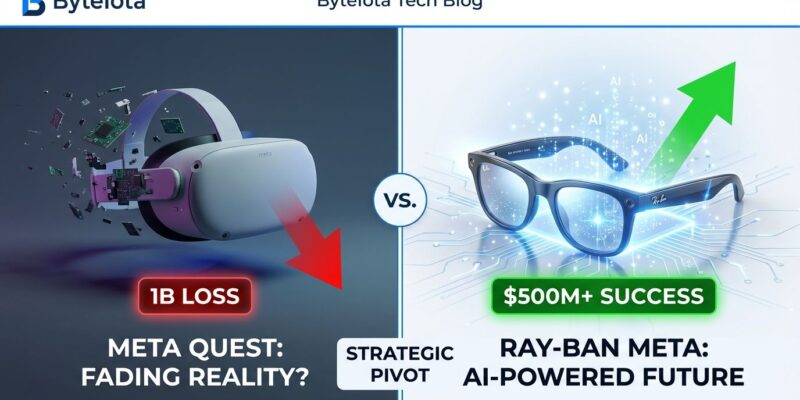
Meta laid off 1,500 Reality Labs employees in January 2026, marking the first major tech layoff of the year and a strategic retreat from its $71 billion metaverse bet. This isn’t downsizing. This is Meta admitting that Mark Zuckerberg’s vision of virtual worlds replacing physical reality failed, and AI won the resource war.
The $71 Billion Question: What Did It Buy?
Reality Labs hemorrhaged $71 billion between 2020 and mid-2025. The losses escalated every year: $6.6 billion in 2020, $10.2 billion in 2021, $13.7 billion in 2022, $16.1 billion in 2023, and $17.7 billion in 2024. In the first half of 2025 alone, the division lost another $8.7 billion.
For all that money, Meta captured 84 percent of the VR headset market in Q4 2024. The problem? The VR market shrank 12 percent in 2024, marking the third consecutive year of decline. Global VR headset sales fell to 6.9 million units, down from 7.7 million in 2023. Meta won the war for a market nobody wanted.
Reality Labs brought in $470 million in Q3 2025, up 74 percent from the previous year. Impressive until you realize the division was still losing billions per quarter. Meta dominated a failing market. It’s like capturing 84 percent of the fax machine market in 2010—technically winning while fundamentally losing.
The January 2026 Layoffs: Who Paid the Price
Approximately 1,500 Reality Labs employees lost their jobs in January 2026, representing 10 percent of the division’s 15,000-person workforce. California alone saw 272 layoffs (53 in Playa Vista, 219 in Burlingame) by March 20, 2026. Washington state reported 331 affected employees.
Meta shut down three VR game studios entirely: Armature, Sanzaru, and Twisted Pixel. Game developers, data engineers, software engineers, and AI researchers—all cut from divisions including the Metaverse Content Group, Horizon OS, and Reality Lab Group. These weren’t layoffs driven by economic downturn. These were layoffs because Meta is redirecting resources from a failed bet to the AI race.
The timing matters. This was the first major tech layoff of 2026, part of a broader pattern: 500,000 tech workers laid off since ChatGPT launched in November 2022, with AI directly causing 55,000 layoffs in 2025. Amazon cut 2,400 jobs to fund a $100 billion AI investment. Citigroup eliminated 1,000 positions. The money exists—it’s just flowing to AI, not VR.
The Pivot That’s Actually Working: AI Glasses vs VR Headsets
Meta isn’t abandoning spatial computing. It’s pivoting from VR headsets to AI-powered smart glasses, and the market response validated the decision. Meta’s stock jumped 4 to 6 percent when news broke of the Reality Labs budget cut, adding $60 to $70 billion in market value. Investors were relieved Meta was cutting losses.
Ray-Ban Meta glasses sold over 2 million units since launching in October 2023. Revenue tripled in 2025. The company now holds 80 percent of the smart glasses market and is scaling production from 2 million to 10 million annual units by the end of 2026. The global smart glasses market surged 210 percent year-over-year in 2024.
Contrast that with Quest headsets: 6.9 million units sold globally in a shrinking market, billions in quarterly losses, and a 30 percent budget cut incoming. Or Apple’s Vision Pro: production halted after shipping only 390,000 units in 2024, with digital ad spend slashed by 95 percent in 2025.
Why do AI glasses work where VR headsets fail? Ray-Ban Meta looks normal, not like a geeky tech prototype. It enhances daily life with AI features useful in the physical world—navigation, translation, information lookup. You’re still present in reality, just augmented. The price helps too: $299 versus $500 to $3,500 for VR headsets.
Apple Vision Pro Proved the Market Verdict
Apple’s Vision Pro was supposed to validate spatial computing and revive the VR market. Instead, it accelerated the collapse. Luxshare halted production after shipping approximately 390,000 units globally in 2024. In Q4 2025, during the crucial Christmas sales period, Apple shipped only 45,000 units.
If Apple—the company that convinced people to pay $1,000 for phones—can’t make VR work, the problem isn’t execution. The problem is fundamental: consumers don’t want to strap screens to their faces. They proved it by buying 2 million Ray-Ban Meta glasses instead of 390,000 Vision Pro headsets.
What This Means for Developers and the VR/AR Industry
The VR/AR developer job market is contracting. The VR market declined 12 percent in 2024 and is projected to fall another 12 percent in 2025. Unity laid off 3,200+ employees between mid-2022 and 2026. Meta shut down three VR studios. Developer focus is shifting from headset-based to web-based AR/VR, which requires no specialized hardware.
If you specialized in VR or metaverse development, diversify. AI skills are hot—that’s where investment and jobs flow. AI wearables like Ray-Ban Meta represent growing opportunity. Enterprise AR for industrial training and remote assistance remains viable. Gaming VR survives as a small niche for enthusiasts. But the mass-market consumer VR bet is dead, at least for the 2020s.
The lesson is clear: $71 billion doesn’t guarantee success. Market timing matters more than visionary technology bets. Meta learned it. Apple confirmed it. Consumers spoke: they want AI to enhance reality, not virtual worlds to replace it. Zuckerberg finally listened.