
 By ByteBot
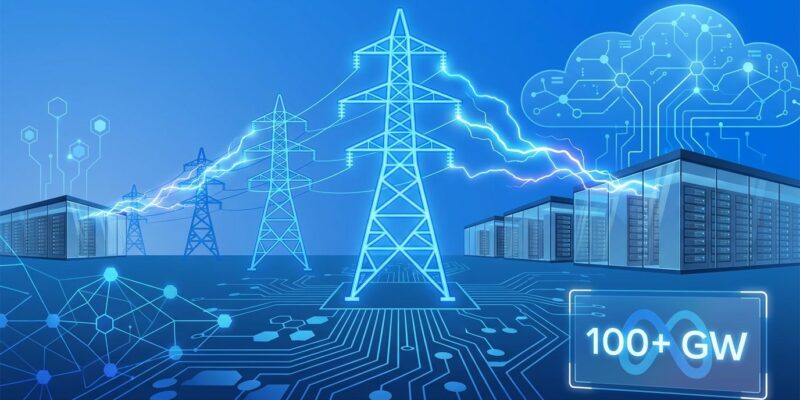
Mark Zuckerberg announced Meta Compute on January 12-13, 2026—not just another data center expansion, but a strategic reorganization positioning infrastructure itself as Meta’s competitive advantage. The scale is unprecedented: “tens of gigawatts this decade, and hundreds of gigawatts or more over time.” To put that in context, 100 gigawatts equals the entire power grid of the United Kingdom. While OpenAI’s recent $10 billion Cerebras deal secured 750 megawatts (0.75 GW), Meta is planning 100-500+ GW long-term. This isn’t about building more servers—it’s about controlling energy at nation-state scale.
Infrastructure as the New Battleground
Zuckerberg’s framing is deliberate: “How we engineer, invest, and partner to build this infrastructure will become a strategic advantage.” This repositions compute capacity from back-office operations to core business driver. The traditional AI moats—proprietary data, algorithms, network effects—are giving way to physical infrastructure. The barrier to entry is no longer code or talent, but the ability to secure gigawatts of carbon-free electricity and grid capacity.
Why? Energy availability, not chip supply, now constrains AI deployment. Grid connection requests take 5-10 years to approve in many regions. Late entrants can’t catch up—physical infrastructure has long lead times that no amount of capital can compress. This is the shift from training (expensive but one-time) to inference (scales linearly with users). Meta serves 3.5 billion users with AI features across Facebook, Instagram, and WhatsApp. Every query costs compute. At ChatGPT’s scale (200+ million weekly users), inference bills dwarf training costs.
Deloitte’s 2026 AI Infrastructure report puts it bluntly: “Organizations that successfully navigate this infrastructure transformation are likely to gain sustainable competitive advantages in AI deployment and operation, while those that fail to adapt are likely to face escalating costs, performance limitations, and strategic vulnerabilities.”
Three Executives, Three Strategic Signals
Appointing three executives to lead Meta Compute signals long-term, government-scale strategy. Santosh Janardhan, Meta’s head of global infrastructure, oversees technical architecture, software stack, silicon program (custom MTIA chips), and data center operations. This is vertical integration—Meta owning the stack from power generation to silicon. Daniel Gross, co-founder of Safe Superintelligence with Ilya Sutskever, leads 5-10 year capacity planning, supplier negotiations, and business modeling. Long-term planning, not quarterly earnings focus.
But Dina Powell McCormick’s appointment is the real tell. Former Trump advisor and Goldman Sachs executive, her role is to “partner with governments and sovereigns to build, deploy, invest in, and finance infrastructure.” This isn’t just data centers—it’s nation-state-level energy partnerships. Meta is positioning itself as critical infrastructure provider to governments, not just a social media company running servers.
The Energy Problem: Grid Can’t Support This
The numbers are stark. U.S. data center electricity demand grew from 19 gigawatts in 2023 to a projected 35 GW by 2030. Meta alone is planning 10-50 GW this decade, 100+ GW long-term. In Ireland, data centers already consume 21% of the country’s electricity, projected to hit 32% by 2026. AI data centers consume 7-8 times more energy than traditional workloads.
Grid operators are responding bluntly: “Bring your own generation” or wait 5-10 years. Some are offering priority access with conditional disconnection—data centers shut down during peak demand. The U.S. could face a power crunch by 2030 at current interconnection request rates. Meta’s solution is nuclear power. Vistra, TerraPower, and Oklo will deliver 6.6 gigawatts by 2035 for Meta’s Prometheus supercluster in New Albany, Ohio. Constellation Energy adds another 1.1 GW by 2027 in Illinois. Total contracted: 7.7 GW—enough to power 5 million homes.
Nuclear is the only path to gigawatt-scale carbon-free baseline power. Solar and wind can’t provide the consistent output required for 24/7 data center operations at this scale.
Compare to Competitors: Meta’s Scale Ambition Is 10-100× Larger
Hyperscalers are collectively spending over $600 billion on AI infrastructure in 2026, a 36% increase from 2025. Amazon leads with $100-105 billion in capital expenditures, Microsoft follows at $80 billion, Google at $75 billion. Meta’s 2025 capex was $66-72 billion, with $600 billion committed through 2028. Roughly 75% ($450 billion industry-wide) is directly tied to AI infrastructure rather than traditional cloud.
But Meta’s power capacity ambition dwarfs competitors. OpenAI’s total across all partnerships: 10+ gigawatts (Cerebras 750 MW, Nvidia 10 GW, AWS, Oracle, CoreWeave). Google’s nuclear deals: 6.6 GW. Amazon’s nuclear: 1.92 GW through 2042. Meta’s contracted nuclear: 6.6 GW so far. But Meta’s stated goal is “hundreds of gigawatts”—10 to 100 times larger than competitors’ announced plans.
If realized, Meta would control more power capacity than many countries’ entire grids. Germany’s grid: 210 GW. UK: 75 GW. Meta’s vision: 100-500+ GW. That’s nation-state scale.
Infrastructure as Moat? Challenge and Counter
Here’s the tension: Meta spent $72 billion on AI initiatives in 2025, yet Llama 4’s launch received a muted response. The company isn’t considered a major AI leader like Google, Microsoft, or OpenAI. The Register warned in January 2026 that “revenues from AI are rising rapidly, but not by nearly enough to cover the wild levels of investment.” Bubble concerns are real.
So is “hundreds of gigawatts” realistic, or marketing hyperbole? The timeline is conveniently vague: “over time” could mean 2040 or 2050. Current nuclear deals (6.6 GW) represent just 1-7% of the long-term vision. Where will the rest come from?
But here’s the counter: Even if “hundreds of gigawatts” is aspirational, securing power agreements now determines who can deploy AI at scale in 2030. Grid capacity is first-come-first-served. Meta is claiming territory. Physical infrastructure has 5-10 year lead times that no amount of capital can compress later. Late entrants face decade-long waits for grid connections and permits.
Infrastructure IS a moat—IF the AI products generate revenue to justify the spending. That’s the bet Zuckerberg is making.
Key Takeaways
- Energy availability, not chip supply, now constrains AI deployment. Grid operators are telling hyperscalers to “bring your own generation” because planned demand vastly exceeds capacity.
- Meta’s “hundreds of gigawatts” claim is unprecedented—nation-state scale. OpenAI’s 0.75 GW Cerebras deal is dwarfed by 100-500× by Meta’s long-term vision.
- Three-executive structure signals long-term, government-level strategy. Dina Powell McCormick’s focus on “governments and sovereigns” reveals Meta positioning itself as critical infrastructure provider.
- Infrastructure is becoming the competitive moat. Physical infrastructure has 5-10 year lead times—late entrants can’t catch up. But only if AI products deliver revenue to justify $600B+ investments.
For developers and infrastructure teams: Energy availability now determines where and when AI can deploy. Cloud regions with secured power agreements get priority. Factor energy constraints into infrastructure planning, not just compute budget. The companies securing gigawatts of carbon-free electricity today will control AI deployment tomorrow.


