
 By ByteBot
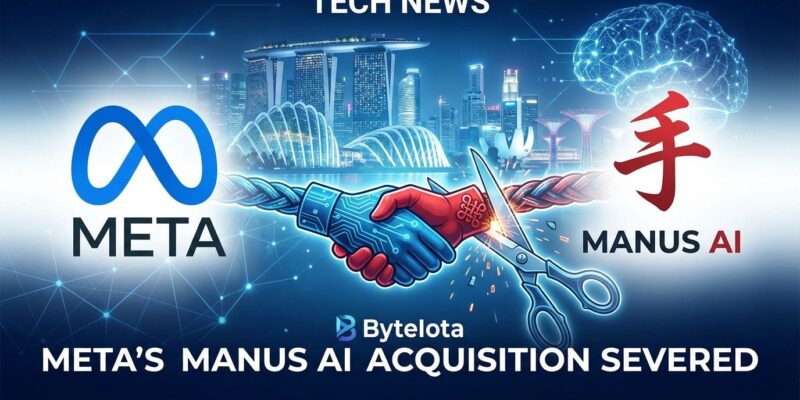
Meta just acquired an 8-month-old AI startup for $2-3 billion with one extraordinary condition: sever all ties with China. On December 30, 2025, Meta confirmed it’s buying Manus, a Singapore-based AI agent that grew from zero to $100 million ARR in eight months. The deal marks Meta’s third-largest acquisition ever and represents a rare instance of a US tech giant acquiring a Chinese-founded startup. Meta’s requirement: eliminate all Chinese ownership and shut down China operations entirely.
This isn’t just another AI acquisition. It’s a precedent for how US tech companies will navigate Chinese innovation amid escalating geopolitical tensions.
The Geopolitical Ultimatum
Meta’s acquisition terms reveal the new reality of US-China tech relations. The company stated: “There will be no continuing Chinese ownership interests in Manus AI following the transaction, and Manus AI will discontinue its services and operations in China.” Manus’s Chinese investors—including Tencent, ZhenFund, and HSG (formerly Sequoia Capital China)—must divest completely.
Manus started as Beijing Butterfly Effect Technology Co., Ltd. in April 2022. By June 2025, founder Xiao Hong relocated headquarters to Singapore. A wave of Chinese AI startups has fled to Singapore this year, positioning themselves as acceptable acquisition targets for US companies while maintaining proximity to China.
The forced severance raises questions: Will every US acquisition of Chinese-founded technology now require this separation? Meta is betting Singapore provides sufficient distance while making founder Xiao Hong a Meta Vice President—they want the talent, not the Chinese ownership.
The $100 Million ARR Miracle
What makes an AI startup worth $2-3 billion after eight months? Revenue that validates the AI agent market explosion. Manus launched in March 2025 and hit $100 million ARR by November. That growth trajectory is nearly unprecedented in enterprise software. The company has millions of paying users, demonstrating actual product-market fit rather than VC-subsidized growth.
TechCrunch captured why this matters: “For Zuckerberg, who has staked Meta’s future on AI, Manus represents something new: an AI product that’s actually making money.” Most AI companies burn billions chasing theoretical future revenue. Manus proved customers will pay for AI agents now. The $2-3 billion valuation translates to a 20-30x revenue multiple—aggressive, but defensible when the AI agents market is growing at 45.3% CAGR toward $103.6 billion by 2032.
The deal went from discussions to signed agreement in 10 days. That’s unusually fast for a multi-billion dollar transaction. Google, OpenAI, and Anthropic are racing to dominate AI agents. Meta couldn’t risk losing Manus to a competitor.
What Manus Actually Does
AI agents differ fundamentally from chatbots. Chatbots answer questions. AI agents execute tasks. Founder Xiao Hong explained that Manus is “more like a human being” compared to conversational AI. This represents the shift from AI as assistant to AI as autonomous employee.
Manus handles multi-step workflows with minimal oversight. Need to screen resumes? Upload applications, and Manus will review each resume, note qualifications, rank candidates, and provide evaluations. Users can close their laptops while the agent works asynchronously in the cloud. The same applies to travel planning, stock analysis, or data visualization.
The technology runs on Claude Sonnet and Qwen fine-tuned models, learning and improving over time. This is why 85% of organizations have integrated agents into at least one workflow, and 96% of IT leaders plan to expand implementations in 2025. The name “Manus” comes from Latin for “hand,” echoing “Mens et Manus”—mind and hand. AI is moving from thinking to doing.
Meta’s AI Acquisition Spree
The Manus deal caps an aggressive 2025 AI acquisition spree for Meta—its fifth AI-related purchase this year, following a $14 billion investment in Scale AI and the NFDG acquisition. Manus ranks as Meta’s third-largest acquisition ever, behind WhatsApp ($19 billion) and ahead of Instagram ($1 billion).
Zuckerberg has declared AI the company’s top priority and established Meta Superintelligence Labs focused on achieving AGI. Meta nearly missed the mobile platform shift a decade ago. They can’t afford to miss the AI agent platform shift now. Acquiring Manus gives Meta proven AI agent technology to integrate into WhatsApp (2 billion users), Instagram (2 billion users), and Facebook (3 billion users).
Unlike Instagram or WhatsApp, Manus arrives with a proven business model and paying customers. That reduces integration risk but introduces a different challenge: maintaining growth momentum without access to the Chinese market.
The Valuation Gamble
Is $2-3 billion justified for an 8-month-old startup with $100 million ARR? The bull case is straightforward. AI agents represent the next computing platform, enterprise demand is exploding, and Manus demonstrated product-market fit faster than nearly any enterprise software company in history. Meta’s distribution could scale revenue 10x.
The bear case is equally clear. Eight months of revenue history isn’t predictive. AI valuations are inflated—Mira Murati’s startup raised $2 billion at a $12 billion valuation before shipping product. The forced China severance may disrupt development if key talent was located there.
The geopolitical complexity adds uncertainty. Will Meta face pressure to divest Manus entirely if US-China tensions escalate? Will Chinese engineers transfer to Meta, or will visa restrictions block that?
What happens next determines whether this was genius or hubris. Xiao Hong joins Meta as VP, Manus continues independent operations initially, and integration into Meta’s social products begins. The forced exit from China is complete—no revenue, no operations, no Chinese investors. Meta owns one of the fastest-growing AI agents in the world, betting $2-3 billion they can maintain momentum while severing the startup’s Chinese roots.


