 By ByteBot
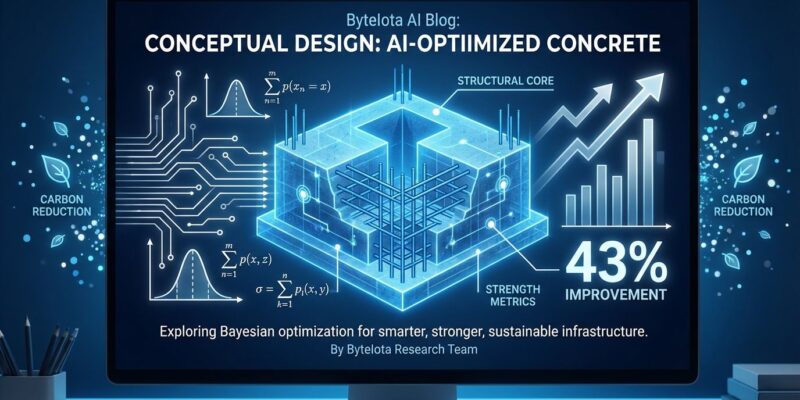
Meta released BOxCrete this week—an open-source AI model that optimizes concrete mix designs for faster curing and lower carbon footprints. At the company’s Rosemount, Minnesota data center, the AI-generated formula achieved full structural strength 43% faster than the originally proposed concrete while reducing cracking risk by 10%. This isn’t another chatbot generating marketing copy. It’s Bayesian optimization solving actual infrastructure problems.
The announcement came March 30 at the American Concrete Institute Spring Convention, and it matters for a straightforward reason: the United States imports 25% of its cement despite producing most of its concrete domestically. Different cement chemistries require reformulated mixes, and switching suppliers without AI assistance means months of validation cycles. Data centers can’t wait that long—construction timelines have compressed from 30-36 months to just 12 months as hyperscalers race to deploy AI infrastructure.
Real Results, Not Research Theater
BOxCrete uses Bayesian optimization and Gaussian processes trained on 500+ strength measurements from 123 concrete and mortar mixes. The model predicts compressive strength at multiple curing ages—1, 3, 5, 14, and 28 days—achieving R² = 0.94 accuracy. More importantly, it optimizes for two objectives simultaneously: structural strength AND Global Warming Potential (GWP).
At Meta’s Minnesota data center, the BOxCrete-generated mix didn’t just meet specifications faster. It qualified for expanded deployment across additional facility areas, using exclusively domestically sourced materials. The model can now predict concrete slump (a workability indicator) alongside strength metrics, addressing a capability gap in previous optimization frameworks.
This is proper machine learning applied to materials science—Gaussian processes and probabilistic modeling, not neural networks thrown at everything hoping for magic. The approach earned Meta and partner Amrize the 2025 Building Innovation Award and the 2025 Slag Cement Award for Sustainable Concrete Project of the Year.
The US Cement Dependency Problem
America pours roughly 400 million cubic yards of concrete annually. The cement sector contributes over $130 billion to the economy and supports 600,000 jobs. Yet despite domestic concrete production dominance, 20-25% of cement consumption relies on imports with inconsistent performance and environmental standards.
When concrete producers switch from imported to domestic cement, mixes optimized for one chemistry can fail catastrophically with another. BOxCrete accelerates the reformulation and validation process that traditionally takes months. Amrize—the largest North American cement manufacturer operating 18 plants, 141 terminals, and 269 ready-mix sites—is investing close to $1 billion in 2026 to increase domestic production capacity. They need faster mix validation to make that investment viable.
The timing aligns with broader reshoring momentum that’s brought 1.1 million jobs back to the United States since 2020. Manufacturing infrastructure needs concrete. Lots of it. And cement manufacturing produces 8% of global CO₂ emissions—more than the entire aviation industry—making optimization both economically and environmentally necessary.
Open Source Meets Industrial Scale
Meta released BOxCrete under an MIT license on GitHub, permitting commercial use with minimal restrictions. This democratizes technology that concrete producers would otherwise build in-house or license from proprietary vendors. Quadrel, a Pennsylvania-based SaaS platform for the ready-mix industry, has already integrated the framework into its commercial software.
The partnership with Amrize brings industrial-scale deployment across 269 ready-mix concrete sites, while the University of Illinois provides academic validation. Meta’s stated goal is an “industry-wide shift in how American producers approach mix design”—positioning the model as foundational infrastructure rather than a competitive moat.
The open-source strategy makes sense. Meta needs massive amounts of concrete for data center construction. Better concrete benefits Meta directly, but the bigger win comes from accelerating domestic cement production industry-wide. Proprietary optimization would help Meta; open-source optimization helps everyone building infrastructure faster.
Developer Skepticism and Engineering Reality
The Hacker News discussion (126 points, 102 comments) reflected mixed reactions. Developers appreciated seeing “AI solving real problems” instead of surveillance technology or yet another image generator. However, engineers raised legitimate safety concerns: “If your multi million dollar cement foundation turns out to be sub-par, that’s multi million dollars to tear it out.”
Meta engineers clarified that BOxCrete provides “recommendations for onsite testing,” not replacements for validation. Lab testing, field trials, engineering sign-off, and building code compliance remain mandatory. The AI accelerates discovery of promising candidates; it doesn’t bypass the rigorous testing that keeps buildings standing.
Some commenters pointed out that simple slump tests—requiring just “a bucket, plywood board & a stopwatch”—already work adequately. Fair point. But those tests measure workability, not strength development over time or carbon footprint optimization. BOxCrete targets a different problem: finding optimal formulations faster when supply chains shift or sustainability mandates tighten.
A roadway engineer noted that mix composition is only one factor—workmanship problems like inadequate vibration or overworked finishing compromise strength regardless of formula quality. True. AI can’t fix human error. But it can reduce the iteration cycles when switching materials, which matters when data center construction timelines compress by 60%.
Industrial AI vs Consumer Hype
BOxCrete represents something broader: Big Tech shifting AI resources from consumer products to industrial infrastructure. Meta isn’t unique here—Google applies machine learning to data center cooling, AWS optimizes server placement with reinforcement learning, and Microsoft uses AI for chip design. The pattern is clear: after saturating consumer AI markets with chatbots and image generators, tech companies are tackling unglamorous but high-impact problems in materials science, logistics, and manufacturing.
Concrete optimization lacks the sexiness of generative AI, but it has measurable ROI. Faster curing means shorter construction timelines. Lower carbon footprint means regulatory compliance and reduced carbon taxes (Canada’s carbon pricing hits $170/tonne by 2030). Better formulations mean longer-lasting infrastructure. These benefits are quantifiable, unlike productivity gains from yet another AI writing assistant.
The Global Cement and Concrete Association’s Net Zero Roadmap demands 25% CO₂ reduction by 2030 from an industry that has struggled to reduce emissions at all. Financial institutions increasingly demand traceable sustainability data. BOxCrete addresses regulatory pressure with open-source tooling that any producer can deploy. That’s a different value proposition than consumer AI, and arguably more impactful.