 By ByteBot
Memory Shortage Crisis 2026: RAM Prices Double as AI Demand Surges
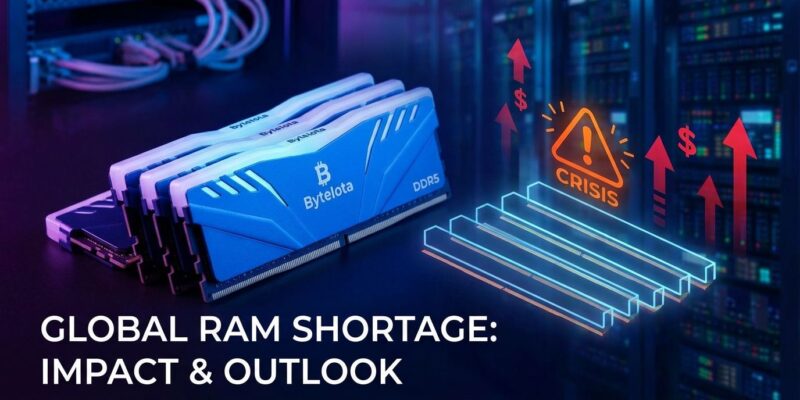
Japanese PC retailers stopped taking custom desktop orders this week, citing an intensifying memory shortage that’s made component availability and pricing unsustainable. The move signals how severe the global RAM crisis has become: prices doubled in December 2025, and industry analysts warn this is just the beginning of a multi-year shortage that could reshape how developers build and upgrade their workstations.
The Crisis Is Real
The Japanese retailers halting orders aren’t being dramatic. RAM prices have genuinely doubled since November, with entry-level DDR5 32GB kits jumping from $100 in 2023 to $425 today. According to IDC’s global memory shortage analysis, DRAM contract prices are projected to rise another 50% in Q1 2026.
Major PC vendors are responding accordingly. Dell has already raised business customer prices up to 30%. Lenovo, HP, Acer, and ASUS are signaling 15-20% price hikes across the board. Furthermore, some vendors are now selling pre-built systems without RAM entirely, forcing customers to source memory separately in whatever secondary market they can find.
IDC forecasts the PC market could shrink 5-9% in 2026 as demand destruction accelerates. Average PC prices are expected to rise 8% this year. For developers planning workstation upgrades or building new development environments, this isn’t abstract market analysis. It’s your budget getting squeezed.
AI Is Eating Your RAM
The root cause is blunt: AI data centers are consuming memory production capacity at consumer expense. AI workloads now account for 20% of total DRAM production in 2026, and that percentage is growing.
The technical bottleneck is High-Bandwidth Memory (HBM), the specialized RAM used in AI accelerators and data center GPUs. As Tom’s Hardware explains, HBM consumes approximately three times the wafer capacity of DDR5 per gigabyte. With limited cleanroom space at Samsung, SK hynix, and Micron, every wafer allocated to HBM for Nvidia’s AI chips is a wafer denied to consumer products.
This is a zero-sum game. Memory manufacturers are making a straightforward business decision: prioritize higher-margin HBM for hyperscalers like Microsoft, Google, Meta, and Amazon over lower-margin consumer DRAM. Consequently, DDR4 production is falling to roughly 20% of 2025 levels. Consumer DRAM supply growth is only 16% year-over-year, well below the historical 20-30% norm.
SK hynix’s advanced packaging lines are at capacity through 2026, with Nvidia reportedly accounting for the majority of HBM output. Meanwhile, Samsung is expanding HBM production capacity by 50% by the end of this year, but that expansion is coming entirely from reallocating consumer memory production, not adding net new capacity.
Recovery Timeline: Years, Not Months
Don’t expect relief soon. Industry consensus points to a shortage lasting through 2027 at minimum, possibly into 2028.
Etron Chairman Lu Chao-Chun stated the shortage will last “at least until the first half of 2027,” driven by structural supply deficits and stagnant production capacity. SK hynix has warned investors that DRAM supply growth will lag demand through 2028. Micron’s CEO noted the company can only meet 50-66% of current demand.
New fab capacity won’t arrive until 2027 at the earliest. SK hynix’s Yongin mega-fab begins production in 2027, but executives have emphasized that HBM and high-margin enterprise DRAM will receive priority. Similarly, Micron’s Hiroshima HBM facility won’t produce output until 2028. Even when new fabs come online, the bulk of capacity will continue flowing toward AI and enterprise products, not consumer DRAM.
The optimistic scenario sees prices beginning to decline in Q4 2027. The moderate scenario: stabilization in 2028 at prices 30-50% above 2023 levels. The pessimistic scenario: shortages persisting through 2028 and beyond as AI infrastructure expansion continues outpacing memory production capacity.
What Developers Should Do
Given a multi-year shortage, the strategic question becomes: buy now or wait?
If you have an urgent need, buy now. Prices are unlikely to drop meaningfully in 2026. They’re more likely to peak mid-year and remain elevated through 2027. Waiting for prices to return to 2023 levels means waiting potentially until 2028.
For workstation planning, understand the new RAM requirements reality. 16GB is the minimum for basic Docker and Kubernetes development, but it struggles with multiple VMs, browser tabs, Slack, and heavy IDEs running simultaneously. 32GB is the recommended sweet spot for most developers handling multi-container applications and virtual machines. 64GB and above is now professional-grade territory, with pricing to match.
The DDR4 versus DDR5 decision is complicated by the fact that both are scarce. DDR5 is the better long-term investment despite higher current prices, as DDR4 production is being actively phased out. Indeed, some vendors are already allocating DDR4 inventory exclusively to legacy enterprise contracts.
Alternative solutions are gaining traction. Cloud development environments like GitHub Codespaces and GitPod shift capital expenditure to operating expenditure, though cloud providers are facing the same memory constraints. Developers are focusing more on memory optimization techniques: container efficiency, VM consolidation, and process-level memory management. The used component market has seen increased activity, though even secondhand RAM is price-inflated in the current environment.
The New Normal
This shortage represents a permanent market restructuring, not a temporary supply chain disruption. The memory industry is reallocating capacity toward enterprise and AI products as a core strategic shift. Consumer DRAM is becoming a secondary product line with correspondingly lower priority.
The irony is sharp: AI is driving memory shortages that limit AI PC adoption. Microsoft’s Copilot+ PCs require a minimum of 16GB RAM, with many systems shipping with 32GB. The same hyperscalers demanding HBM for data centers are finding their consumer AI ambitions constrained by the resulting DRAM shortage.
The gaming market faces similar pressures. GDDR6 and GDDR6X memory used in graphics cards is affected by the same capacity reallocation. Industry analysts project Nvidia’s RTX 5090 could approach $4,000-$5,000 by late 2026. Budget gaming builds under $1,000 are becoming nearly impossible to configure.
For developers, the practical implication is straightforward: plan workstation investments with the assumption that memory will remain expensive and scarce for years. Budget accordingly, prioritize capacity over speed when making tradeoffs, and consider alternative architectures that reduce local memory requirements. The 2023 pricing environment is not coming back.
Key Takeaways
- Buy now if urgent: Prices unlikely to drop in 2026, peak mid-year expected
- RAM requirements: 16GB minimum, 32GB recommended for developers, 64GB+ professional
- Recovery timeline: Q4 2027 optimistic, 2028 moderate, possibly beyond
- Root cause: AI consuming 20% of DRAM production, HBM prioritized over consumer memory
- Alternatives: Cloud dev environments, memory optimization, strategic capacity planning