 By ByteBot
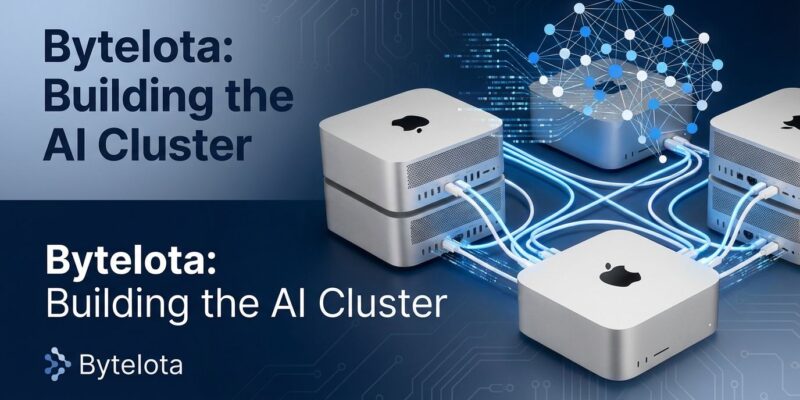
Apple released macOS 26.2 Tahoe on December 12, 2025, introducing RDMA over Thunderbolt 5 that enables Mac-to-Mac AI clustering. Developers immediately demonstrated running a 1 trillion parameter AI model across four Mac Studios consuming just 500 watts—10x less power than an equivalent NVIDIA GPU cluster. This isn’t incremental improvement. Apple just made production-scale AI infrastructure affordable for indie developers and small teams who were priced out a week ago.
The Economics Just Changed
Before macOS 26.2, running 500-billion-plus parameter models locally required $100,000+ in NVIDIA GPUs or expensive cloud APIs. After yesterday’s release, a $6,000 Mac mini cluster provides 256GB of unified memory for AI inference workloads that previously demanded datacenter budgets. Scale up to four Mac Studio M3 Ultra machines with 2TB total memory for $38,000—still 18% the cost of an equivalent NVIDIA GPU cluster at $270,000.
A Hacker News developer calculated the capacity advantage: “A $50K Mac cluster can hold 3TB of model weights—capacity otherwise requiring $270K in NVIDIA hardware while maintaining 87% of that capacity at just 18% of the cost.” That’s not marketing spin. That’s 487 upvotes and 242 comments from developers running real workloads.
Privacy-sensitive industries can finally avoid cloud providers. Bootstrapped startups can build AI products without AWS bills. Small research labs get on-premises AI at affordable scale. Apple is filling the gap NVIDIA left wide open: affordable local AI inference.
Power Efficiency Is the Hidden Advantage
Four Mac Studios running distributed inference consume roughly 500 watts total. An equivalent NVIDIA GPU cluster burns through 5,000 watts—10x more power for comparable capacity. That’s not just a lower electricity bill. It’s the difference between running AI in a small office versus needing datacenter HVAC, between quiet operation versus jet-engine fan noise, between a reasonable carbon footprint versus justifying environmental impact to your team.
Real-world measurements back this up. Two Mac Studios running DeepSeek R1 (671 billion parameters) consumed under 200 watts at the wall. NVIDIA’s RTX 4090 alone draws 450 watts under AI load. Power efficiency enables deployment scenarios that weren’t viable before—think edge inference, small office setups, privacy-focused on-premises AI.
It Actually Works: Developers Running Trillion-Parameter Models
Skepticism is warranted whenever Apple announces anything AI-related. But this isn’t vaporware. MLX developer Awni Hannun demonstrated Kimi K2 Thinking—a 1 trillion parameter model—running across four Mac Studio M3 Ultra machines with 2TB total RAM, achieving 15-18 tokens per second for inference.
Other developers reported 3.5x speedup for token generation across four-machine clusters. The M3 Ultra handles DeepSeek R1 (671B parameters) at 17-18 tokens/second. These are production-capable numbers, not synthetic benchmarks.
The technical foundation is RDMA (Remote Direct Memory Access) over Thunderbolt 5, delivering 80Gbps bandwidth with 5-9 microsecond latency. Apple’s open-source MLX framework supports distributed inference through OpenMPI, enabling Macs to share memory pools across Thunderbolt connections. No special hardware needed beyond Thunderbolt 5 cables and compatible Macs: M4 Pro/Max MacBook Pro, M4 Pro Mac mini, or Mac Studio M3 Ultra.
But Let’s Be Honest About the Limitations
Mac clusters aren’t better than NVIDIA for everything. AI training workloads still favor GPUs with NVLink, which delivers 1,800 GB/s—180x faster than Thunderbolt 5’s 10 GB/s. For large-scale training runs with hundreds of billions of parameters, NVIDIA’s hardware advantage is insurmountable. The CUDA ecosystem (PyTorch CUDA, TensorRT) remains essential for many workflows.
Scaling beyond 3-4 Macs hits diminishing returns. macOS remote management isn’t as efficient as Linux for clustering, and you can’t handle major OS upgrades via CLI—the GUI requirement is a real friction point. This isn’t enterprise-ready infrastructure for mission-critical production deployments.
But here’s the thing: for AI inference workloads at small scale (2-4 machines), Apple’s unified memory architecture and power efficiency compete effectively with GPU clusters that cost 5-7x more and consume 10x the power. If you’re an indie developer, a bootstrapped startup, or a small research lab running inference on frontier models locally, Mac clustering just became a viable option.
Apple’s Play Against NVIDIA’s AI Monopoly
NVIDIA focused on hyperscale training and left a gap in the market: affordable local AI inference. Apple is exploiting that gap. The comparison is clear—NVLink dominates for training, but Thunderbolt 5 RDMA is “good enough” for inference when you factor in cost and power consumption.
NVIDIA will respond. Expect cheaper inference-focused GPUs and more aggressive DGX Spark pricing. But Apple has advantages that are hard to counter: unified memory architecture, tight hardware-software integration, and consumer hardware economics. A Mac mini M4 Pro starts at $1,399. Building an equivalent AI inference machine with NVIDIA GPUs costs 3-4x more.
This isn’t about Apple “killing” NVIDIA. Training workloads will stay GPU-dominated. But for developers who need large memory pools for inference and can’t justify $270,000 clusters, Apple just gave them a $38,000 alternative that works today. That shift matters.