 By ByteBot
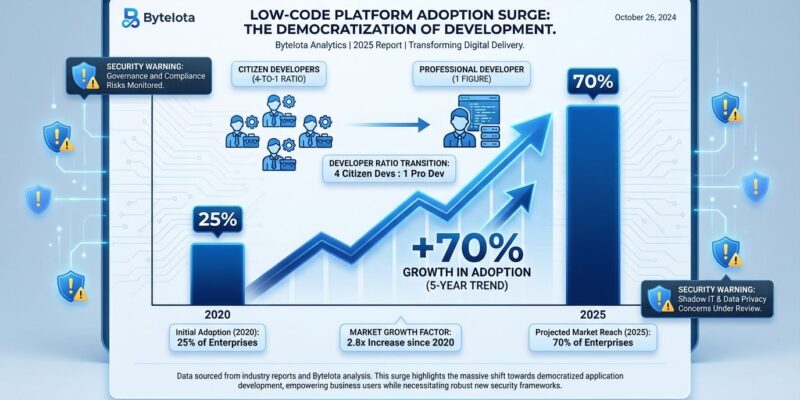
By 2025, 70% of new enterprise applications are being built with low-code or no-code platforms—a dramatic leap from just 25% in 2020, according to Gartner. This isn’t experimentation anymore. At large enterprises, citizen developers (non-programmers) now outnumber professional software developers 4-to-1, creating 60% of custom applications. The market has exploded to $21.17 billion this year, with projections hitting $81.35 billion by 2030. But this rapid democratization comes with a steep price: 75% of IT leaders cite security vulnerabilities, 47% report scalability concerns, and 37% fear vendor lock-in as major risks.
The 70% Tipping Point: Low-Code Is Now Standard Practice
Gartner’s 2025 forecast shows a fundamental transformation. The 280% growth from 25% to 70% adoption in just five years marks low-code’s shift from emerging trend to standard IT capability. More telling: 75% of large enterprises now use at least four different low-code platforms, indicating a multi-platform strategy rather than all-in commitment to a single vendor.
The numbers back this up. The market grew to $21.17 billion in 2025 and will hit $81.35 billion by 2030 at a 30.9% compound annual growth rate. Moreover, 65% of enterprises have adopted citizen development models, with 41% running active programs right now. Consider the U.S. Air Force CON-IT project: they saved $83 million by consolidating over 100 legacy systems into a single low-code app built in just 9 months. That’s not a pilot project—that’s production at scale.
The 70% threshold indicates this is no longer optional for enterprise IT. Organizations not adopting low-code risk falling behind on digital transformation timelines and developer productivity. The question has shifted from “Should we use low-code?” to “How do we govern it effectively?”
Citizen Developers Outnumber Professionals 4-to-1
Here’s where it gets interesting. Citizen developers—business users with little to no coding experience—now outnumber professional software developers by a factor of 4-to-1 at large enterprises, according to Gartner. These non-technical builders create 60% of custom enterprise applications, with 30% built by users having limited or zero coding skills. The average citizen developer creates 13 applications.
The speed advantage is real. Low-code delivers 90% faster app development compared to traditional coding. Additionally, 70% of users master low-code platforms in under one month, and 72% build and launch functional apps within three months of training. Bendigo Bank in Australia created 25 customer-centered apps in 18 months using citizen developers—significantly cheaper and faster than traditional development. Companies save $4.4 million over three years by avoiding two additional developer hires.
This fundamentally changes what “developer” means. Professional developers aren’t being replaced—they’re becoming architects, security reviewers, and governance leads. The new model is “fusion teams”: citizen developers building, professional developers governing. Organizations that resist this shift miss productivity gains. Those that embrace it without governance create security nightmares.
The Dark Side: Security Gaps and the Vendor Lock-In Trap
The rapid democratization of development has exposed serious risks. 75% of IT leaders cite security vulnerabilities as a primary concern with low-code platforms. Furthermore, 47% worry about scalability limitations, and 37% fear vendor lock-in. The lock-in concern is well-founded: 83% of data migration projects fail or exceed budgets by 30% when organizations try to switch platforms.
Most low-code platforms use proprietary data structures that make migration nearly impossible. Multi-tenant environments introduce data privacy risks, weak authentication is common, and insufficient input validation creates attack surfaces. Meeting GDPR and HIPAA requirements is harder than traditional development due to limited control over security implementation.
Then there are the hidden costs. Microsoft Power Apps appears “free” with Office 365, but premium connectors and Dataverse create considerable unexpected expenses. Meanwhile, unmanaged citizen development creates ungoverned apps outside IT visibility—Shadow IT 2.0, the same chaos that IT spent years eliminating.
Developer communities aren’t buying the hype uncritically. Hacker News discussions reveal concerns about “cutting corners—no code reviews, no test suites.” As one developer noted, “The hard part of programming is translating requirements, not the language.” Low-code doesn’t solve that fundamental challenge.
Platform Landscape: Power Apps, Mendix, OutSystems
The three leading enterprise low-code platforms serve different use cases. Microsoft Power Apps dominates in Microsoft-centric organizations and citizen development but locks users into the Microsoft ecosystem. Mendix excels at complex, integrated multi-device applications with strong developer tools and cloud-native architecture, popular in Europe and among agile teams. OutSystems targets full-stack development with AI-powered automation but requires steep technical understanding and has higher initial costs.
Platform selection determines long-term flexibility and total cost of ownership. Power Apps appears “free” but premium features add up. Mendix has higher upfront costs but transparent pricing. OutSystems is expensive initially but cheaper at scale. There’s no one-size-fits-all answer—choose based on your ecosystem, complexity requirements, and governance maturity.
Governance: The Make-or-Break Factor
Organizations succeeding with low-code implement structured governance from day one. Microsoft recommends establishing governance frameworks before launching citizen development programs, not after. Best practices include fusion teams pairing citizen developers with professional developers, mandatory code reviews, security training programs, and clear role definitions.
McKinsey research shows organizations empowering citizen developers score 33% higher on innovation measures—but only when properly governed. Governance prevents shadow IT by bringing unsanctioned work into IT visibility. Professional developer code reviews confirm applications meet security standards. Citizen developers need training on security, compliance, and access management.
The difference between low-code success and disaster is governance. Without it, organizations get Shadow IT 2.0—ungoverned apps with security gaps, compliance violations, and technical debt. With proper governance, they get the best of both worlds: business agility from citizen development plus security oversight from professional developers. Governance isn’t a barrier to speed—it’s the foundation that makes speed sustainable.
The Verdict: Transformation with Growing Pains
Low-code has crossed the irreversible adoption threshold. The 70% statistic isn’t a prediction—it’s current reality. Citizen developers outnumber professionals 4-to-1, and that ratio will grow. This isn’t about replacing developers; it’s about redistributing how development work happens.
However, security vulnerabilities, vendor lock-in, and scalability limitations are real risks requiring proactive strategies. The 83% data migration failure rate should give every CTO pause before choosing a platform. Organizations succeeding with low-code don’t just adopt the technology—they implement governance frameworks, fusion teams, and security oversight from day one.
For developers, this means role evolution: from builder to architect, from coder to governor, from solo contributor to fusion team leader. The future isn’t low-code replacing developers—it’s developers mastering low-code governance while citizen developers handle the straightforward applications. Organizations that figure this out gain massive productivity advantages. Those that don’t end up with Shadow IT chaos and a technical debt crisis.