 By ByteBot
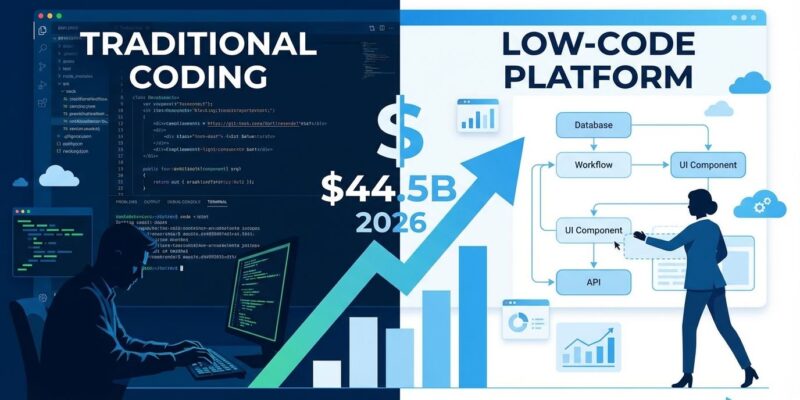
Gartner forecasts the low-code development market will hit $44.5 billion by 2026, with 75% of new applications built using low-code platforms—nearly double the 40% in 2021. The driver? A brutal DevOps talent shortage creating a 115,000-person gap between demand and supply, with roles taking 89 days to fill. Companies can’t wait for developers they can’t hire, so they’re turning to platforms that let citizen developers build apps without code.
The Talent Crisis Nobody Talks About
Here’s the uncomfortable truth behind Gartner’s bullish forecast: Universities produce 65,000 CS graduates annually while the market demands 180,000 AI-capable engineers. That’s a 115,000-person shortfall, and it’s getting worse. DevOps roles now take an average of 89 days to fill—nearly three months of projects stalled, deadlines missed, and managers desperate for anyone who can write functional code.
Jason Wong, Distinguished VP Analyst at Gartner, puts it bluntly: “The high cost of tech talent and a growing hybrid or borderless workforce will contribute to low-code technology adoption.” Translation: Companies can’t find developers, can’t afford to wait three months to fill roles, and can’t justify premium salaries for basic CRUD apps. Low-code isn’t a strategic choice—it’s a pressure release valve.
The 2026 shortage is 40% worse than 2025. Senior engineers are retiring, taking 18% of experienced developers out of the workforce. H-1B visa restrictions cut the talent pool by another 15%. Meanwhile, AI demand requires 3X more ML engineers than currently exist. The math doesn’t work, so companies are changing the equation: instead of hiring developers, they’re empowering business users to build apps themselves.
Citizen Developers Take Over
By 2026, developers outside formal IT departments will account for 80% of low-code users, up from 60% in 2021. This isn’t IT adopting better tools—this is business users bypassing IT entirely. Marketing builds their own analytics dashboards. HR creates employee onboarding flows. Operations deploys inventory tracking systems. All without a software engineer in sight.
Gartner predicts that by 2029, low-code will power 80% of mission-critical applications, up from just 15% in 2024. Read that again: The majority of enterprise software will be built by people who don’t write code professionally. The question isn’t whether this shift is happening—it’s who ends up in control of your company’s technology stack.
This creates a strange paradox. Companies are building more software than ever, but professional developers are writing less of it. The 75% low-code adoption rate means three out of four new apps won’t see a traditional development environment. For developers watching citizen devs drag-and-drop their way to production, it feels like automation coming for their jobs. But that’s the wrong framing.
Developers Aren’t Being Replaced, They’re Being Elevated
Low-code won’t replace developers, but developers who can use low-code will replace those who can’t. The role is evolving from “build CRUD apps” to “architect systems, ensure security, manage integrations.” Someone still needs to think about scalability, data integrity, user experience, and long-term maintenance. Low-code tools don’t remove complexity—they hide it. And hidden complexity always resurfaces.
The market recognizes this shift. Certified low-code specialists in platforms like MuleSoft and Dell Boomi earn up to 40% more than traditional developers, according to Glassdoor data. These aren’t “no-code weekend warriors”—they’re technical professionals who understand both the business logic layer and the underlying architecture. They know when to use the platform and when to write custom code.
Hybrid development is the future: low-code for rapid prototyping and standard workflows, custom code for complex business logic and performance-critical systems. Instead of spending hours building basic admin panels, developers focus on optimization, architecture, and solving problems that platforms can’t touch. It’s a better use of scarce engineering talent, assuming you’re willing to cede control of simpler applications to business users.
The Hidden Costs You Won’t See in Gartner’s Slides
Vendor lock-in is the elephant in the low-code room. Most platforms don’t offer access to source code, making migration nearly impossible. You’re not building software—you’re renting development capability. Proprietary dependencies create barriers that make switching platforms require rebuilding apps from scratch, retraining teams, and eating significant switching costs.
The more you invest in a low-code platform, the harder it becomes to leave. When the vendor raises prices, you pay. When your requirements outgrow the platform’s capabilities, you’re stuck. When technology evolves and the platform doesn’t, your apps degrade into technical debt. Fast development today becomes maintenance nightmares tomorrow.
Technical debt cuts both ways with low-code. These platforms can reduce overhead by automating updates and managing infrastructure. But they can also create debt when business users build apps without documentation, proper architecture, or understanding of long-term maintenance needs. Adding features beyond platform support often requires rewriting the entire system instead of “just adding a bit of code.”
What Works, What Doesn’t
Low-code excels at the 80% of enterprise apps that are “glue and forms”: CRUD applications, internal tools, employee onboarding workflows, customer portals, admin dashboards. These are solved problems with standard patterns. There’s no competitive advantage in custom-building your HR leave request system.
But highly customized solutions, performance-critical systems, and novel applications? Low-code struggles. Unique architectures don’t fit predefined components. Real-time processing requires hand-tuned code. Complex algorithms need developers who understand computer science fundamentals, not drag-and-drop interfaces.
The divide is clear: standard business logic belongs on platforms, complex engineering stays in IDEs. The skill is knowing which bucket your project falls into and being honest about the trade-offs.
How Developers Should Respond
First, learn low-code. Not because it’s the future of all development, but because understanding what these platforms can and can’t do makes you more valuable. You become the person who knows when to use Power Apps for a quick internal tool and when to spin up a custom Node.js API.
Second, focus on what low-code can’t do: architecture, security, performance optimization, complex integrations, and systems thinking. These skills become more valuable as simpler work migrates to platforms. The “I only write real code” stance is career limiting. The market rewards versatility.
Third, get certified. Low-code platform expertise commands premium salaries because it’s a hybrid skill—part business analysis, part technical implementation. Companies need people who can bridge the gap between citizen developers building apps and IT teams managing infrastructure.
The talent shortage isn’t going away. The low-code market will hit $44.5 billion because the alternative—waiting three months to hire developers for every new project—is worse. Professional developers survive this transition by adapting their role, not defending territory. The work is changing. The question is whether you change with it.