 By ByteBot
Frontend development in 2026 looks radically different than it did two years ago. AI copilots are no longer experimental—90% of Fortune 100 companies use GitHub Copilot. Low-code platforms aren’t just for “citizen developers”—they’re building 75% of new enterprise applications. The transformation everyone feared (or hoped for) is already here.
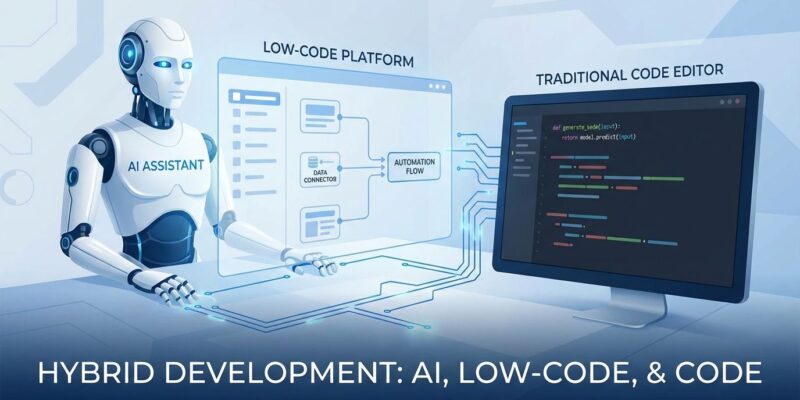
Developers aren’t writing every line of code anymore. They’re orchestrating systems—integrating AI suggestions, validating low-code components, enforcing design patterns, ensuring security. This isn’t about “AI replacing developers.” It’s about a hybrid human + AI + low-code workflow becoming the new baseline.
But developers are ignoring it. Some cling to “pure code” as if typing every character is a badge of honor. Others blindly copy-paste AI output without understanding it. Both camps are getting left behind.
The Numbers Don’t Lie—Hybrid is Already Here
This isn’t a future trend. It’s current reality.
GitHub Copilot reached 15 million users by early 2025—a 4x increase in one year. Ninety percent of Fortune 100 companies adopted it. Among developers who try it, 80% successfully integrate it into their workflow, with 67% using it at least five days per week.
Meanwhile, the low-code market hit $44.5 billion in 2026, growing 19% annually according to Gartner. Seventy-five percent of new applications this year are built with low-code platforms, up from less than 25% in 2020. Eighty-seven percent of enterprise developers already use low-code for some work.
If you’re still debating whether to adopt hybrid workflows, you’re already behind. The question isn’t “Should I?” It’s “How do I do it strategically?”
Real Companies, Real Results—Not Just Hype
Ricoh achieved a 253% ROI in seven months by replacing legacy systems with a low-code platform. Schneider Electric launched 60 apps in 20 months, with most delivered in just 10 weeks. The U.S. Air Force saved $83 million by consolidating over 100 legacy systems through low-code in nine months.
An insurance company reduced claims processing app development from months to weeks. A manufacturing firm deployed 15 operational applications in three months with minimal IT resources. These aren’t startups experimenting—they’re Fortune 500 companies and government agencies betting their operations on hybrid development.
And winning.
The Dark Side—Legit Concerns You Can’t Ignore
However, the skeptics aren’t wrong. Hybrid development introduces genuine risks.
Skill erosion is real. Microsoft and CMU research found that increased AI tool usage directly reduces critical thinking skills. A July 2025 study by the nonprofit METR revealed that while developers felt 20% faster with AI, objective tests showed they were actually 19% slower. GitClear data shows developers producing 10% more code since 2022—but with sharp declines in code quality.
Vendor lock-in is dangerous. Most low-code platforms use proprietary technologies with no source code access, making migration nearly impossible once you’re committed. Gartner warns that by 2026, 80% of low-code users will be outside formal IT departments, creating cost spiral risks. You must accept the vendor’s security procedures even if they’re inadequate.
Moreover, the productivity paradox persists. Early studies from AI vendors claimed 20-55% speed gains. Independent research tells a different story. Stack Overflow reports that trust in AI tools is falling for the first time, even as 65% of developers use them weekly.
Blind adoption is as risky as stubborn resistance.
The Stance—What Developers Need to Do Right Now
The future belongs to “orchestrators,” not code purists or button-clickers.
First, accept the baseline shift. Hybrid workflows aren’t optional anymore. Developers who master AI, low-code, and traditional coding will outpace those who don’t. Furthermore, stop debating “AI versus real coding.” Start learning strategic integration.
Second, evolve your skills. The developer role is shifting from “code writer” to “system orchestrator.” Critical skills now include AI output validation (checking correctness, security, performance), low-code component integration, prompt engineering for code generation, architecture and system design—and traditional fundamentals for when AI fails.
Third, stay intentionally sharp. Developer Addy Osmani advises: “Periodically code without AI to keep raw skills sharp.” Therefore, use AI for boilerplate. Handle complex logic yourself. Validate everything. Understand what the tools generate instead of blindly copy-pasting.
Fourth, choose tools strategically. Avoid vendor lock-in by preferring open-source or exportable platforms. Additionally, prioritize security by auditing AI suggestions and vetting low-code platforms. Start hybrid for speed, but maintain traditional skills for depth.
This isn’t about picking a side. It’s about strategic integration. The developers thriving in 2026 aren’t AI zealots or low-code evangelists. They’re pragmatists who use the right tool for each job.
Adapt or Get Left Behind
The market has decided. By 2029, 80% of mission-critical applications will be low-code-powered. Seventy-five percent of new apps in 2026 already use low-code. Ninety percent of Fortune 100 companies are on GitHub Copilot. Consequently, the developer role is fundamentally changing from “maker” to “curator.”
Resisters will be viewed as outdated—like developers who refused to learn Git. Blind adopters will build fragile, insecure systems they don’t understand. Strategic adopters will leverage all tools, maintain fundamentals, and thrive.
The hybrid model isn’t a threat to developers—it’s an opportunity for those smart enough to adapt. But adaptation means more than installing Copilot or clicking low-code buttons. It means mastering orchestration, validation, and integration while keeping traditional skills sharp.
The developers who figure this out will build better software faster. The rest will fade into irrelevance.