 By ByteBot
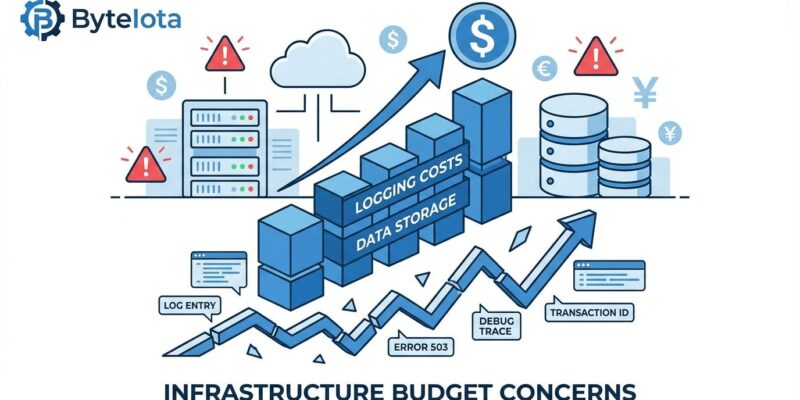
Logging infrastructure is consuming 15-20% of infrastructure budgets with logs alone accounting for 50% of observability spending, according to Gartner research. Organizations routinely waste over $140,000 annually on unoptimized logging strategies—storing debug logs in expensive hot storage, indexing high-cardinality fields that crash platforms, and drowning developers in noise instead of signal. Yet despite this massive spending, 73% of organizations still lack full-stack observability. The problem isn’t logging itself—it’s that most teams treat all logs equally, inflating costs without improving debugging.
The Real Cost: Storage + Compute + Developer Time + Morale
Most teams fixate on storage bills while missing the real cost drivers. Gartner reports that 44% of organizations now spend over $1 million annually on observability, up from 36% just last year. Harness documented a real-world case where optimizing cloud logging saved over $140,000 per year. However, infrastructure costs are just the visible tip of the iceberg.
Developer productivity loss dwarfs storage expenses. Coralogix analysis reveals developers spend 25-50% of their time debugging—roughly 1,500 hours annually per engineer. In the US alone, $113 billion per year goes toward identifying and fixing defects. When your observability infrastructure generates “300-400 megabytes per hour” of logs from a single service (actual developer complaint from a recent Hacker News discussion), finding actionable information becomes harder, not easier.
Moreover, the morale cost rarely appears in budget spreadsheets. Developers describe wading through unhelpful logs as “soul-destroying,” and poor logging UX drives retention issues. When good engineers quit because debugging infrastructure frustrates them daily, the real cost exceeds any line item for Datadog or Splunk.
The “3 Cs” Problem: Context, Correlation, Cloud Complexity
Technical challenges in log management group under what industry analysts call the “3 Cs”: Context, Correlation, and Cloud complexity. Logs frequently lack crucial metadata—transaction IDs, user IDs, service names—making it impossible to trace requests across microservices. As one developer put it, “user_id vs userID vs user.id across services” creates query nightmares when different teams use inconsistent field naming.
Correlation failures compound context problems. Distributed systems disagree on precise time, making exact event ordering across components mathematically impossible to reconstruct. When you’re debugging a race condition that manifests once every 10,000 requests, imprecise timestamps turn investigation into guesswork.
High cardinality turns these theoretical problems into platform-killing failures. Using request IDs, session IDs, or timestamps as indexed labels creates millions of unique time series. Query performance degrades 10-100x. Platforms crash from memory exhaustion. Meanwhile, cloud complexity—diverse log formats, dynamic infrastructure, constantly changing service topologies—frustrates integration attempts. These aren’t edge cases. They’re the default state for microservices architectures.
Related: Cloud Waste Crisis: $44.5B Wasted on Unused Infrastructure in 2025
Treating All Logs Equally Is the $140K Mistake
Here’s the expensive assumption most teams make: storing debug logs in the same hot tier as production errors. Azure Blob Hot tier costs $370,000 for one petabyte over three years. Azure Blob Cool tier costs $200,000 for the same data—a 46% savings. Alternative cloud providers without egress fees deliver 60-80% savings versus AWS or Azure.
Strategic tiered storage based on access patterns delivers immediate ROI. Active debugging needs fast queries on recent data (last 7 days). Compliance needs long retention but tolerates slower retrieval (31-90 days or longer). Yet teams pay premium hot storage prices for months-old debug logs they’ll never query again. The math doesn’t justify it.
Sampling strategies cut log volume 70-80% without losing critical signals. Netflix ingests 5 petabytes daily by sampling intelligently: 100% coverage for errors and slow requests, 10% sampling for routine 200 OK responses, 1% for verbose debug output. This isn’t reckless data loss—it’s strategic signal extraction. If you’re logging every successful health check at full verbosity, you’re paying to store noise.
Open Source vs SaaS: 50-80% Savings with Trade-offs
Enterprise SaaS tools charge $2,500-$3,500 monthly for ingesting 1TB of logs. Datadog and New Relic customers report costs scaling unpredictably as workloads grow, with vendor lock-in via proprietary query languages making migration painful. One common complaint: “Observability bill exceeded infrastructure bill when using enterprise tools without aggressive sampling.”
Open-source alternatives deliver 50-80% cost savings. SigNoz costs approximately $800 per month total (including infrastructure) for the same 1TB, using ClickHouse backend for 10-20x compression that achieves 80% storage cost reduction versus Elasticsearch. Grafana + Loki offers label-based indexing that reduces costs further, though high-cardinality support remains limited.
However, open-source isn’t “free.” Self-hosting requires ops expertise, ongoing maintenance, and infrastructure management overhead. The break-even point sits around $50,000 annual observability spend. Below that threshold, managed SaaS complexity wins versus DIY operational burden. Above that threshold, open-source savings justify the engineering investment. Choose based on your scale and team capabilities, not ideology.
Strategic Solutions: Structured Logging, Sampling, Tiered Storage
Three tactical changes deliver immediate ROI. First, implement structured JSON logging with common schemas like Elastic Common Schema (ECS). Standardizing field names across services eliminates translation hell and enables cross-service queries. Consistent timestamp formats, log levels, and metadata structure turn logs from text blobs into queryable data.
{
  "timestamp": "2025-12-21T17:00:00Z",
  "level": "ERROR",
  "service": "api-gateway",
  "transaction_id": "abc-123",
  "user_id": "user-456",
  "endpoint": "/api/v1/orders",
  "duration_ms": 523,
  "error": "database connection timeout"
}
Second, implement sampling strategies aligned to business value. High-traffic applications log 1-10% of routine operations while maintaining 100% error coverage. This reduces volume 70-80% while retaining debugging capability. Errors matter. The ten-thousandth successful health check doesn’t.
Third, set retention policies aligned to actual business needs. Debug logs serve debugging (7 days), application logs support operations (30 days), audit logs meet compliance (365+ days). Default retention of “keep forever” wastes money on data that serves no purpose. Google Cloud’s cost management guide explicitly recommends avoiding storing logs longer than needed—it’s table-stakes optimization most teams skip.
Key Takeaways
- Logging consumes 15-20% of infrastructure budgets (Gartner), with logs accounting for 50% of observability spending, yet 73% of organizations lack full-stack observability despite this investment.
- Real costs extend beyond storage: developer productivity loss (25-50% time debugging = 1,500 hours/year) and morale impact (“soul-destroying” UX drives retention issues) often exceed infrastructure bills.
- The “3 Cs” problem—Context, Correlation, Cloud complexity—compounds with high cardinality, degrading query performance 10-100x and causing platform crashes when request IDs or session IDs are indexed as labels.
- Treating all logs equally is the $140K mistake: tiered storage (hot/warm/cold/archive) delivers 60-80% savings, sampling cuts volume 70-80% while retaining 100% error coverage, and strategic retention policies (debug 7d, ops 30d, audit 365d+) eliminate waste.
- Open-source alternatives (SigNoz, Loki) cost $800/month vs $3,000+ for enterprise SaaS (50-80% savings), but require ops expertise with break-even around $50K annual observability spend—choose based on scale, not ideology.
The logging cost crisis isn’t technical—it’s strategic. Teams that audit costs, implement tiered storage, fix high cardinality, and adopt structured logging with sampling turn observability from a budget drain into a competitive advantage. Start by measuring what you’re actually spending, including developer time. The numbers justify action.