
 By ByteBot
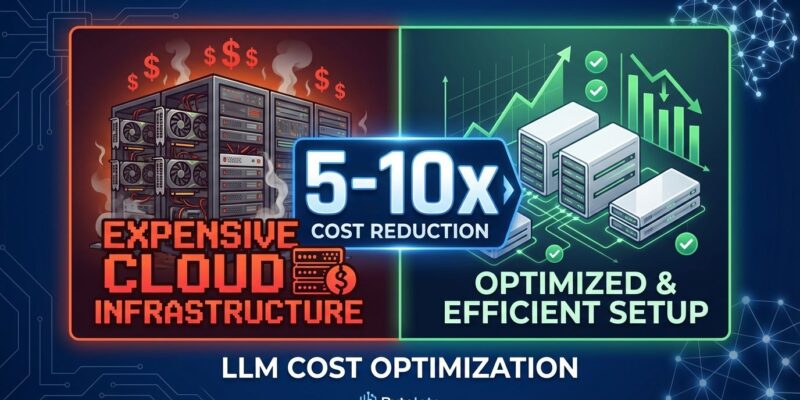
Without benchmarking LLMs, you’re likely overpaying 5-10x on inference costs. This isn’t a theoretical problem. Pricing for the same model performance varies 10x across providers, and teams deploying AI applications at scale are bleeding money on wrong provider choices and poor configurations. As AI workloads become the fastest-growing and most expensive cloud category, with spending projected to exceed $840 billion by 2026, the benchmarking gap has shifted from a technical nice-to-have to a business imperative. The culprit? Optimization without measurement is just guesswork.
The Costly Assumptions Killing Your Budget
Teams overpay because they operate on false assumptions. “Latest model equals best value” and “biggest model equals best performance” are myths that cost real money. Reality check: DeepSeek costs 50x less per token than ChatGPT o1 while maintaining comparable quality. Yet organizations continue defaulting to brand-name models without questioning the price tag.
The numbers are brutal. GPU instances for AI workloads cost 5-10x standard compute, yet organizations waste 32% of their cloud budget on idle or underutilized resources. Moreover, pricing for the same model differs 10x across hosting providers—even for identical open-source models. DeepSeek charges $0.27 per million input tokens versus GPT-4 Turbo’s $10. That’s a 50x difference for comparable performance.
Hidden taxes compound the problem. Verbose prompts create exponential costs at scale when GPT-4o charges $0.15 per 1,000 input tokens. Every “Could you possibly provide me with a detailed explanation…” instead of “Explain…” multiplies expenses across thousands of daily API calls. Furthermore, poor batching strategy wastes GPU utilization. Wrong model selection for your use case ignores critical accuracy-versus-cost trade-offs. The default behavior—using OpenAI without comparing alternatives—leaves massive savings on the table.
What to Benchmark: The Measurement Framework
Optimization without measurement is guesswork. To avoid the 5-10x overpayment trap, teams must benchmark four dimensions: throughput (tokens per second), latency (time to first token), cost per token, and quality (model accuracy). The key is establishing a latency-throughput trade-off curve that identifies the optimal deployment configuration balancing speed, cost, and accuracy.
NVIDIA’s GenAI-Perf framework provides the foundation. It measures time to first token (TTFT), intertoken latency (ITL), tokens per second (TPS), and requests per second (RPS). This isn’t academic. It’s the required first step for total cost of ownership estimation. “To estimate TCO for LLM applications, developers must first complete performance benchmarking to measure throughput and latency,” NVIDIA’s guidance states. These metrics help size deployments: how many GPUs do you actually need?
CEBench’s open-source toolkit takes multi-objective benchmarking further. It evaluates quality, latency, memory, and cost simultaneously, then provides a Pareto front showing optimal configurations. The results can be striking. For instance, Llama3’s 8B model achieves 95.8% of the 70B model’s performance while using only 11.75% of the memory. If slight performance degradation is acceptable, the 8B model saves massive costs versus the 70B.
Trade-off curves reveal there’s no one-size-fits-all solution. A real-time chatbot needs low latency. Batch document processing can tolerate higher latency for lower costs. Consequently, the framework helps teams make informed decisions rather than defaulting to “use the biggest model.”
Proven Optimization Strategies with Real ROI
Benchmarking reveals optimization opportunities that deliver 40-60% cost reduction without sacrificing quality. The big three strategies have documented ROI across production deployments.
Quantization reduces model size by up to 75% by converting weights from high precision (FP16/FP32) to lower precision formats (INT4, FP8). Memory bandwidth is the bottleneck for LLM inference, so smaller weights mean faster computation and lower costs. CEBench’s Llama3 comparison proves the point: the 8B model delivers 95.8% of 70B performance with 11.75% of memory requirements.
Continuous batching improves throughput by 2-4x through per-iteration scheduling instead of static batching. New sequences insert as others complete, yielding 40% cost reduction through better GPU utilization. Indeed, vLLM users report 23x throughput increases. Combined with quantization, these strategies consistently deliver 40-60% cost reduction across different model sizes and use cases.
Prompt engineering cuts token usage by 15-30% without quality loss. Remove filler words: “very,” “quite,” “actually,” “basically.” Replace long phrases with short equivalents: “in order to” becomes “to.” The verbose “Could you possibly provide me with a detailed explanation…” shrinks to “Explain…” Combined with context pruning, teams achieve 40-50% token savings. At scale, this translates directly to infrastructure budget.
Why 2026 Makes LLM Cost Optimization Critical
Three trends make LLM cost benchmarking a business imperative in 2026. First, AI spending explodes. Cloud spending projected to exceed $840 billion by 2026, with AI workloads as the fastest-growing and most expensive category. Organizations tracking AI/ML costs jumped from 31% in 2024 to 63% in 2026.
Second, FinOps automation becomes standard. 75% of enterprises adopt FinOps automation by 2026, shifting from reactive cost control to autonomous optimization. AI agents managing AI costs—meta, but inevitable. Teams measure unit economics: cost per user, per transaction, per feature, not just total spend. Consequently, LLM costs transition from a dev team problem to a FinOps business imperative.
Third, inference-time scaling complicates the equation. 2026 sees growing focus on spending more compute during inference (OpenAI o1, DeepSeek R1’s longer reasoning chains) rather than training better models. The trade-off between latency, cost, and accuracy requires benchmarking to answer: is it cheaper to use a better model or scale inference on a cheaper model?
Start with Measurement, Not Optimization
Use available tools to establish baseline costs and identify the 10x gaps. GenAI-Perf and CEBench provide frameworks for systematic measurement. Comparison platforms like LLM-stats.com and ArtificialAnalysis.ai enable side-by-side provider evaluation. Test alternatives: DeepSeek, smaller models, open-source options. Implement proven optimizations: quantization, continuous batching, prompt engineering. Then measure again to establish ROI from optimization efforts.
The 2026 shift is clear. From “biggest model” to “cost-effective model.” From guesswork to systematic benchmarking. From dev team problem to FinOps imperative. With open-source alternatives like DeepSeek proving 50x cost reduction possible, teams must benchmark to justify premium pricing for proprietary models. The 5-10x overpayment isn’t inevitable. It’s a choice to skip measurement. Choose differently.


