
 By ByteBot
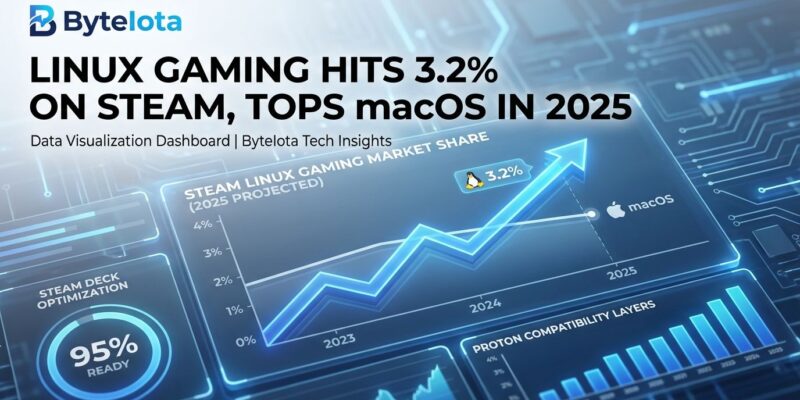
Linux gaming on Steam hit 3.2% market share in November 2025—a record high that surpasses macOS for the first time in Steam’s history. Over 30 million active gamers now run Linux, with Valve’s Proton compatibility layer supporting 96% of the top 500 Steam titles. This isn’t another “Year of Linux Desktop” meme. Three forces converged: Proton maturity (DirectX 12 support via VKD3D-Proton 3.0 released November 17), Windows 10’s end-of-life on October 14, 2025, and a hardware price crisis that saw DDR5 RAM double from $90 to $310 for 32GB kits in three months.
Three Forces Converge: Proton, Windows 10 EOL, RAM Crisis
After 20 years of “Year of Linux Desktop” predictions, skepticism is warranted. But 2026 is different. Proton achieving 96% compatibility means gaming “just works” for most titles. VKD3D-Proton 3.0, released November 17, 2025, added DirectX 12, AMD FSR4, and Anti-Lag support—closing the gap between Windows and Linux gaming performance.
Windows 10 reaching end-of-life on October 14, 2025 forced migration decisions. Users facing Windows 11’s TPM 2.0 and Secure Boot requirements had three options: buy new hardware, pay for Extended Security Updates, or switch to Linux. Zorin OS 18 hit six-figure downloads within days of the deadline—measurable proof that users chose Linux over costly upgrades.
The hardware economics sealed the deal. DDR5-4800 32GB kits went from $90 in May 2025 to $310 in December 2025—a 244% increase driven by AI chip production shifting memory capacity to HBM. Tom’s Hardware warns shortages will last until Q4 2027. Linux runs 10-15% faster on the same hardware Windows would choke on, turning migration into a $500+ cost-saving decision. Users aren’t being pulled by ideology anymore—they’re being pushed by economics.
AMD Driver Parity Eliminates the Performance Gap
AMD’s open-source amdgpu driver now matches or exceeds Windows performance on most titles. Bazzite gaming tests show AMD’s RX 9070 XT hitting 105.2 fps on Linux versus 98.4 fps on Windows 11—a +6.9% advantage with steadier frame-times. Meanwhile, NVIDIA’s RTX 4070 showed inconsistent 82-115 fps range with frame-pacing issues. The Gamers Nexus summary: “AMD consistent, NVIDIA varied.”
The difference is architectural. AMD’s open-source driver integrates with the Linux kernel and updates automatically via package managers. No manual downloads, no kernel module rebuilds after system updates. Bazzite, a Fedora-based gaming distro, auto-installs Mesa drivers on first boot. Plug in an AMD GPU and it works—zero configuration required. NVIDIA’s proprietary driver still requires manual setup and breaks on kernel updates.
For the first time, Linux delivers better gaming performance than Windows on mainstream hardware. That’s not a compromise—that’s an advantage.
The Reality Check: Anti-Cheat Still Blocks Major Titles
Honesty matters. Despite EasyAntiCheat and BattleEye officially supporting Proton since September 2021, anti-cheat remains the critical blocker. Support is opt-in, and most competitive AAA titles don’t enable it. Apex Legends, Destiny 2, Valorant, and League of Legends all block Linux users despite technical compatibility.
War Thunder enabled BattleEye for Linux in January 2025—one of the rare examples of developer opt-in. GTA VI ships with BattleEye, but Rockstar hasn’t enabled Linux support. Valorant’s kernel-level Vanguard will never work on Linux by design. The 96% top 500 compatibility rate means approximately 20 major titles remain broken, almost exclusively due to anti-cheat.
If you play competitive shooters daily, you still need Windows. Linux gaming is viable for single-player and co-op gamers (80%+ of the market), but claiming it’s “perfect for everyone” is dishonest. Anti-cheat is the elephant in the room, and vendor cooperation is slow.
Valve’s Ecosystem Play: Steam Machine Ships 2026
Valve announced three new Steam hardware devices on November 12, 2025: Steam Machine for living room gaming, Steam Frame VR headset, and a redesigned Steam Controller—all slated for early 2026. Combined with Steam Deck 2 confirmed in development (2027-2028 timeline), Valve is betting its hardware business on Linux.
The Steam Deck proved the model. By February 2025, IDC estimated 3.7-4 million units sold. Linux Journal calls it “doing for Linux gaming what the iPhone did for mobile computing.” The Steam Machine extends that ecosystem to TV gaming, normalizing Linux for users who don’t know—or care—that they’re running SteamOS.
If the 3.2% November 2025 baseline holds and Valve hardware ships on schedule, projections point to 4% market share by mid-2026. Still small, but growing with hardware and economic tailwinds behind it.
Key Takeaways
- The 3.2% milestone is real—first time Linux surpasses macOS on Steam, with 30 million active gamers and 96% top 500 game compatibility. This isn’t hype, it’s data.
- Economics drive adoption now—DDR5 prices doubled while Windows 10 reached EOL. Linux migration saves $500+ in hardware upgrades, making the decision financial instead of ideological.
- AMD GPUs are the clear winner—open-source amdgpu driver delivers +6.9% performance over Windows with zero-touch setup. NVIDIA’s proprietary driver still struggles with consistency.
- Anti-cheat remains the hard blocker—competitive shooters like Apex Legends, Valorant, and Destiny 2 still require Windows. Linux gaming works for 80% of gamers (single-player/co-op), not 100%.
- Cautious optimism is warranted—after 20 years of false starts, this cycle has unique catalysts: external economic pressure, forced migrations, and Valve hardware expansion. The shift is gradual, not overnight, but it’s backed by data for the first time.












[…] Quelle: ByteIota – Linux Gaming überholt macOS […]