 By ByteBot
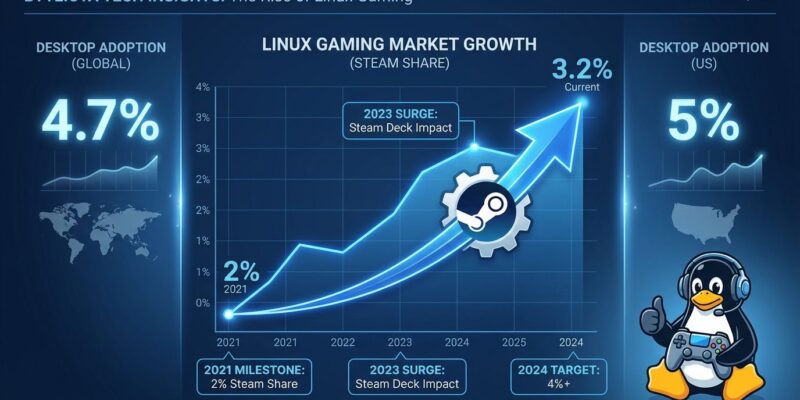
Linux gaming hit 3.19% of Steam users in December 2025, holding steady after November’s all-time high of 3.20% that marked the first time Linux surpassed macOS on the platform. Desktop Linux market share reached 4.7% globally and crossed 5% in the United States, representing a 70% increase from 2.76% in July 2022. This isn’t another “year of Linux desktop” prediction—it’s actual market data showing gaming, not enterprise deployment, is driving mainstream adoption.
Gaming Succeeded Where Enterprise Failed
For 30 years, Linux desktop advocates pushed GNOME and KDE development, targeting enterprise and developer adoption. Red Hat courted Fortune 500 companies. Canonical built Ubuntu for the masses. None of it moved the needle past 2% for two decades. Then Valve released Proton in 2018 and the Steam Deck in 2022, and Linux gaming went from 2% to 3.2% in just three years.
Proton, Valve’s compatibility layer, solved the chicken-egg problem that killed every previous Linux desktop push: no games meant no users, which meant developers wouldn’t port games. Instead of begging developers to create native Linux versions, Valve built a Wine-based DirectX-to-Vulkan translation layer that makes Windows games work on Linux. The result? About 80 of the top 100 Steam games now run on Linux without any developer effort.
The Steam Deck—running Arch Linux-based SteamOS—proved the concept at scale. Steam’s December 2025 hardware survey shows the Steam Deck accounts for 27.18% of Linux users on the platform, with its custom GPU representing 21.4% of Linux gaming GPU share. That’s not hobbyists dual-booting Arch; it’s millions of gamers who don’t even realize they’re running Linux.
Desktop Market Share: 4.7% Global, 5%+ in US
StatCounter Global Stats—tracking via code on 1.5+ million websites—shows Linux desktop market share hit 4.7% globally in 2025. The United States crossed 5% in June 2025 for the first time. India leads major economies at 16.21%. These aren’t impressive percentages by Windows standards, but the growth curve tells the real story.
Linux took 20 years to reach 1% (2011), another 10 years to hit 2% (2021), then just 2.2 years to reach 3%. The jump from 3% to 4% took only 0.7 years. That’s exponential acceleration, not linear growth. Network effects are kicking in: more users means more developer attention, which means better tools, which attracts more users.
If the curve holds, 6% by late 2026 is plausible. That’s not “year of the Linux desktop” mainstream replacement for Windows—but it’s the first time growth predictions have exponential momentum backing them instead of just hope.
Windows 10 EOL and Hardware Requirements Force Choices
Microsoft handed Linux its biggest opportunity in decades by making Windows 11 incompatible with older hardware. TPM 2.0, UEFI Secure Boot, and a whitelist of supported CPUs exclude millions of still-functional PCs. Windows 10’s mainstream support ended October 14, 2025, leaving users with three options: buy new hardware, pay for Extended Security Updates, or switch operating systems.
Zorin OS 18, released to coincide with Windows 10 EOL, saw six-figure downloads with the majority coming from Windows systems. Bazzite, a Fedora-based SteamOS alternative for gaming PCs and non-Deck handhelds, reports over 150,000 monthly ISO downloads. Germany’s Schleswig-Holstein is migrating 30,000 government PCs to Linux by 2026. Denmark is planning a national-level open-source transition.
This isn’t Linux improving—it’s Microsoft creating a forcing function. Windows 11’s hardware requirements are a self-inflicted wound that’s pushing users toward Linux alternatives. The migration wave is external pressure, not internal Linux advocacy finally working.
Is 2026 Really the Year? Data Says…Complicated
The “year of Linux desktop” has been a running joke since before the Star Wars prequels. Every year, some pundit declares this is finally the one, and every year, Linux desktop share stays below 3%. But 2026’s predictions come with receipts: 5%+ US market share, government migrations, and gaming viability through Proton.
PC Gamer ran a late 2025 editorial headlined “I’m brave enough to say it: Linux is good now.” HowToGeek published “6 reasons 2026 could finally be the year of desktop Linux.” Meanwhile, skeptics like Baud Attitude counter with “2026 still isn’t going to be the Year of the Linux Desktop, but…maybe it will be my year.” The community is divided between cautious optimism (backed by data) and meme fatigue (backed by 30 years of false starts).
Here’s the honest take: 5% market share is real, government migrations are happening, and gaming is genuinely viable via Proton. But anti-cheat software still blocks competitive games like Valorant and Destiny 2. Adobe Creative Suite doesn’t run natively. Windows 11’s Extended Security Updates will slow the migration wave. Linux won’t replace Windows for most users in 2026—but it’s the first time “year of the desktop” predictions have concrete milestones instead of aspirational hope.
The real story isn’t universal adoption. It’s that gaming succeeded where enterprise advocacy failed. Proton’s three-year track record proves compatibility layers beat native development for driving adoption. Microsoft’s hardware requirements created the migration window that decades of GNOME polish couldn’t. And 5% US market share means Linux is viable for specific niches—gamers, developers, privacy-focused users, and governments—even if it’s not ready for grandma’s Facebook machine.
Key Takeaways
- Gaming drove Linux adoption where 30 years of enterprise advocacy couldn’t. Valve’s Proton compatibility layer (DirectX-to-Vulkan translation) solved the chicken-egg problem by making Windows games work on Linux instead of waiting for native ports. The Steam Deck proved the concept at millions-of-users scale.
- Linux desktop market share hit 4.7% globally and 5%+ in the US, with exponential growth acceleration. The jump from 3% to 4% took 0.7 years compared to 10 years for 1% to 2%, showing network effects are kicking in. StatCounter data backs predictions of 6% by late 2026.
- Windows 10 EOL (October 2025) and Windows 11’s strict hardware requirements created a forced migration window. Microsoft’s TPM 2.0 and UEFI mandates exclude millions of PCs, pushing users toward Linux alternatives. This is external pressure, not Linux improving on its own.
- “Year of Linux desktop” remains aspirational, but 2026 has actual milestones. Government migrations (Germany’s 30,000 PCs), gaming viability through Proton, and 5% US market share make this the first prediction backed by data instead of hope. Linux is viable for specific niches (gaming, development, privacy-focused) even if not mainstream.