 By ByteBot
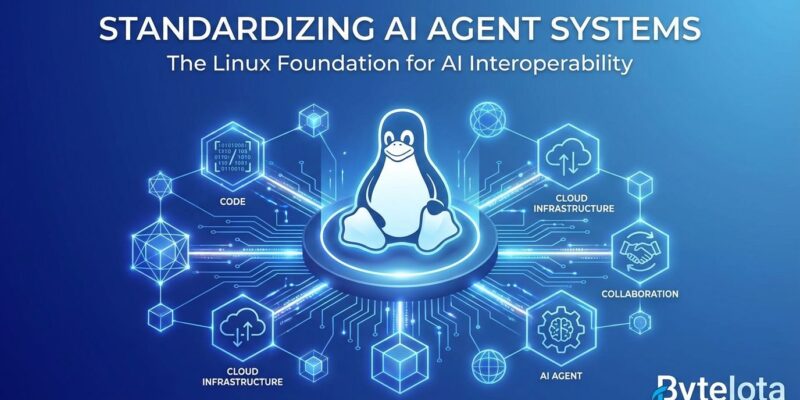
On December 9, 2025, the Linux Foundation announced the formation of the Agentic AI Foundation with founding contributions from Anthropic’s Model Context Protocol, Block’s goose agent framework, and OpenAI’s AGENTS.md specification. Platinum members include Amazon Web Services, Anthropic, Block, Bloomberg, Cloudflare, Google, Microsoft, and OpenAI. Every major AI company that normally competes fiercely just agreed to collaborate on standardizing the agent ecosystem.
The Problem Every Developer Hits Immediately
Building with AI agents means solving the M×N integration problem: connect M AI models to N tools and data sources, and you face exponential complexity. ChatGPT needs a custom connector for GitHub. Claude needs a different one for the same GitHub API. Gemini needs yet another. Every integration requires custom code, endless one-off adapters, unpredictable behavior across codebases, and developer time wasted maintaining connectors instead of building features.
The Agentic AI Foundation transforms this M×N nightmare into an M+N solution. Tool creators build N MCP servers—one per system. Application developers build M MCP clients—one per AI application. Universal standards eliminate custom connector hell.
Three Projects with Proven Adoption
Model Context Protocol
Anthropic donated the Model Context Protocol, a universal protocol connecting AI models to tools, data, and applications. Think of it like HTTP for AI agents—standardized communication that just works.
The adoption numbers aren’t projections. MCP already has 10,000+ active servers built by the community, 97 million+ monthly SDK downloads, and integration into ChatGPT, Cursor, Gemini, Microsoft Copilot, and Visual Studio Code. Enterprise infrastructure from AWS, Cloudflare, Google Cloud, and Microsoft Azure supports it. Anthropic maintains a directory of 75+ connectors powering Claude.
goose Framework
Block contributed goose, an open source, local-first AI agent framework that builds entire projects, writes and executes code, and debugs failures autonomously. It uses MCP for tool integration with Databricks, Snowflake, GitHub, Jira, Slack, and Google Drive.
At Block, non-technical staff query their data warehouse via natural language. goose generates SQL queries, executes them through an MCP connector to Databricks, and returns results. Custom MCP servers teach goose how to interact with internal tools like their Beacon machine learning pipeline. The framework is Apache 2.0 licensed—free for commercial use.
AGENTS.md Specification
OpenAI donated AGENTS.md, a simple Markdown file format that serves as a README for AI agents. It contains build steps, conventions, and project-specific context that’s too detailed for standard README files but critical for reliable agent operation.
60,000+ open-source repositories already adopted AGENTS.md before the foundation even launched. It works across Cursor, GitHub Copilot, Devin, Jules, VS Code, and 20+ other tools. Instead of maintaining separate proprietary formats like .cursorrules for Cursor and .github/copilot-instructions.md for GitHub Copilot, developers write one AGENTS.md file that works everywhere.
Why Neutral Governance Matters
The Linux Foundation brings decades of experience stewarding critical open source infrastructure: Linux Kernel, Kubernetes, Node.js, and PyTorch. No single company controls MCP, goose, or AGENTS.md under this model. Community-driven development serves developers, not corporate interests.
Developers won’t invest time in standards controlled by one vendor. The risk of rug-pull is too high. Neutral governance ensures long-term sustainability. When all major AI companies back a standard, fragmentation risk drops significantly.
It’s the same pattern as web development. Companies compete on browsers—Chrome versus Firefox versus Safari. They collaborate on HTML, CSS, and JavaScript specs. Everyone benefits when the underlying infrastructure is standardized and neutral.
The Skeptical Take
Tech history is littered with failed “universal standards.” SOAP promised to unify web services. CORBA was supposed to solve distributed computing. XKCD comic 927 immortalized the pattern: “Standards proliferate because everyone creates ‘the one standard to unify them all.'”
Will the Agentic AI Foundation actually reduce fragmentation or just add another layer?
The difference this time: adoption already proven before the foundation launched. MCP has 10,000+ servers. AGENTS.md is in 60,000+ repositories. These aren’t vaporware announcements from companies promising future support. Developers already solved their own integration problems using these tools. The foundation provides neutral governance for standards that work in production today.
What Developers Should Do
Add an AGENTS.md file to your repositories. It works with Cursor, GitHub Copilot, Devin, Jules, and other tools immediately. Include build steps, test procedures, coding conventions, and context that agents need.
Install MCP SDKs in Python or TypeScript. Browse Anthropic’s directory of 75+ connectors. Build a custom MCP server for proprietary data sources your agents need to access.
Try goose for automating development workflows. It’s open source under Apache 2.0, connects to popular MCP servers out of the box, and handles real tasks like querying databases via natural language.
Why Competitors Collaborated
Anthropic, OpenAI, Google, Microsoft, and Block compete fiercely on AI models. Claude versus GPT versus Gemini is a real battle for market share. They collaborate on infrastructure standards because standardized infrastructure grows the total market.
More AI agent adoption means more demand for everyone’s models. Fragmentation benefits no one. It’s the same logic cloud providers follow: AWS, Azure, and Google Cloud compete on services but collaborate on Kubernetes because a standard container orchestration platform makes all their offerings more valuable.
The Bottom Line
The Agentic AI Foundation might actually solve agent integration hell. Unlike past failed standards attempts, MCP and AGENTS.md have massive adoption before official governance even started. The Linux Foundation prevents vendor lock-in. Every major AI company is backing it.
Developers building with AI agents should pay attention. Standards that reduce connector maintenance, enable predictable behavior across tools, and simplify deployment are worth adopting. Especially when they’re already proven at scale.