 By ByteBot
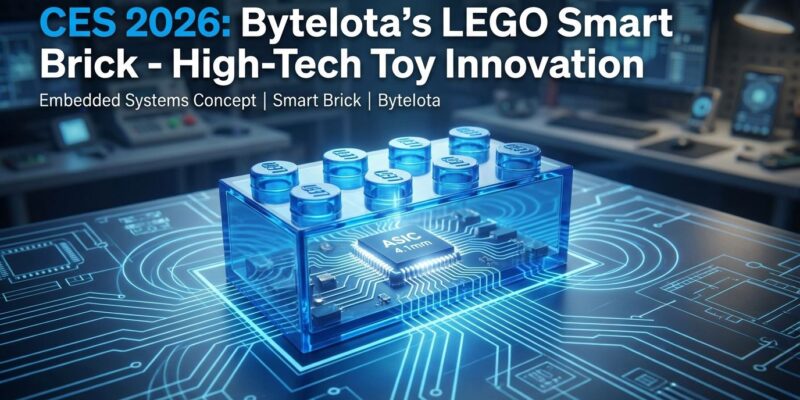
LEGO announced its first-ever CES appearance with the Smart Brick—a standard 2×4 LEGO brick containing a 4.1mm custom ASIC chip, making it the smallest computer showcased at CES 2026. The Smart Brick, launching March 1, 2026, represents LEGO’s entry into smart toys with a differentiated approach: screen-free, offline-first, no data collection. For embedded systems developers, the engineering challenge is remarkable—packing sensors, accelerometers, RGB LEDs, a speaker, wireless charging, and magnetic positioning into a chip smaller than a standard LEGO stud.
Engineering a Computer Inside a LEGO Brick
The 4.1mm custom mixed-signal ASIC is smaller than a LEGO stud’s 4.8mm diameter. LEGO’s Creative Play Lab partnered with Cambridge Consultants for chip design and JABIL for manufacturing. The result: over 20 patented innovations crammed into a chip that contains sensors, accelerometers, light sensing, a sound sensor, RGB LEDs, a miniature speaker with onboard synthesizer, wireless charging, and a radio stack. The speaker is acoustically tuned through internal air spacing to amplify sound within the brick’s enclosure.
The ASIC runs a bespoke “Play Engine” firmware that interprets motion, orientation, and magnetic fields in real-time. This isn’t a general-purpose microcontroller—it’s custom silicon optimized for one task: bringing LEGO creations to life through responsive physical play.
Why ASIC Instead of Microcontroller?
Most IoT products use off-the-shelf microcontrollers. LEGO chose a custom ASIC despite $1-5 million in upfront development costs. The trade-offs make sense at LEGO’s scale. A custom ASIC delivers ultra-low power consumption, optimized size (4.1mm vs typical 5-10mm+ microcontroller packages), and estimated unit costs of $1-3 versus $2-5 for microcontrollers. When you’re shipping millions of units annually, those savings justify the investment.
Microcontrollers offer flexibility—you can reprogram them. ASICs are fixed-function. But LEGO optimized for power efficiency and size, not flexibility. The Play Engine firmware is baked into silicon. For high-volume consumer products where requirements are locked, ASICs outperform microcontrollers on the metrics that matter: power, size, and cost.
Magnetic Positioning: The Novel Technical Bet
The Smart Brick’s Neighbor Position Measurement (NPM) system is the most interesting technical innovation. A precision copper coil assembly emits a low-power magnetic field. When another Smart Brick enters that field, distortion occurs. The system measures the distortion to calculate distance, direction, and orientation between bricks in real-time.
This is a novel alternative to Bluetooth mesh networks for near-field positioning. Magnetic field sensing consumes microwatts versus milliwatts for wireless protocols. The trade-off: limited range. NPM works brick-to-brick (centimeter scale), not room-scale. But for LEGO’s use case—bricks physically touching or nearby—ultra-low-power magnetic sensing is smarter than wireless.
The approach has applications beyond toys. Industrial robotics could use magnetic positioning for swarm robots in warehouses without GPS or Wi-Fi. Medical devices could position implants with ultra-low power consumption. Consumer electronics could detect docking or pairing through magnetic field sensing. LEGO just demonstrated a working implementation at scale.
Solving Smart Toy Privacy With Architecture
The smart toy market is littered with privacy disasters. Mattel’s Hello Barbie was hacked in 2015, exposing children’s conversations. CloudPets leaked 2 million personal recordings from an unsecured database. The FBI warned consumers about cyber security risks in connected toys. The pattern: cloud-connected toys recording audio, storing data on manufacturer servers, and creating attack surfaces.
LEGO solved this with architecture, not privacy policy. The Smart Brick operates entirely offline. No cloud connectivity. No data collection. No microphones recording conversations. No personal data stored. No app requirement means no accounts, passwords, or online profiles. All processing happens on-device through brick-to-brick magnetic communication. Nothing is transmitted externally.
This isn’t just marketing—it’s a fundamentally different security model. Offline-first architecture eliminates entire classes of vulnerabilities. You can’t breach a server that doesn’t exist. You can’t leak data that’s never collected. LEGO’s “screen-free” positioning addresses parent concerns about screen time and privacy simultaneously.
The Creative Play Lab Model
The Smart Brick came from LEGO’s Creative Play Lab, a 250-person team from 30+ countries that grew from 30 people eight years ago. The team includes engineers, futurists, computer scientists, and video game designers with one mission: look 5-10 years ahead to keep LEGO relevant for the next generation.
Tom Donaldson, Vice President of Creative Play Lab, describes the philosophy: “Nurturing ideas that we don’t always know the outcome of, encouraging risk-taking.” The collaboration model combines internal R&D with external experts—Cambridge Consultants provided ASIC design expertise LEGO didn’t have in-house. This is how established brands innovate at scale: dedicated teams, long time horizons, and partnerships that bring specialized capabilities.
Launch and Market Context
The Smart Brick launches March 1, 2026, in select markets with three Star Wars sets priced from $69.99 to $159.99. Pre-orders open January 9. Each set includes a Smart Brick with charger, at least one Smart Minifigure, and Smart tags. LEGO is entering a market dominated by Sphero’s programmable robots, which require app connectivity and screen time. The differentiation is clear: Sphero targets coding education with JavaScript programming. LEGO targets traditional builders with screen-free, intuitive play enhanced by invisible technology.
Whether kids will accept screen-free smart toys in 2026 remains an open question. But LEGO’s bet is that parents want alternatives to app-dependent toys, and the brand’s 90+ year trust gives them credibility that startups lack.
Developer Takeaways
The Smart Brick offers lessons for embedded systems developers. First, custom ASICs make economic sense when production volumes exceed hundreds of thousands of units and size or power constraints matter. Second, offline-first architecture isn’t just about privacy—it’s a security strategy that eliminates attack surfaces. Third, magnetic positioning offers a low-power alternative to wireless for near-field IoT applications. And fourth, novel form factors create novel challenges—acoustically tuning a speaker inside a LEGO brick requires physics, not just software.
LEGO didn’t invent embedded systems or magnetic sensors. They packaged existing technologies into a 4.1mm chip that fits inside a children’s toy and survives being dropped, stepped on, and abused. That’s the engineering achievement worth studying.