 By ByteBot
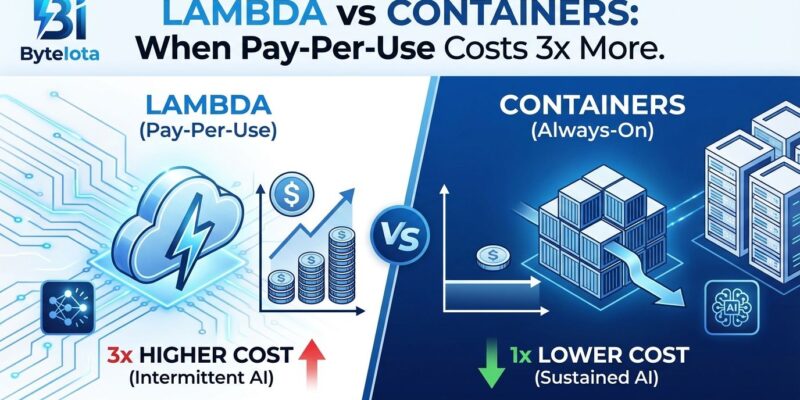
A company migrated 40 Lambda functions to containers and slashed their AWS bill by 73%—from $9,400 to $2,500 per month. Another team saved 90% with a similar move. These January 2026 case studies expose a serverless paradox: pay-per-use can cost significantly more than pay-per-month when workloads hit specific patterns. The break-even point? 50,000 invocations per day. Above that threshold, hidden costs in data transfer, NAT Gateway fees, and CloudWatch logs turn Lambda’s elastic pricing into an expensive trap.
Where Your $9,400 Lambda Bill Really Goes
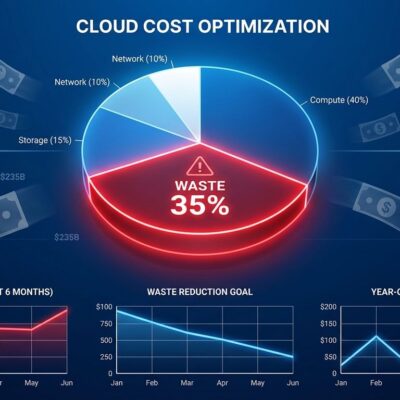
In the 73% cost reduction case, Lambda compute was only $2,100 per month—22% of the bill. The remaining 78% went to silent accumulators: data transfer out hit $3,800/month (40%), CloudWatch logs cost $1,200 (13%), NAT Gateway for VPC Lambdas added $1,100 (12%), and provisioned concurrency took $1,200 (13%).
The workload? Image processing functions downloading 5-20MB images. At $0.09/GB for egress, transfers compounded fast. NAT Gateway runs 24/7 at $0.045/hour plus $0.045/GB processing—$0.135/GB total for internet traffic. Provisioned concurrency costs $15-30/month per function to avoid cold starts. Scale that across 50 functions with 5 instances each: $19,000/year just to keep Lambda warm.
How Containers Cut Costs 73%
The same workload on ECS Fargate (1 vCPU, 2GB RAM) cost $2,500/month—73% less. Processing 50,000 images: $4.80 on containers vs $380 on Lambda. That’s 79x cheaper. How? VPC endpoints for AWS services like S3 are free, replacing NAT Gateway entirely. Consolidated logging from one container replaced per-invocation Lambda logs. Containers run continuously—no cold starts, no provisioned concurrency. A single container handles thousands of requests per second without Lambda’s per-invocation overhead.
“Pay per use” becomes “pay way too much” when you use Lambda constantly. Running a container 24/7 at 20% utilization often costs less than Lambda executing 100,000 times daily.
The 50,000-Per-Day Break-Even Point
Lambda still wins for low-volume workloads. A daily 2-minute backup job costs $0.90/month on Lambda vs $72/month for a 24/7 container—80x cheaper. Sporadic workloads, unpredictable spikes, event-driven triggers (S3 uploads, SNS messages), and dev environments that scale to zero all favor Lambda’s pay-per-use model.
The crossover happens at 50,000 invocations per day. Below that, Lambda wins. Above it, containers dominate. Migrate to containers when you have: high-frequency execution (>50K/day), data-intensive workloads (5-20MB transfers/invocation), long-running tasks (approaching 15-minute Lambda limit), predictable always-on traffic, or VPC requirements causing NAT Gateway costs.
Use AWS Cost Explorer to identify migration targets. Functions costing >$500/month are prime candidates. Calculate hidden costs: data transfer + NAT Gateway + CloudWatch logs + provisioned concurrency. If data transfer exceeds 10GB/month per function, that’s a red flag.
Why NAT Gateway Destroys Lambda Economics
NAT Gateway costs $0.045/hour whether Lambda runs or not—$32.85/month base per gateway. Add $0.045/GB processing plus $0.09/GB transfer: $0.135/GB total. High availability needs one NAT Gateway per AZ, so three-AZ setups triple costs. For low-throughput workloads, NAT often exceeds compute charges. The case study’s $1,100/month NAT bill proves it.
CloudWatch logs accumulate per invocation. At high volumes, this gets expensive—one example hit $10K/year in logs, exceeding compute costs. May 2025 tiered pricing helps (58% reduction for 60TB/month users), but per-invocation overhead remains.
The 2026 Hybrid Architecture Win
Smart teams stopped asking “Lambda or containers?” and started asking “which workload fits where?” Hybrid FinOps workload placement achieves 30-48% cost reduction. Lambda handles event-driven triggers—S3 uploads, SNS messages, daily jobs. Containers handle APIs with steady traffic, high-volume pipelines, ML serving.
AWS introduced Lambda Managed Instances in December 2025, bridging Lambda’s developer experience with EC2 cost models. Pay standard EC2 pricing plus 15% management fee. Target: steady-state, high-volume workloads (>5M invocations/month). Supports EC2 Compute Savings Plans (up to 72% discounts). Fargate Spot offers 70% off for batch workloads.
The context: FinOps practitioners cite workload optimization as their #1 priority in 2026, with cloud spending headed toward $1 trillion and 32% waste industry-wide.
What to Do Now
Check your Lambda bill in AWS Cost Explorer. Filter by Lambda, sort by cost. Functions >$500/month need evaluation. Calculate hidden costs: data transfer + NAT Gateway + CloudWatch + provisioned concurrency. If a function exceeds 50,000 invocations/day or transfers >10GB/month, run a 30-day utilization analysis. Compare Lambda costs against ECS Fargate equivalents.
Don’t over-migrate. Lambda remains 80x cheaper for infrequent workloads. The winning strategy: keep Lambda for events, migrate sustained loads to containers. Use Fargate Spot for batch workloads (70% savings). Apply break-even analysis per function. The 2026 serverless landscape rewards teams who optimize both models, not those who pick sides.
Sometimes “pay per use” means “pay way too much.” The question isn’t whether serverless works—it’s whether you’re using it for the right workloads.