 By ByteBot
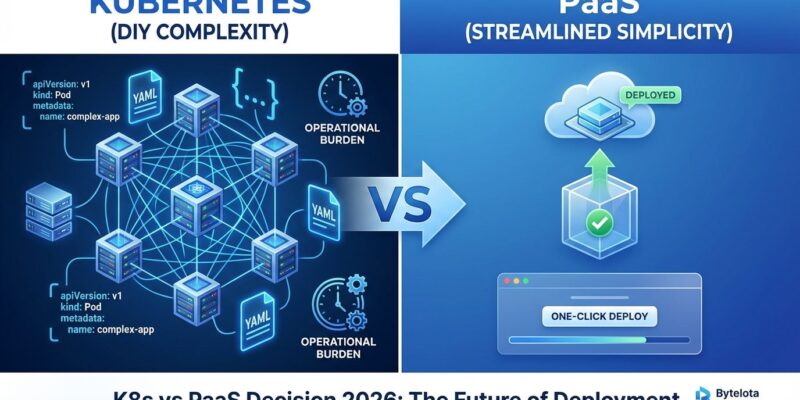
In 2026, the “Kubernetes by default” era is ending. The complexity tax of managing even managed clusters like EKS or GKE is no longer justifiable for most engineering teams. Modern PaaS platforms—Railway, Render, Fly.io, Northflank, Koyeb—now offer the features that once forced teams into Kubernetes, while cutting deployment complexity by 90%. Survey data backs this up: 42% of organizations that adopted microservices have consolidated back to simpler architectures, and Amazon Prime Video achieved 90% cost reductions by simplifying. The pendulum is swinging back to simplicity.
The Kubernetes Complexity Tax is Real
Kubernetes imposes a dual tax that most teams ignore until they’re drowning in YAML. The financial cost is straightforward: $72 per month for the EKS or GKE control plane alone, plus compute, storage, and networking. For a standard web app with two services and Postgres, managed Kubernetes runs $133-143 per month compared to $20-30 on Railway—a 4-7x cost difference. The math gets worse when you factor in platform engineering salaries: managed Kubernetes requires 3-5 dedicated engineers, while DIY Kubernetes demands 8 or more.
However, the cognitive cost cuts deeper. Every developer on the team must understand Deployment specs, Service accounts, RBAC policies, and ImagePullSecrets. When a developer spends four hours debugging why a pod can’t pull an image due to a missing ImagePullSecret, that’s four hours not shipping product features. This context switching between product development and infrastructure firefighting dilutes team focus and velocity.
The cost comparison reveals why teams are reconsidering Kubernetes for standard workloads. The complexity was justified when PaaS platforms couldn’t deliver equivalent capabilities. That’s no longer true in 2026.
PaaS Platforms Finally Caught Up
The capability gap that made Kubernetes necessary in 2020 has closed. Modern PaaS platforms now offer features that previously required Kubernetes orchestration: autoscaling based on CPU, RAM, or request count is a checkbox on Railway or Render, not a multi-file HPA configuration. Fly.io deploys containers to 15 global regions with a single command, while multi-region Kubernetes demands complex cluster federation. Northflank provides built-in CI/CD automation that rivals ArgoCD or Flux without the setup overhead.
The deployment experience gap is even starker. Railway auto-imports build configurations, deploy commands, and environment variables from your Git repository—developers deploy in 5 minutes. Compare this to Kubernetes: cluster setup, kubectl configuration, creating Deployment and Service manifests, configuring ingress controllers, and managing RBAC policies consume days of engineering time. Both approaches run containers, but one gets out of the way while the other demands constant attention.
Database and service management follows the same pattern. Render offers high-availability Postgres, Redis, and cron jobs as managed services. Kubernetes requires StatefulSets, persistent volumes, and custom operators to achieve equivalent reliability. The operational burden isn’t theoretical—it’s measured in on-call rotations and weekend outages.
42% Are Already Consolidating
The shift from complexity to simplicity isn’t speculative—it’s happening now with hard data. A CNCF survey found that 42% of organizations that adopted microservices have consolidated services back into larger deployable units. The primary drivers? Debugging complexity, operational overhead, and network latency that impacted user experience. Teams that rushed into distributed architectures during the 2018-2022 hype cycle are quietly admitting the complexity wasn’t worth it.
Amazon Prime Video provides the most public example. Their Video Quality Analysis team moved from a distributed AWS serverless architecture to a consolidated single-process application, achieving 90% cost reduction by eliminating expensive S3 Tier-1 calls and Step Functions orchestration. When data transfer happens in memory instead of across service boundaries, both latency and AWS bills drop dramatically.
Related: Microservices Rollback 2026: 42% Return to Monoliths
The Hacker News developer community reflects this pragmatism. The consensus: “If you’re managing less than 25 servers, Kubernetes is probably overkill.” Companies announcing moves away from Kubernetes complexity aren’t admitting failure—they’re optimizing for business value over architectural resume padding.
When to Actually Use Kubernetes vs PaaS
Kubernetes isn’t wrong—it’s over-applied. The decision framework is simpler than most teams admit: start with PaaS (Railway, Render, Fly.io) for new projects. Only migrate to Kubernetes when you hit specific, measurable problems that PaaS can’t solve. Massive scale with millions of requests per second justifies Kubernetes orchestration. Multi-tenant SaaS platforms requiring strict customer isolation benefit from Kubernetes’ namespace and RBAC controls. Complex compliance requirements like HIPAA or SOC2 that demand custom networking and security policies warrant the investment.
Team capacity matters more than technical requirements. If you have 3 or more dedicated platform engineers, Kubernetes becomes manageable. Without that capacity, the operational burden crushes product velocity. The server count threshold from the community aligns with this reality: under 25 servers, PaaS wins on simplicity and cost. Beyond 40 servers, Kubernetes’ orchestration capabilities start justifying the complexity tax.
Related: Platform Engineering ROI 2026: Prove Value or Lose Funding
Migration paths run both directions now. Moving from PaaS to Kubernetes takes 1-2 weeks for a standard containerized application. Moving from Kubernetes to PaaS takes 5-20 minutes per service since platforms like Railway auto-import configurations. The “we’ll need Kubernetes eventually” argument assumes you’ll outgrow PaaS. For 90% of applications, that day never comes.
Resume-Driven Development Has a Cost
Kubernetes became the default not because most teams needed it, but because of hype and resume-driven development. Engineers chose Kubernetes to pad their resumes with buzzwords, not to solve actual scaling problems. This isn’t malicious—it’s human nature in a competitive job market. However, businesses pay the price in delayed product shipping, ballooning infrastructure costs, and burned-out platform teams.
The vendor lock-in argument against PaaS deserves scrutiny. Modern PaaS platforms use standard Dockerfiles and container images—your application is portable. Kubernetes itself represents lock-in: you’re locked into Kubernetes APIs, YAML specifications, and the operational complexity. The difference is that Kubernetes lock-in comes with a 3-5 person platform team salary burden.
In 2026, simplicity wins. Optimizing for business value means shipping products faster with PaaS, not managing Kubernetes clusters to impress future employers. The best engineers optimize for actual problems, not anticipated problems three years out. Use the right tool for your problem today, not your imagined problem tomorrow.
Key Takeaways
- Start with PaaS (Railway, Render, Fly.io) for new projects—deployment complexity drops 90% compared to Kubernetes while costs run 4-7x lower for standard workloads
- Modern PaaS platforms offer features that previously required Kubernetes: autoscaling, multi-region deployment, CI/CD automation, and integrated databases without operational overhead
- 42% of organizations that adopted microservices have consolidated back to simpler architectures, with companies like Amazon Prime Video achieving 90% cost reductions through simplification
- Migrate to Kubernetes only when hitting specific, measurable limits: massive scale (millions of requests/second), multi-tenant isolation requirements, custom compliance controls, or you already have 3+ dedicated platform engineers
- The capability gap between PaaS and Kubernetes has closed in 2026, while the complexity gap remains massive—optimize for business value by using the simplest tool that solves your actual problem today