
 By ByteBot
Platform engineering is exploding in 2025. Gartner predicts 80% of large organizations will adopt it by 2027—up from less than 30% in 2023. But here’s what nobody’s saying: this massive industry shift is an admission of failure. Platform engineering exists to hide the kubernetes complexity that 93% of platform teams struggle with daily. The uncomfortable truth? Most companies never needed Kubernetes in the first place.
The Hidden Cost of Kubernetes Complexity: 49% Developer Time Wasted
IDC research reveals a staggering fact: 49% of developer time is spent on operational and background tasks instead of building products. High cognitive load from infrastructure management reduces developer productivity by up to 50%. Your developers aren’t shipping features—they’re fighting YAML files.
This isn’t about tools being hard to learn. It’s about the wrong tools consuming half your engineering capacity. When 93% of platform teams report struggling with kubernetes complexity and costs, and 37% of organizations list reducing cognitive load as their top priority, we’re not dealing with a learning curve problem. We’re dealing with a systemic over-engineering problem.
The numbers don’t lie. When your infrastructure requires more cognitive effort than your product logic, you haven’t built sophisticated architecture. You’ve built expensive complexity.
Resume-Driven Development: The Cargo Cult Problem
Research shows 82% of software professionals believe using trending technologies makes them more attractive to employers. This creates “resume-driven development”—choosing Kubernetes not because it solves business problems, but because it looks good on CVs. Teams copy Netflix and Google architectures without having their scale problems.
The pattern is predictable. Companies adopt microservices and Kubernetes “like Netflix” without asking whether their operational knowledge or application complexity warrant distributed systems infrastructure. They hire “DevOps Engineers,” deploy Jenkins and Terraform, and mistake the tools for the philosophy.
Here’s the diagnostic test: if the answer to “why do we use this tool?” is “because that’s what successful companies do” rather than an explanation linked to specific needs, you’re dealing with cargo cult engineering. The sophistication isn’t in choosing the most complex tool. It’s in choosing the right one.
Platform Engineering: Damage Control, Not Progress
Platform engineering promises impressive gains: 30% faster time-to-market and 4x higher deployment frequency by hiding kubernetes complexity behind abstraction layers. Organizations report environment provisioning dropping from weeks to minutes. These are real improvements—but they’re treating symptoms, not causes.
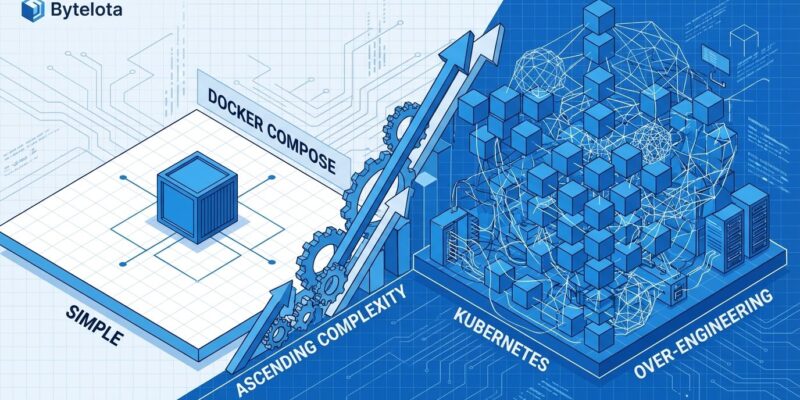
Think about the absurdity. We’re building platforms to hide platforms to run applications that could run on Docker Compose. Gartner predicts 80% of large organizations will adopt platform engineering by 2027, creating entire teams dedicated to making infrastructure usable for developers. If you need a full engineering discipline just to make your infrastructure accessible, maybe question the infrastructure itself.
Platform engineering helps—no question. However, prevention beats cure. The rise of platform engineering isn’t proof that we’re getting better at infrastructure. It’s proof that we over-engineered in the first place.
When You Don’t Need Kubernetes: The 90% Problem
Kubernetes has achieved market dominance: 90%+ adoption overall, 80% in production environments. But sustained Hacker News debates argue “K8s is overkill for 90% of systems.” The math doesn’t add up. If most systems don’t need it, why is everyone using it?
Here’s the reality check. For single-host applications, static workloads, small teams, or simple deployments, Docker Compose provides everything needed. Learn it in 1-2 days versus Kubernetes’s weeks or months. No auto-scaling requirements? No multi-node production system? No dedicated platform team? You don’t need Kubernetes.
The red flags are clear: running on a single server, team smaller than 10 engineers, static workload without scaling needs, startup in MVP phase. If any of these describe your situation, Kubernetes adds operational complexity without solving actual problems. The most sophisticated engineering choice is often the simplest one.
The Uncomfortable Truth About Complexity
Kubernetes solves real distributed systems problems. However, most companies don’t have those problems. The CNCF is right: kubernetes complexity isn’t the tool itself—it’s the distributed systems challenges it addresses. Network topologies, load balancing, service discovery, multi-node coordination. These are genuine engineering challenges.
But if you’re not running multi-node production systems with unpredictable scaling needs, you don’t have these challenges. Choosing Kubernetes anyway doesn’t make you sophisticated. It makes you over-engineered. As one developer put it: “We crave simplicity, yet we worship complexity like it’s an achievement badge.”
The industry is beginning to recognize this. The platform engineering explosion isn’t progress—it’s an admission that kubernetes complexity went too far. Moreover, the real engineering maturity is knowing when NOT to adopt the trending tool. Ask “what problem does this solve?” not “what does everyone else use?”
Key Takeaways
- 49% of developer time wasted on ops tasks instead of product work is unacceptable—measure where your team’s cognitive load actually goes
- 82% of developers choose technologies for career attractiveness, not business value—root cause of cargo cult Kubernetes adoption
- Platform engineering delivers 30% faster delivery by hiding kubernetes complexity, but question whether you need that complexity at all
- Docker Compose solves 90% of use cases and takes 1-2 days to learn versus weeks for Kubernetes—simplicity isn’t lack of sophistication
- Real engineering maturity means choosing the right tool for your actual problems, not copying Google’s architecture when you don’t have Google’s scale
The smartest infrastructure decision isn’t always the most complex one. It’s the one that lets your team ship products instead of wrestling YAML.


