 By ByteBot
Andrej Karpathy just admitted something most developers are thinking but won’t say out loud: he’s barely writing code anymore. The OpenAI co-founder and former Tesla AI director went from 80% manual coding to 80% AI agents in just four weeks last December—a shift he calls the “biggest change to my basic coding workflow in ~2 decades of programming.” When someone with Karpathy’s credentials makes this kind of confession, it’s worth paying attention. The question isn’t whether AI is changing how we code. It’s whether we’re witnessing the end of coding as we know it.
December’s “Phase Shift”
Karpathy pinpointed exactly when everything changed: December 2025. That’s when AI coding agents like Claude, Codex, and Cursor crossed what he calls “some kind of threshold of coherence”—suddenly they weren’t just autocomplete on steroids, they were actually useful for real work. His new workflow looks radically different: multiple Claude conversation windows on the left, an IDE on the right purely for code review. He’s orchestrating rather than typing. Humans handle requirements and quality checks. AI handles implementation.
This wasn’t gradual. Four weeks of rapid adaptation culminated in a complete workflow inversion. When Karpathy posted his observations to X in late January, the Hacker News thread exploded to 453 comments within hours. Developers everywhere recognized themselves in his experience.
The Ego Problem
Here’s the part that makes this story compelling: Karpathy admits it hurts. “I really am mostly programming in English now, a bit sheepishly telling the LLM what code to write… in words. It hurts the ego a bit,” he wrote. This is someone who helped build GPT at OpenAI, who led Tesla’s Autopilot AI team. If he feels sheepish about not typing code anymore, imagine how the rest of us feel.
The Hacker News reactions revealed a community in crisis. One developer captured the tension perfectly: “I got into programming because I like programming, not whatever this is.” The split is real: outcome-focused “builders” are embracing AI productivity gains, while craft-oriented developers who loved the problem-solving journey are questioning whether they even want to do this anymore. Karpathy calls Claude Code “some powerful alien tool” that got handed around without a manual. We’re all figuring this out in real-time, and the psychological adjustment is harder than the technical one.
The “Slopacolypse” Warning
But Karpathy didn’t stop at describing the shift. He made a prediction that should concern everyone: 2026 will be the “slopacolypse,” when digital platforms get flooded with massive amounts of low-quality AI-generated content. This isn’t just about spam. It applies to code repositories, technical documentation, and the software that increasingly runs our lives.
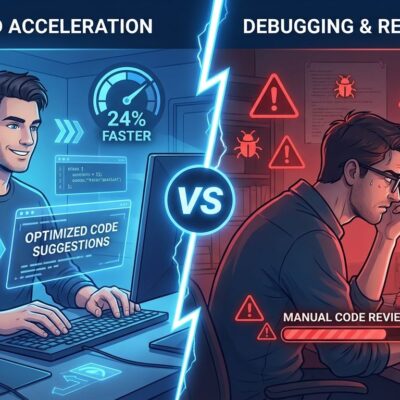
The signs are already visible. “AI slop” was Merriam-Webster’s Word of the Year for 2025. YouTube’s CEO made “managing AI slop” a top priority for 2026 after studies showed 21% of recommendations to new users are now AI-generated content. One Hacker News developer described building a multiplayer game in Rust with AI assistance but not understanding the code “in my bones.” His question haunts: can he handle a production SEV0 bug independently? Research shows experienced developers were actually 19% slower when using AI, despite believing they were faster. The perception gap is real, and it’s dangerous.
What It Means for the Rest of Us
If you’re waiting for permission to ignore this trend, you won’t get it. The numbers tell the story: 82% of developers already use AI tools weekly, and 25% of Google’s code is AI-assisted. This transformation happened in weeks, not years. Karpathy’s four-week workflow flip from November to December 2025 is the timeline you should be planning around.
The developer role is evolving, not disappearing. Skills like requirements gathering, system architecture, and code review are more valuable than ever. What’s declining: typing syntax, memorizing APIs, writing boilerplate. The new core skill is effective prompting—programming in English. It’s uncomfortable. Karpathy even admitted to feeling “behind as a programmer” despite literally helping invent this technology.
But discomfort is a luxury only senior developers with job security can afford. Junior developers entering the field in 2026 won’t have the choice to opt out. Karpathy predicts 2026 will be “a high energy year as the industry metabolizes the new capability.” Translation: this year separates those who adapt from those who fall behind.
When someone with Karpathy’s background experiences a fundamental workflow shift in four weeks and calls it the biggest change in 20 years, that’s a signal worth heeding. December 2025 may be remembered as the month software engineering fundamentally changed. Whether you’re ready or not, you’re already living in the aftermath.