 By ByteBot
The tech industry is experiencing a junior developer hiring crisis that threatens the entire talent pipeline. Entry-level postings have dropped 60% since 2022, computer engineering graduates face 7.5% unemployment (nearly double the national average), and Salesforce—San Francisco’s largest private employer—announced a complete software engineer hiring freeze for 2025. The economics are brutal: GitHub Copilot costs $10/month while junior developers cost $90,000/year. But here’s the paradox nobody’s talking about: without juniors today, where will senior developers come from in 10 years?
The Economics: $10/Month AI vs $90K/Year Juniors
Companies are making a stark calculation. GitHub Copilot costs $10-$39/month per seat. A junior developer costs $70,000-$90,000 in salary, plus 6-12 months of training before they’re productive. The math is simple: one senior developer with AI can match the output of 2-4 juniors.
Over five years, a 10-seat Copilot deployment costs $11,400. That’s less than hiring one junior for a single year. When CFOs see those numbers, junior hiring freezes become inevitable.
The data backs this up. According to a 2025 LeadDev survey, 54% of engineering leaders plan to hire fewer juniors due to AI copilots. 37% of employers say they’d rather “hire” AI than a recent graduate.
Here’s what the new team structure looks like:
OLD TEAM (Pre-AI):
• 1 Senior Developer ($150K)
• 2 Mid-level Developers ($120K each)
• 3 Junior Developers ($90K each)
Total: $630K/year for 6 developers

NEW TEAM (AI-Augmented):
• 1 Senior Developer ($150K)
• 3 Mid-level Developers ($120K each)
• 0 Junior Developers
• GitHub Copilot Enterprise ($1,872/year for 4 seats)
Total: $512K/year for 4 developers
Savings: $118K/year + increased velocity
Missing: Future talent pipeline
The economics make sense short-term. The long-term cost? Nobody’s calculating that yet.
Salesforce Sets the Precedent: Zero Engineers in 2025
In February 2025, Salesforce CEO Marc Benioff announced the company would hire zero software engineers in 2025. Not fewer. Zero.
“Maybe we aren’t going to hire anybody this year,” Benioff told the 20VC podcast. “We have seen such incredible productivity gains because of the agents that work side by side with our engineers.”
Salesforce reported a 30% engineering productivity increase from its Agentforce AI platform. The company isn’t struggling—it’s a $300 billion enterprise and San Francisco’s largest private employer. When companies of this scale publicly freeze engineering hiring, it signals to the industry: this is acceptable. Even desirable.
Meanwhile, Salesforce is hiring 1,000-2,000 additional salespeople to sell those AI products. The message: we need people to sell AI, not people to build software.
The Numbers: Crisis-Level Unemployment for Grads
Computer engineering graduates face 7.5% unemployment. Computer science grads sit at 6.1%. For developers aged 22-27, unemployment is 7.4%—nearly double the 4.2% national average as of June 2025.
These aren’t “tech is tough” numbers. These are crisis-level unemployment rates for highly-skilled graduates in a supposedly booming industry.
One 2023 computer science graduate applied to 5,762 jobs without receiving a single full-time offer. That’s not an outlier. That’s systemic failure.
The data confirms it:
- Entry-level tech hiring down 25% year-over-year in 2024
- Entry-level postings down 60% since 2022
- Graduate hiring at major companies down 50%+ compared to pre-2020 levels
- Google and Meta hiring ~50% fewer new grads compared to 2021
- In the UK, junior developer openings down 33% since 2022
- In India, outsourcing giants paused campus hiring entirely
And here’s the kicker: 55% of “entry-level” job postings now require 3+ years of experience. In the San Francisco Bay Area, 80% of entry-level jobs require at least 2 years of experience.
The experience paradox: you can’t get experience without a job, and you can’t get a job without experience. Even when junior positions exist, they’re effectively mid-level positions with junior titles and salaries.
The Talent Pipeline Paradox Nobody’s Talking About
Here’s the uncomfortable question companies aren’t asking: if you stop hiring juniors, where do future senior developers come from?
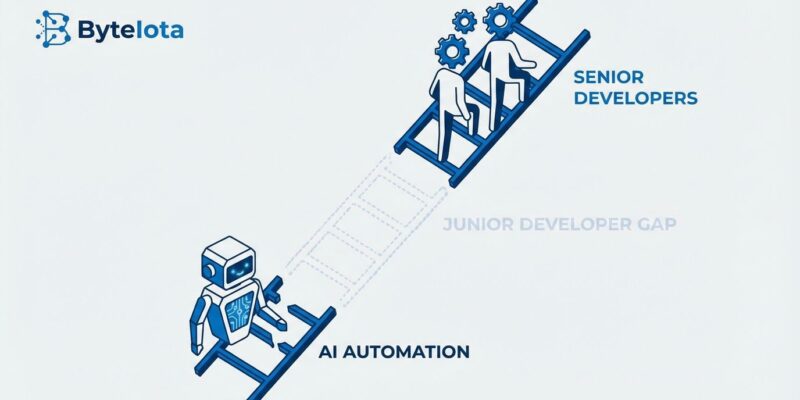
The industry is creating what experts call a “hollowed-out career ladder.” Plenty of seniors at the top. AI doing grunt work at the bottom. Nobody learning the craft in the middle.
A Stanford Digital Economy study found that companies adopting AI at higher rates are hiring juniors 13% less. Employment for software developers aged 22-25 declined 20% from its late 2022 peak by July 2025. Meanwhile, employment for developers aged 35-49 increased 9%.
AI is specifically displacing junior roles while increasing demand for experienced developers. The problem: those experienced developers started as juniors somewhere. Where will the next generation come from?
This is the tragedy of the commons. Each company benefits individually from cutting juniors—immediate cost savings, higher short-term efficiency. But collective action creates industry-wide failure.
In 10-20 years, when today’s senior developers retire, who replaces them? The junior you didn’t hire in 2025 would be a mid-level engineer with 10+ years of experience by then. But they’re currently unemployed with 5,762 rejected applications.
Microsoft provides a preview of what’s coming: 40% of the company’s 2025 layoffs targeted software engineers, while CEO Satya Nadella announced that 30% of Microsoft’s code is now written by AI. AI writes code. Humans still architect, review, and integrate. But who trains those future architects if no one starts as a junior?
What Developers Should Actually Do
The crisis is real. The economics are brutal. But there are paths forward.
If you’re a junior developer: Target startups. Enterprise companies (5000+ employees) have slashed junior hiring to 15%, but startups still hire juniors at a 75% rate. Build in public—contribute to open source, write blog posts, create a public GitHub portfolio. Companies won’t give you experience, so you have to create proof of capability yourself. Specialize early in niche areas (Rust, WebAssembly, embedded systems) that are harder for AI to replace. Network aggressively—with formal hiring frozen, personal connections matter exponentially more.
If you’re a mid-level or senior developer: Mentor publicly even if your company won’t hire juniors. Write tutorials, review OSS code, share knowledge. You came from somewhere—ensure others have the same path. Advocate internally for junior pipeline. Make the business case to leadership: no juniors today means expensive senior talent wars in 5 years. Document your knowledge. The junior who would have learned from you by working alongside you doesn’t exist—write it down.
If you’re a hiring manager or company leader: Calculate the long-term cost. Saving $90K today might cost you $200K in senior hiring competition in 5 years. Experiment with hybrid apprenticeships—pair juniors WITH AI copilots for accelerated learning instead of choosing one or the other. Ring-fence junior hiring budgets separately from efficiency metrics. Treat it as R&D, not headcount optimization.
The Bottom Line
The junior developer hiring crisis isn’t a recession-driven slowdown. It’s a structural shift driven by AI economics that make brutal short-term sense but threaten the industry’s long-term sustainability.
60% of entry-level postings have disappeared. 7.5% unemployment for computer engineering graduates. Salesforce freezing all engineering hiring. 37% of employers preferring AI over recent graduates. These aren’t warning signs anymore—this is the new reality.
The paradox: companies are optimizing for efficiency today at the expense of their talent pipeline tomorrow. When your senior architect retires in 15 years, where does the replacement come from? The junior you’re not hiring today would be ready. But they won’t be there.
The industry has to decide: is AI a tool to augment developers, or a reason to stop developing new developers entirely? Because right now, we’re choosing the latter. And that choice has consequences we won’t feel until it’s too late to fix.