Java is undergoing a dual transformation: 62% of organizations now use Java to power AI functionality (up from 50% last year), while 92% are concerned about Oracle’s pricing and 81% are actively migrating to OpenJDK, according to Azul’s 2026 State of Java Survey published in February 2026. The survey of 2,000+ Java professionals worldwide reveals the biggest shift in Java’s 30-year history—one driven not by technical innovation alone, but by economic necessity.
The Great Oracle Exodus
Oracle’s January 2023 shift to employee-based subscription pricing has backfired spectacularly. The new model charges $15 per employee per month for companies under 1,000 employees—and counts every employee, not just Java users. Full-time, part-time, temporary workers, contractors, consultants: everyone counts. As a result, cost explosions drove 81% of enterprises to plan migrations to OpenJDK alternatives.
The numbers are staggering. One documented case shows a 23× increase: from $33,600 to $768,000 for identical usage. A medium-sized business with 250 employees saw annual costs jump from $3,000 to $45,000. Moreover, enterprises that once paid for 20 desktop users and 8 processors now pay for their entire headcount. Oracle turned Java licensing from a manageable line item into a strategic crisis.
The migration math is straightforward: OpenJDK is free under the GPL license with no commercial restrictions. It’s functionally identical to Oracle JDK—same quarterly security patches, same TCK testing. Furthermore, migration typically costs 5-15% of the first year’s Oracle subscription. Even with commercial support for OpenJDK (available from multiple vendors at 70% less than Oracle’s price), the financial case is overwhelming. Nine in ten developers are concerned about Oracle pricing; eight in ten are planning to leave. That’s not a trend—it’s an exodus.
Java as the AI Production Layer
While Oracle’s pricing strategy crumbles, Java is quietly winning a different battle: 62% of enterprises now use Java to power AI applications. Python dominates AI research and model training, commanding 25.87% of the TIOBE index versus Java’s 8.71%. However, enterprises aren’t running production AI systems in Python—they’re deploying them in Java.
The reasons are pragmatic. Java brings proven scalability, stability, and security to AI workloads. When you’re integrating AI into mission-critical financial systems or healthcare platforms, Python’s experimental agility becomes Java’s production reliability. Consequently, the pattern emerging across enterprises: train models in Python where the tooling is mature, deploy them in Java where your production infrastructure lives. Python for experimentation, Java for operations.
Java 26 makes this pattern viable. Virtual Threads (Project Loom, JEP 525) handle millions of concurrent AI connections with negligible memory overhead. Additionally, Structured Concurrency orchestrates complex multi-agent workflows safely. The Foreign Function & Memory API (Project Panama) breaks down barriers to GPU acceleration, enabling direct access to C++ and CUDA libraries that power high-performance AI inference. Therefore, Java is no longer a bystander in the AI revolution—it’s becoming the production runtime that scales AI from prototype to enterprise deployment.
The bridging technologies are maturing too. Deep Java Library (DJL) provides Java-native deep learning capabilities. ONNX Runtime enables cross-platform model deployment, letting teams train in PyTorch or TensorFlow and serve in Java. In fact, the “bilingual” developer—fluent in both Python and Java—is increasingly valuable. Java isn’t replacing Python in AI. It’s complementing it, and that complementary role is exactly what enterprises need.
Cloud Cost Crisis Meets JVM Performance
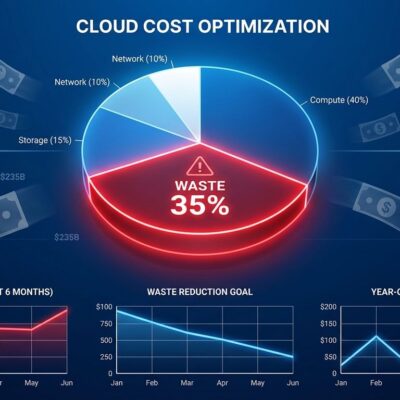
The third force reshaping Java: cloud cost optimization is no longer optional. 97% of enterprises are taking actions to reduce public cloud costs, according to the Azul survey. Specifically, 41% are using high-performance JVMs as a top-five cost reduction strategy. When enterprises waste an estimated 31% of cloud spending on unused resources, JVM performance tuning becomes a CFO mandate.
The technical approach is straightforward: faster execution means less CPU time, reduced memory usage enables smaller instance sizes, improved garbage collection delivers better throughput. Consequently, run the same workloads on fewer cloud resources, and cloud bills drop proportionally. A 20% performance improvement translates directly to 20% fewer instances—measurable, immediate ROI.
High-performance JVMs deliver these gains. Azul Platform Prime (formerly Zing) claims the title of world’s fastest JVM, built on OpenJDK and fully TCK-compliant. Its C4 Pauseless Garbage Collector is the only production-ready generational pauseless GC in Java, eliminating stop-the-world pauses through four-stage concurrent execution. Moreover, the platform works across all major Java versions without code changes, delivering speed, memory, and latency improvements simultaneously. Oracle removed the Graal JIT compiler from Oracle JDK in 2026, leaving Azul as the primary option for organizations prioritizing performance.
Performance optimization isn’t academic anymore. When 71% of enterprises expect cloud budget increases, squeezing efficiency from the JVM is a financial imperative. Therefore, developers who understand garbage collection tuning, memory management, and thread models aren’t just writing faster code—they’re cutting infrastructure costs by millions. That’s the kind of impact that gets noticed in quarterly earnings calls.
What This Means for Java Developers
These three trends—Oracle migration, AI adoption, cloud optimization—create new career demands. Enterprise Java roles increasingly require AI integration knowledge. Furthermore, migration projects need developers fluent in OpenJDK distributions like Eclipse Temurin, Amazon Corretto, and Red Hat’s OpenJDK builds. FinOps teams seek developers who can profile JVM performance and optimize garbage collection for cost efficiency.
The skill stack is expanding. Java developers need working knowledge of Python AI tooling (PyTorch, TensorFlow) and bridging technologies (DJL, ONNX Runtime). Additionally, they need expertise in Virtual Threads and structured concurrency for AI orchestration. They need to understand high-performance JVM internals well enough to justify the business case for switching. Consequently, being “bilingual”—equally comfortable in Java and Python—is more valuable than single-language mastery. The developers adapting to these shifts are positioning themselves for the next decade of enterprise development.
Java isn’t dying under economic pressure. It’s evolving. Oracle’s pricing squeeze accelerated the move to OpenJDK, democratizing enterprise Java. Cloud cost crises pushed JVM performance optimization from niche specialty to mainstream necessity. AI adoption forced Java to prove its production relevance beyond traditional enterprise backends. Therefore, the result: a more open, more performant, more AI-capable Java ecosystem. Economic necessity, it turns out, is one hell of a catalyst for innovation.