 By ByteBot
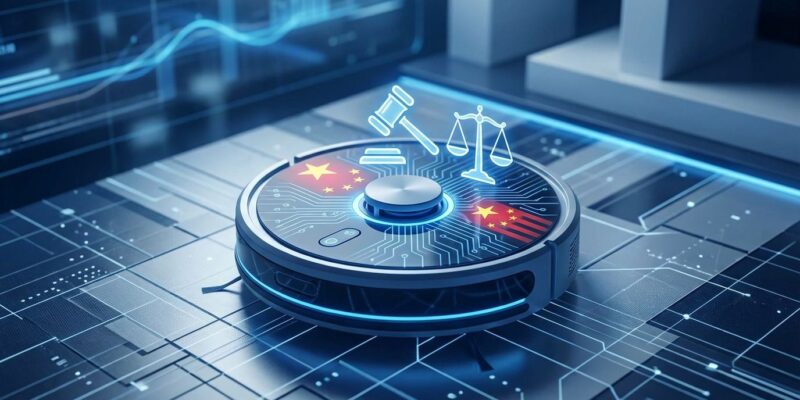
iRobot Corporation, the MIT spinout that pioneered consumer robotics with the Roomba vacuum, filed Chapter 11 bankruptcy on December 14, 2025, ending a 35-year run. The company is being acquired by its Chinese contract manufacturer, Shenzhen Picea Robotics, in exchange for canceling $264 million in debt. Current shareholders get wiped out completely—zero recovery expected. The irony is striking: 22 months earlier, EU regulators blocked Amazon’s $1.7 billion acquisition, citing antitrust concerns. They sought to protect competition in smart home devices. The result is Chinese ownership of American robotics IP.
Company founders are publicly calling it “a tragedy” and a “warning” for competition watchdogs. This is a case study in regulatory unintended consequences—policies working at cross-purposes with no one considering geopolitical implications.
How EU Regulators Blocked Amazon, Delivered iRobot to China
In August 2022, Amazon offered $1.7 billion to acquire iRobot. EU Competition Commissioner Margrethe Vestager’s office signaled in January 2024 it would block the deal, arguing Amazon might restrict competing robot vacuums on its marketplace or unfairly limit third-party access to Alexa voice control integration. The concerns were hypothetical—no evidence Amazon would actually foreclose competitors. UK regulators cleared the deal entirely, finding no competitive harm. Amazon and iRobot terminated the agreement anyway, with Amazon paying a $94 million breakup fee. iRobot immediately laid off 31% of its workforce.
The decision left iRobot without an exit strategy, mounting debt, and declining sales. Former CEO Colin Angle told Fox Business the FTC’s opposition was “wrong-minded” in retrospect: “I bet if you asked almost anyone prior to the blocking of the deal: Would you rather see iRobot innovating like crazy, coming out with new and better robots for your home, or would you like to see it file for Chapter 11 in the process of being sold to a Chinese manufacturer? The wrong thing probably happened.”
Co-founder Helen Greiner was even more direct, calling the outcome “not good for consumers, employees, stockholders, Massachusetts or the USA.” She told Bloomberg it was “bizarre” that there’s no outcry over U.S. know-how moving to China. The Information Technology and Innovation Foundation (ITIF) issued a policy analysis stating regulators “must recognize that blocking transactions that pose no credible risk of anticompetitive harm can directly undermine Western competitiveness.” Read the full ITIF analysis.
46% Vietnam Tariffs: Policy Blowback That Bankrupted a US Company
In April 2025, the Trump administration imposed 46% tariffs on Vietnam imports—Vietnam had a $123.5 billion trade surplus with the U.S. in 2024. iRobot manufactured a significant portion of its devices in Vietnam. The tariffs added $23 million in costs in 2025 alone. The company couldn’t absorb the hit or pass costs to consumers without losing to cheaper Chinese competitors manufacturing in China. Chinese rivals like Roborock, Ecovacs, and Dreame were unaffected.
By March 2025, iRobot filed an SEC disclosure warning of “substantial doubt about the company’s ability to continue as a going concern” due to “macroeconomic and tariff-related uncertainties.” The company owes $3.4 million in unpaid tariffs to U.S. Customs. Q3 2025 sales in the U.S. dropped 33% year-over-year. This is trade policy blowback in action: tariffs designed to protect American manufacturing bankrupted an American company while leaving Chinese competitors unscathed. NPR reported on the tariff impact.
The Fall from $3.56B to $140M: A Death Spiral in 22 Months
iRobot’s valuation collapsed from $3.56 billion at its 2021 pandemic peak to $140 million at bankruptcy filing—a 96% loss. The company’s stock crashed 70% in premarket trading on December 15, dropping to $1.20 from $4.32. For the year, shareholders lost approximately 85%. Revenue fell from $193.4 million in Q3 2024 to $145.8 million in Q3 2025. The company had less than $25 million in cash on hand when it filed.
Multiple factors converged: the Amazon deal termination eliminated the exit strategy, transitioning to Chinese contract manufacturing in early 2024 undermined product quality, and tariffs crushed margins. Reviews of new Picea-manufactured models like the 505 and 205 were underwhelming—described by TechCrunch as “generic lidar-based robot vacs with the Roomba name plastered on.” iRobot’s market share dropped to less than 10% by Q1 2025. TechCrunch detailed how iRobot lost its way.
How Your Contract Manufacturer Can Eat You: The Picea Playbook
Shenzhen Picea Robotics, also known as 3irobotix, is one of the world’s largest robot vacuum original design manufacturers (ODMs) with 7,000+ employees and facilities in China and Vietnam. iRobot hired Picea as its contract manufacturer in early 2024 to cut costs after the Amazon deal collapsed. The relationship evolved quickly: Picea became both manufacturer and lender—a dual role that’s common in hardware but concentrates power dangerously.
By November 2025, Picea subsidiary Santrum had taken on iRobot’s $190 million Carlyle loan debt. When iRobot filed bankruptcy, Picea was the largest creditor with a $98.9 million unsecured claim. Under the restructuring agreement, Picea cancels $264 million in combined debt ($190 million loan plus $74 million in manufacturing obligations) in exchange for 100% equity ownership. The pattern is simple: supplier becomes lender, lender becomes owner. iRobot is expected to emerge from bankruptcy as a wholly owned subsidiary of Picea by February 2026.
The acquisition shifts Chinese control of the global robot vacuum market from roughly 50% before the deal to more than 63% after. For hardware companies, the lesson is clear: overdependence on a single contract manufacturer is an existential risk. When financial trouble hits, your supplier controls your fate.
What iRobot’s Collapse Means for US Tech Policy
The policy debate over who killed iRobot is fierce. Critics blame EU antitrust regulators for blocking the Amazon deal based on hypothetical harm while ignoring real geopolitical consequences. Others point to tariffs that bankrupted the company they were ostensibly designed to protect. Some argue management failed by becoming overdependent on a single supplier and losing product differentiation.
The truth is all three factors combined. But the regulatory irony remains inescapable: the EU tried to protect competition in smart home devices, and the result is Chinese market dominance. Chamber of Progress CEO Adam Kovacevich summarized it bluntly: “In their rush to hurt Amazon, Elizabeth Warren and Lina Khan chased iRobot right out of Massachusetts and straight into China’s hands.”
For tech professionals and policy makers, iRobot’s bankruptcy exposes the consequences of siloed policy decisions. Antitrust regulators focused exclusively on competition without considering national interest. Trade policy imposed tariffs without accounting for supply chain reality. Industrial policy was absent entirely—no coordinated effort to maintain American competitiveness in robotics. The result: a pioneering American company falls to China. Former CEO details the regulatory failure.
Key takeaways:
- Antitrust enforcement can’t ignore geopolitical consequences—protecting hypothetical competition while losing American companies to foreign competitors defeats the purpose
- Tariffs alone can’t fix manufacturing competitiveness without a domestic ecosystem to support production
- ODM dependency is an existential risk for hardware companies—your supplier can become your lender, then your owner
- US needs coherent industrial policy that coordinates antitrust, trade, and strategic competitiveness—or more American pioneers will fall to China