 By ByteBot
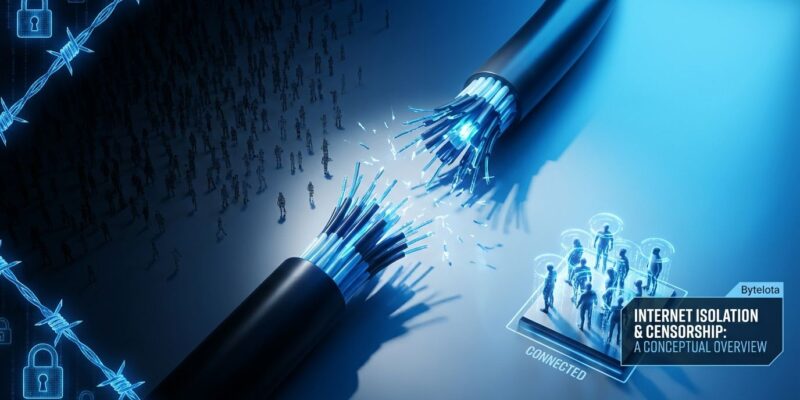
On January 8, 2026, Iran severed internet access for 92 million people—and officials just confirmed this isn’t temporary. The government calls it “Absolute Digital Isolation,” a permanent system where only security-cleared elites can access the global internet through a strict whitelist. This is the “Barracks Internet”: you’re either on the approved list, or you’re cut off indefinitely.
Filterwatch’s January 15 investigative report exposed the confidential plan. Government spokesperson Fatemeh Mohajerani confirmed there’s no expectation of reopening international internet access until at least March 2026, and it will “never return to its previous form.” Translation: this is the new normal.
The Barracks Internet Whitelist System: Elite Access Only
Here’s how Iran’s permanent shutdown works. The government issues “white SIM cards” to individuals and organizations with security clearance—Revolutionary Guard approval required. Everyone else? Completely blocked from the global internet. No GitHub. No Stack Overflow. No AWS. No international communication.
The hypocrisy is visible and deliberate. While 92 million Iranians remain isolated, the Supreme Leader’s X account continued posting throughout the shutdown. Government officials maintain full access to Telegram, Twitter, and all social media platforms citizens can’t reach. Iran created a two-tier internet system and isn’t hiding it.
This isn’t China’s Great Firewall, which allows filtered access. This isn’t Russia’s sovereign internet, which maintains international connections. Iran went further—complete isolation for citizens, unrestricted access for the ruling class.
How Iran Defeated Uncensorable Technology
Tehran proved satellite internet isn’t censorship-proof. Iran deployed military-grade GPS jammers that crippled Starlink with 30-80% packet loss, using mobile jamming units that move neighborhood-to-neighborhood. The tactics mirror Russia’s approach in Ukraine—but Iran succeeded where Moscow failed.
VPNs don’t work when there’s no infrastructure to connect to. Iran didn’t just block protocols—it severed the entire network. Deep Packet Inspection (DPI) systems deployed by contractors Yaftar and Doran block encrypted traffic by fingerprinting connection patterns. The protocol whitelist is brutal: only DNS, HTTP, and HTTPS are forwarded. Everything else—OpenVPN, SSH, custom ports—gets dropped without response.
Even Iran’s $6 billion National Information Network (NIN), the domestic intranet designed to stay online during international shutdowns, was severed this time. Landline phones were cut. This is an escalation beyond previous Iranian shutdowns in 2019 and 2022, which kept domestic networks functioning.
Hiding the Crackdown: At Least 28 Killed Before Blackout
The shutdown followed protests triggered by Iran’s December 28 currency collapse and soaring inflation. Amnesty International documented at least 28 protesters and bystanders killed—including children—in 13 cities across eight provinces before the January 8 blackout. Reports suggest security forces intensified lethal force after communications went dark.
Rebecca White, researcher at Amnesty International’s Security Lab, stated the obvious: “The Iranian authorities deliberately blocked internet access inside Iran to hide the true extent of the grave human rights violations and crimes under international law they are carrying out.” Amnesty explicitly calls this blanket shutdown a “serious human rights violation in itself”—not just the violence it conceals, but the isolation itself.
The UN Fact-Finding Mission on Iran and the Electronic Frontier Foundation joined 47 organizations calling for immediate restoration. Human Rights Watch reported credible evidence of large-scale killings across the country post-shutdown. Without connectivity, citizens can’t document abuses, call for help, or alert the international community.
Iranian Developers Cut Off From Global Tech Ecosystem
For ByteIota’s developer audience, this hits close to home. Iranian developers are now completely isolated from GitHub, Stack Overflow, cloud services, and all global development resources. This compounds a difficult history: GitHub blocked Iranian users from 2019-2021 due to U.S. sanctions (later rolled back), sparking massive backlash from the global dev community. Now the Iranian government has finished what sanctions started—complete professional isolation.
The Iranian diaspora developer community faces an agonizing reality. As one Toronto-based cybersecurity expert put it, “everything is bad”—unable to verify family safety or contact colleagues inside Iran. Ninety million people are isolated from the outside world, and for tech professionals, that means career-ending separation from the ecosystem they depend on.
Blueprint for Authoritarian Digital Control
Other authoritarian regimes are watching Iran’s success closely. Russia is already moving toward similar isolation—Signal blocked in 2024, YouTube throttled in 2025, sporadic mobile internet shutdowns beginning in May 2025. China may adopt lessons for more complete blocking beyond its Great Firewall. The “splinternet” is accelerating: Freedom House reports 80% of internet users globally already live in censored countries.
Iran’s “Barracks Internet” model offers a blueprint more authoritarian than existing systems. It’s technically feasible, politically effective (keeps regime in power by hiding crackdowns), and proves that even “uncensorable” technologies like Starlink can be defeated with sufficient sophistication. For Russia, Iran’s model appears more feasible than China’s—less disruptive to banking and international trade while achieving total information control.
Internet governance is fragmenting from open multistakeholder forums to state-led security regimes. We’re not heading toward a binary “splinternet”—we’re watching a layered governance environment where authoritarian states demonstrate that permanent digital isolation is not just possible, but sustainable.
Key Takeaways
- Iran’s “Barracks Internet” is explicitly PERMANENT—government confirmed access will “never return to its previous form”
- 92 million people affected in the largest and most sophisticated internet shutdown in history
- Successfully defeated Starlink (30-80% packet loss via GPS jamming) and VPNs (complete infrastructure severance)
- At least 28 killed in protests before shutdown, with reports of intensified violence concealed by blackout
- Whitelist system creates two-tier internet: security-cleared elites maintain full global access while citizens remain isolated
- Iranian developers cut off from GitHub, Stack Overflow, and global tech resources—professional catastrophe
- Sets dangerous precedent: Russia, China, and other authoritarian regimes now have a proven blueprint for permanent digital control