
 By ByteBot
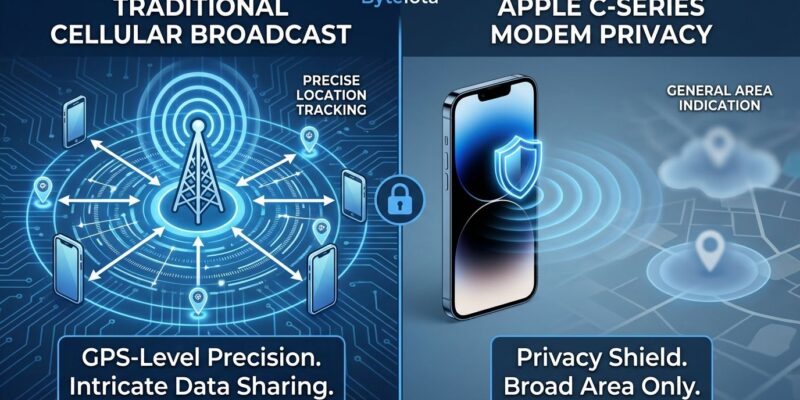
Apple released iOS 26.3 on January 27, 2026, introducing the first technical solution to stop mobile carriers from obtaining GPS-level location data. The feature limits carrier access to “general area” positioning instead of single-digit meter precision—but only works on devices with Apple’s C-series modem: the iPhone Air, iPhone 16e, and cellular iPad Pro with M5 chip. For years, cellular standards have required all phones to silently send GPS coordinates to carriers via built-in protocols. Apps, settings, and VPNs can’t stop this. iOS 26.3 is the first modem-level enforcement that actually works.
Carriers Have Been Silently Collecting Your GPS Location for Years
Every phone with cellular connectivity—Android and iPhone—has been sending GPS-level location data to mobile carriers through network protocols most users don’t know exist. These aren’t app permissions or settings you can disable. They’re baked into 2G, 3G, 4G, and 5G standards.
In 2G and 3G networks, the Radio Resources LCS Protocol (RRLP) works like this: the network asks “tell me your GPS coordinates if you know them,” and the phone responds with precise location. In 4G and 5G, the LTE Positioning Protocol (LPP) operates as what engineers call “control-plane positioning protocols”—systems that run invisibly within cellular network infrastructure. Cell tower triangulation alone provides accuracy in tens to hundreds of meters. However, when carriers request GNSS data via these protocols, they get single-digit meter precision—the same accuracy you see in Maps.
The FCC fined AT&T, Sprint, T-Mobile, and Verizon a combined $200 million in April 2024 for selling customer location data to aggregators who resold it to third-party data brokers. Those brokers sold access to government agencies, bounty hunters, and private investigators. Real-world examples include a Missouri sheriff who abused location tracking to monitor judges and a U.S. marshal who tracked former romantic partners. Moreover, more than 250 bounty hunters purchased location data from data brokers.
Why Only Apple’s C-Series Modems Can Block This
iOS 26.3’s carrier location privacy works exclusively on devices with Apple’s in-house C1 or C1X modems. That’s three products as of January 2026: the iPhone 16e ($599), iPhone Air ($999), and cellular iPad Pro with M5. Every other iPhone uses Qualcomm modems and cannot get this protection.
Third-party modem silicon adheres to 3GPP cellular standards as written. Qualcomm modems are locked to standard protocol behavior—they must send GPS data when carriers request it. Consequently, Apple controls the C-series silicon, which means Apple can modify how the modem responds to carrier location requests. This is vertical integration delivering a privacy benefit no third-party component supplier can provide.
Apple acquired Intel’s smartphone modem business for $1 billion in 2019. The iPhone 16e launched with the C1 modem in February 2025, followed by the iPhone Air with the upgraded C1X modem in September 2025. Apple’s 2026 roadmap targets the iPhone 18 Pro for the C2 modem with mmWave support, and the 2027 “Prometheus” modem aims to match Qualcomm’s performance across all metrics. Furthermore, the payoff from this six-year, multi-billion dollar investment is now visible: privacy enforced at the silicon level, not just the OS layer.
Millions of iPhone users on Qualcomm modems remain exposed. This creates what privacy advocates call a “hardware privacy tax”—the cheapest device with carrier location protection costs $599, while older iPhones have no technical path to gain this feature.
What Changes (And What Doesn’t)
iOS 26.3 restricts carrier access to “general area” positioning. Before the update, carriers knew “user at 123 Main Street, Apartment 4B” with single-digit meter GPS accuracy. After iOS 26.3, carriers get “user in downtown area near X and Y streets.” The precision loss is significant enough to disrupt data broker business models built on tracking individuals to specific businesses, medical clinics, or protest locations.
User-facing location services remain unchanged. If you grant an app location permission, it still receives precise GPS coordinates. Find My iPhone still works with full precision using end-to-end encryption. Emergency SOS and 911 calls bypass the carrier restriction entirely—dispatchers still receive exact location data. Additionally, navigation and Maps apps function identically. The C1X modem is 30% more energy efficient than Qualcomm alternatives according to Apple, and this privacy feature adds no additional battery drain.
Only five carriers globally support iOS 26.3 at launch: Telekom (Germany), EE and BT (United Kingdom), Boost Mobile (United States), and AIS and True (Thailand). Notably absent: Verizon, AT&T, and T-Mobile. Carriers have financial incentive to resist this feature—they sell location data to aggregators who resell to data brokers. The FCC found that 10 of the top 15 mobile carriers offer no opt-out mechanism for geolocation data collection, with retention periods ranging from two months to five years.
The Data Broker Context That Makes This Matter
The FTC shut down multiple location data brokers in 2024 and 2025 for systemic privacy violations. Gravy Analytics and Venntel collected 17 billion location signals daily from approximately one billion mobile devices, then sold access to ICE, FBI, DEA, and Customs and Border Protection. Government agencies purchased this data instead of obtaining warrants—a legal loophole that bypassed Fourth Amendment protections.
Allstate collected what it called “trillions of miles” of location data from more than 45 million consumers to build what the company described as “the world’s largest driving behavior database.” Insurers used this data to justify premium increases or deny coverage entirely. The business model depends on precise location data. When iOS 26.3 reduces carrier-sourced location to “general area,” the data loses commercial value for tracking individuals to sensitive sites.
FCC and FTC enforcement achieved limited success through fines and consent decrees. Carriers paid $200 million in penalties but continued data-sharing arrangements with minor modifications. Data brokers shut down by enforcement actions often restructured under new corporate entities. In contrast, technical enforcement like iOS 26.3 succeeds where policy-based approaches failed—it removes the capability at the hardware level rather than relying on compliance.
Privacy researchers note that de-identified location data can reveal where people live and work, who they associate with, where they worship, and where they seek medical care. The Electronic Frontier Foundation documents that dozens of data brokers collect this information from hundreds of millions of people without meaningful consent, selling it to private actors and government agencies. iOS 26.3’s carrier location restriction reduces one significant data source for this surveillance infrastructure.
Key Takeaways
- Mobile carriers obtain GPS-level location data from all phones through cellular network protocols—RRLP in 2G/3G and LPP in 4G/5G. These protocols operate invisibly, and no app permission or user setting can disable them.
- iOS 26.3 is the first modem-level solution to restrict carrier location tracking, but it only works on Apple C-series modem devices: iPhone 16e, iPhone Air, and iPad Pro M5. Qualcomm-based iPhones cannot implement this feature because third-party modem silicon adheres to standard cellular protocols.
- User-facing location services remain unchanged. Apps with granted permissions, Find My, emergency services, and navigation all work identically. Only carrier-level location access is restricted to “general area” instead of GPS precision.
- The data broker industry built business models on precise carrier location data sold to government agencies, insurers, bounty hunters, and surveillance firms. FTC and FCC enforcement in 2024-2025 revealed systemic abuses including tracking people to medical clinics and protests. iOS 26.3 disrupts this market by reducing location data precision at the source.
- Technical privacy enforcement succeeds where policy approaches failed. Instead of relying on carrier compliance or regulatory oversight, iOS 26.3 removes the capability at the silicon level. This creates a precedent for privacy-by-design in regulated industries where policy mechanisms have proven insufficient.


