 By ByteBot
A federal judge in California ruled this week that ICE can access Medicaid data from nearly 80 million patients to plan deportation raids using Palantir’s ELITE surveillance tool—a platform that aggregates health records with IRS data, immigration databases, and private sources to generate map-based “deportation targets” with confidence scores. The January 2026 ruling allows sharing “basic biographical, location, and contact information,” but privacy advocates warn this repurposes HIPAA-protected health data collected under promises it would never be used for law enforcement. Furthermore, with 891 points and 537 comments on Hacker News, the developer community is divided on whether this represents necessary enforcement or dangerous surveillance precedent.
How ELITE Turns Health Data Into Deportation Maps
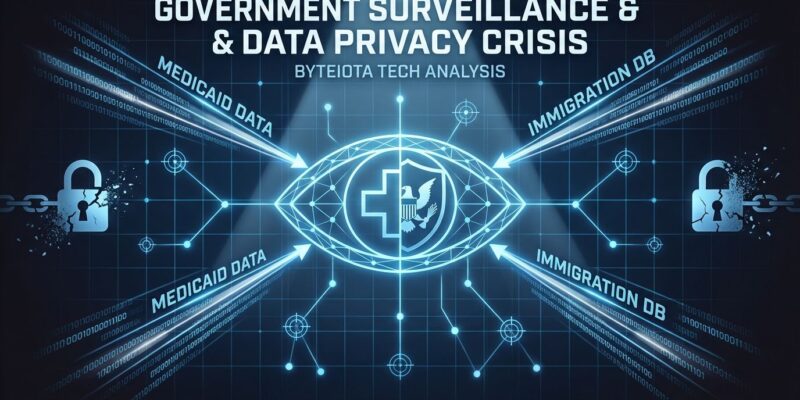
ELITE (Enhanced Leads Identification & Targeting for Enforcement) is a $29.9 million Palantir platform that receives Medicaid patient addresses from HHS, cross-references them with IRS records, immigration databases, and private data sources like Thomson Reuters, then generates an interactive map showing potential “deportation targets” with confidence scores out of 100 and detailed dossiers. Consequently, officers can draw boundaries around neighborhood-scale areas to identify “target-rich” zones for maximum deportation yield. However, this isn’t just ICE using Medicaid data—it’s the aggregation architecture that’s dangerous.
Individual databases have limited surveillance power. Medicaid knows addresses. IRS knows income. Immigration databases know visa status. However, combine them into one platform with probabilistic targeting, and you create capabilities no single database allows. Moreover, 404 Media published the actual DHS-CMS agreement showing data includes banking info (routing numbers, account numbers) beyond what the judge allowed. ELITE is part of the broader $30 million ImmigrationOS platform awarded in April 2025 that runs through September 2027. Additionally, Palantir has received over $900 million in federal contracts since Trump took office. The technical model here can be replicated for other surveillance purposes: FBI accessing cancer registries, DEA tracking mental health prescriptions, IRS cross-referencing health spending with tax filings.
The January 2026 Ruling: “Basic Information” Enables Mass Surveillance
U.S. District Judge Vince Chhabria ruled Monday, January 2026, that DHS can share “basic biographical, location, and contact information” from Medicaid with ICE, but granted an injunction blocking “more sensitive health data.” This partially overturns the August 2025 preliminary injunction that blocked all data sharing in 20 plaintiff states. Furthermore, the court found data sharing was implemented “without a reasoned decision making process” and likely violated the Administrative Procedures Act (APA). Allowed data includes citizenship/immigration status, address, phone number, date of birth, and Medicaid ID. Meanwhile, blocked data includes medical records, diagnoses, prescriptions, and sensitive financial details.
“Basic information” sounds benign until you realize what happens when it’s aggregated with other sources in ELITE’s platform: mass surveillance and raid planning at scale. In fact, the ruling sets precedent. If courts allow repurposing Medicaid data for one enforcement purpose, it becomes difficult to deny future requests from FBI, DEA, or IRS. California AG Rob Bonta was “gratified that the court enjoined DHS’s broader efforts to obtain more sensitive health data,” but the APA violation finding suggests the agreement was rushed through without proper legal analysis. Meanwhile, DHS called the ruling “a victory for the rule of law and American taxpayers.” Therefore, the gap between those reactions tells you everything about the stakes.
Healthcare Chilling Effect: When Medical Care Risks Deportation
Research shows 29% of immigrant adults skip or postpone healthcare in the past 12 months, with 19% citing immigration-related worries. One Chicago clinic reported 30% of patients missing appointments and 40% drop in medication pickups after enforcement actions. Moreover, Health Affairs research found that 74% of non-U.S. citizens in Florida study reported fears about accessing medical care due to restrictive policies. Consequently, this “chilling effect” creates a public health crisis: untreated contagious diseases spread, vaccination rates drop, chronic conditions worsen.
The downstream harm extends beyond the individuals who skip care. When children (including U.S. citizens in mixed-status families) don’t get vaccinations or prenatal care is avoided due to deportation fears, immigration enforcement becomes a public health issue. Healthcare workers consistently report acute health impacts on children. In fact, the chilling effect doesn’t just affect undocumented immigrants—it extends to entire immigrant communities and their families, including legal residents fearful of misidentification. For developers building surveillance tools, this is the human cost beyond “technically it works”: disease outbreaks, emergency room strain, children’s health compromised because your code made seeking medical care feel dangerous.
Privacy Law Erosion Sets Dangerous Precedent
The DHS-CMS agreement circumvents longstanding privacy protections under the Privacy Act of 1974, Social Security Act, and HIPAA. CMS data was historically only permitted for administering federal health benefits or investigating waste and fraud—not for law enforcement purposes. Furthermore, Medicaid enrollees signed up under explicit assurances their data would never be shared for immigration enforcement. Applying new policy retroactively breaks that trust with 80 million patients and creates a template for other agencies.
If ICE gets Medicaid data, what stops the FBI from requesting health data for criminal investigations? What prevents the DEA from accessing prescription databases to track opioid users? Additionally, what about the IRS cross-referencing health spending with tax filings to detect fraud? Or state and local police requesting data for various enforcement purposes? Project On Government Oversight warns that once health privacy protections are breached for one agency, it becomes nearly impossible to deny others. Therefore, this ruling doesn’t just affect immigration enforcement—it creates precedent for repurposing any protected database collected under specific promises for new enforcement purposes. Every protected database (mental health records, HIV status, genetic testing, substance abuse treatment) becomes a potential surveillance source for any agency that requests access.
Developer Ethics: Build Surveillance or Walk Away?
Over 1,200 students from 17 college campuses signed the #NoTechForICE pledge refusing to work at Palantir. In May 2025, about a dozen former “Palantirians” published an open letter accusing the company of “disregarding its founding commitments to democracy, ethical data use and other key values.” Former employees wrote: “Early Palantirians understood the ethical weight of building these technologies… These principles have now been violated, and are rapidly being dismantled at Palantir Technologies and across Silicon Valley.” Meanwhile, current employees report “palpable fears of reputational damage” and internal discussions about the ethics of their work.
This is the real-world choice developers face: high-paying government contracts versus ethical red lines. Palantir offers top compensation—$900 million in federal contracts means lucrative pay—but faces recruitment challenges among younger developers who refuse to build surveillance tools. A Glassdoor review from an employee with immigrant parents illustrates the moral conflict: “genuinely believe what we do makes the world a safer, better place though coming from someone with immigrant parents there are times when our work tows the line of what I personally support.” The pattern repeats across the industry: Google’s Project Maven saw 4,000+ employee protests and Google didn’t renew the contract. Furthermore, Microsoft’s HoloLens military contract faced 50+ employee protests. Amazon employees demanded the company stop selling Rekognition facial recognition to police. The question for every developer: Will you take the check and build ELITE, or join the 1,200 students who said no? If surveillance tech can’t recruit talent, it can’t scale.
Key Takeaways
- Federal judge ruled January 2026 allowing DHS to share “basic biographical, location, and contact information” from 80 million Medicaid patients with ICE, but blocked more sensitive health data
- Palantir’s ELITE tool aggregates Medicaid data with IRS records, immigration databases, and private sources to create map-based “deportation targets” with confidence scores—the aggregation architecture is more dangerous than any single database
- Healthcare chilling effect: 29% of immigrant adults skip care, with 30% appointment no-shows and 40% drop in medication pickups after enforcement actions, creating public health crisis (untreated diseases, vaccination gaps)
- Privacy law precedent: If ICE gets Medicaid data, precedent set for FBI, DEA, IRS to request similar access to protected databases, eroding Privacy Act 1974, Social Security Act, and HIPAA protections
- Developer ethics crisis: 1,200+ students pledged not to work at Palantir, former employees accuse company of abandoning ethical commitments, recruitment challenges show surveillance tech talent shortage
Legal challenges are expected from EFF, POGO, and immigrant rights groups to further restrict data sharing beyond “basic information.” Other federal agencies are watching closely to see if they can request similar access to protected databases. Healthcare providers face the challenge of rebuilding trust with immigrant patients who now associate seeking care with deportation risk. Tech workers must decide whether to work on government surveillance projects that offer high compensation but raise ethical concerns about who their code harms. The precedent has been set: protected health data collected under specific promises can be repurposed for enforcement purposes if courts allow sharing “basic information.”