 By ByteBot
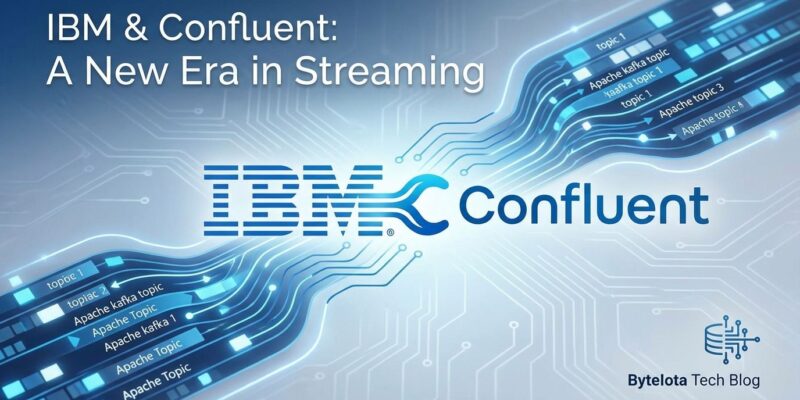
IBM announced it will acquire Confluent for $11 billion, bringing Apache Kafka—the de facto standard for real-time data streaming—into Big Blue’s enterprise AI arsenal. The deal, expected to close mid-2026, is IBM’s largest acquisition since Red Hat in 2019 and its biggest bet yet that AI infrastructure needs a real-time data backbone. But developer skepticism is already brewing: can IBM execute without killing what made Confluent valuable?
Why Real-Time Data Became Critical for AI
AI shifted from batch processing to real-time inference, and that change made streaming platforms essential infrastructure. LLMs need fresh context pulled from live data sources. AI agents coordinate through event streams. Continuous learning systems can’t wait for nightly batch jobs—they update models as new data arrives.
Confluent saw this coming. In 2025, they launched the Real-Time Context Engine, which materializes enriched enterprise datasets into in-memory caches and serves them to AI systems via Model Context Protocol. They’re not just selling Kafka anymore—they’re positioning as “the context layer for enterprise AI.”
IBM’s watsonx platform was missing this real-time data layer. Every major AI use case—retrieval augmented generation, agent orchestration, anomaly detection—runs better on streaming infrastructure than traditional databases. The strategic logic is sound: if you’re building enterprise AI, you need real-time data pipes.
The Red Hat Playbook: Success or Trap?
IBM is betting they can repeat their Red Hat playbook. Acquire the leading open-source platform, keep it operationally separate, and build a consulting multiplier around it. Red Hat worked spectacularly—OpenShift revenue doubled each year since the 2019 acquisition, and IBM’s hybrid cloud business now generates $5-6 in consulting revenue for every software dollar sold.
CEO Arvind Krishna made the parallel explicit: “In the same way we’ve built a consulting practice around Red Hat’s hybrid cloud platform that is now measured in the billions of dollars, we will do the same with AI.” Confluent will operate as a distinct brand within IBM, just like Red Hat does.
But here’s the problem: Red Hat was IBM’s crown jewel. Watson AI was a disaster. Between 2011 and 2021, IBM spent billions promoting Watson as the future of AI, only to quietly wind down most initiatives when they failed to deliver. Which pattern will Confluent follow?
Execution risk is real. The Red Hat model works when you don’t mess with what made the company successful. Watson failed because IBM overpromised and underdelivered. Developers have long memories, and they’re not assuming this goes well.
Developer Skepticism Runs Deep
The Hacker News thread on the acquisition is brutal. One developer wrote: “I am now witnessing the demise of confluent now.” Another noted that “IBM have an absolutely stellar record of blowing acquisitions.”
The most damning comment came from someone who worked at a company IBM previously acquired: “A lot of the successful projects at the original company are now dead… if your ‘contract’ ends they put you on the bench. Then you basically have to job hunt within IBM, and if you can’t find anything within a month or so you are out.”
Talent flight is the real risk. Confluent employs many of Apache Kafka’s core committers. Even though Kafka is Apache Foundation-governed and won’t be controlled by IBM, innovation slows when the engineers who understand the codebase leave. Developers are the canary in the coal mine for tech acquisitions.
Some are already discussing alternatives. Redpanda is Kafka API-compatible but written in C++ instead of Java, delivering 3-6x cost savings and simpler operations. Apache Pulsar offers better multi-tenancy and geo-replication. If IBM botches this, the migration paths exist.
IBM Was Playing Catch-Up, Not Leading
Context matters here: this isn’t a strength play—it’s gap-filling. AWS has Managed Streaming for Kafka. Google has Pub/Sub. Azure has Event Hubs. Microsoft just committed $23 billion to AI infrastructure expansion. Google is spending $15 billion on data centers. AWS launched “AI Factories” at re:Invent 2025.
IBM’s cloud footprint is the weakest among hyperscalers. Confluent’s multi-cloud strategy helps IBM compete in environments where their own cloud infrastructure can’t—but that means they’re buying their way back into a race they were losing, not setting the pace.
The Verdict: Smart Move, High Risk
The strategic logic is solid. Real-time data is genuinely critical for production AI systems, and Kafka is the standard. IBM needs this capability to make watsonx competitive, and the Red Hat model proved large open-source acquisitions can work within Big Blue.
But execution is everything. Developers are skeptical for good reasons—IBM’s track record is mixed, and talent retention determines whether Confluent thrives or withers. If engineers start leaving, that’s your signal. The technology might be sound, but the execution risk is real.
Watch what happens in the next six months. If Confluent’s leadership and core engineers stick around post-acquisition, IBM might actually pull this off. If they don’t, alternatives like Redpanda are ready to absorb refugees.