
 By ByteBot
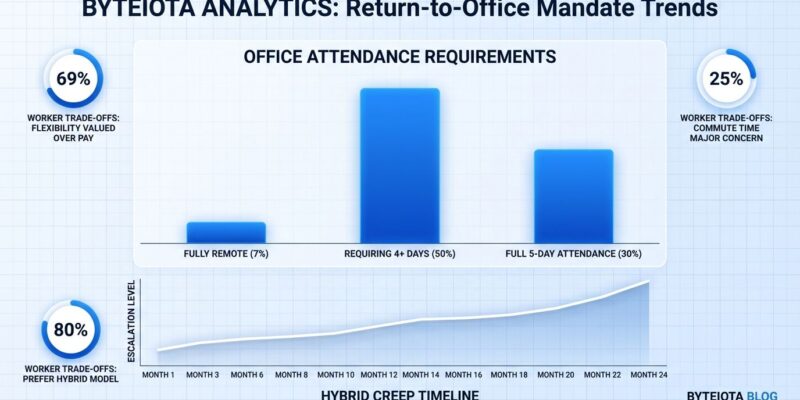
“Hybrid creep” is the defining workplace trend of 2026—a gradual expansion of in-office requirements that companies are using to nudge remote workers back to their desks one extra day at a time. Coined by Boston-based Owl Labs, the phenomenon describes how organizations avoid blunt mandates by incrementally increasing required office days from 2 to 3 to 4 to 5 over months or years. The shift is dramatic: only 7% of companies now allow fully remote roles (down from 21% the year before), while 50% require 4 or more days in the office—and 30% demand full five-day attendance.
The Gradual Escalation Playbook
Hybrid creep operates through a predictable pattern: companies start with “2 days encouraged,” escalate to “3 days required,” introduce badge tracking, then push to 4-5 days with termination threats. It’s boundary-testing disguised as policy evolution.
The enforcement surge reveals the power shift. 37% of companies now monitor office attendance with badge swipes and desk sensors—up from 17% in 2024. Moreover, 47% of companies requiring five-day schedules plan to terminate non-compliant employees. This isn’t hybrid flexibility—it’s managed retreat from remote work.
Amazon implemented one of tech’s strictest policies in January 2025, requiring all employees back five days per week with badge swipe monitoring. Instagram announced an even harsher mandate—five days starting February 2026—while parent company Meta allows three days for Facebook and WhatsApp. This intra-company divergence exposes the arbitrary nature of these policies. If productivity justified five-day mandates, why the inconsistency within Meta?
The Turnover Paradox: $56M vs $13M
Here’s the economic contradiction: companies justify RTO by pointing to expensive office leases, yet the turnover costs from strict mandates dwarf the real estate savings.
80% of companies lost talent to RTO policies. Companies with strict mandates see 13% higher turnover—169% vs 149% for flexible setups. Furthermore, replacing 300 employees who quit over RTO mandates costs $56.25 million (using the standard 6-9 months salary replacement cost), while office space for 1,000 employees in Manhattan averages $13 million annually. The math doesn’t add up.
The rationale becomes clearer when you note that 8% of companies admit stricter attendance policies are designed to encourage turnover—stealth layoffs without severance packages. Consequently, RTO mandates aren’t just about culture; they’re tools for workforce reduction.
Workers Pay for Remote, Lose It Anyway
The irony is striking: workers demonstrate extraordinary willingness to pay for remote flexibility, yet companies increasingly override these preferences. 69% of workers would accept pay cuts for remote work (up 11% from 2024), and tech workers would sacrifice 25% of their salary for remote or hybrid arrangements. 85% say remote work matters more than salary when evaluating jobs.
However, the labor market power shift changes everything. During “The Great Resignation” of 2022-2023, workers quit over RTO mandates. In 2026’s “Great Compliance,” only 7% would quit outright, while 44% say they’d comply with five-day mandates. The weakened labor market empowers employers to impose policies workers would have rejected 18 months ago.
The asymmetry is clear: workers value remote work enough to accept massive salary reductions, yet lack the leverage to preserve it. That’s not a preference mismatch—it’s a power imbalance.
Productivity Data Says Otherwise
The productivity rationale for RTO mandates contradicts the research. Remote workers are 13-47% more productive than office workers (Stanford study), make 40% fewer mistakes, and hybrid workers show a 5% productivity boost compared to fully remote or fully office setups (McKinsey). Additionally, 78% of managers say remote teams outperform.
Stanford research found hybrid workers perform equally well while being 33% less likely to leave—a retention advantage that could save millions in turnover costs. Nevertheless, Amazon, Instagram, Dell, and others moved to strict five-day mandates in 2025-2026.
This reveals RTO mandates aren’t data-driven productivity decisions. They’re cultural and strategic choices about visibility, control, and office utilization—defended with productivity claims that the research doesn’t support.
The Polarized Future: No Middle Ground
The trend isn’t convergence on hybrid work—it’s polarization between extremes. Companies are doubling down on either full RTO (Amazon, Instagram) or full remote (GitLab, Zapier), with hybrid as the unstable middle ground gradually eroding through creep.
Remote-first companies show 23% higher retention and access to 5x larger talent pools. McKinsey projects a 13% decline in office space demand by 2030 ($800 billion in real estate value at risk), yet Manhattan office leasing surged in Q4 2025 to its highest level since 2019 as companies signed new leases for RTO space needs. Office vacancy rates remain at 19.7% nationally despite the RTO wave.
The future is two distinct talent markets: remote workers seeking remote-first employers, office workers accepting in-person mandates. Companies aren’t finding compromise—they’re choosing sides. Remote-first organizations will increasingly use flexibility as a hiring advantage, while office-centric firms bet culture and collaboration gains justify the retention costs.
Key Takeaways
- Hybrid creep succeeds because workers lack 2022 leverage. Only 7% would quit outright over RTO mandates in 2026, down from much higher rates during The Great Resignation. The weakened labor market empowers gradual escalation.
- The economic paradox is real. Companies lose $56.25 million replacing 300 RTO-driven departures while saving $13 million on office space. Turnover costs dwarf real estate savings, revealing these are cultural choices, not financial optimizations.
- Productivity data contradicts RTO rationale. Remote workers are 13-47% more productive, make 40% fewer mistakes, and hybrid workers show 5% productivity gains. RTO mandates aren’t data-driven.
- Workers value remote work extraordinarily but can’t preserve it. 69% accept pay cuts, tech workers sacrifice 25% salary, yet only 7% of companies allow fully remote (down from 21%). Power shifted from workers to employers.
- The future is polarization, not consensus. Companies are choosing between full RTO (Amazon, Instagram) and full remote (GitLab, Zapier). Hybrid is the unstable middle ground eroding through creep, not the future equilibrium.


