 By
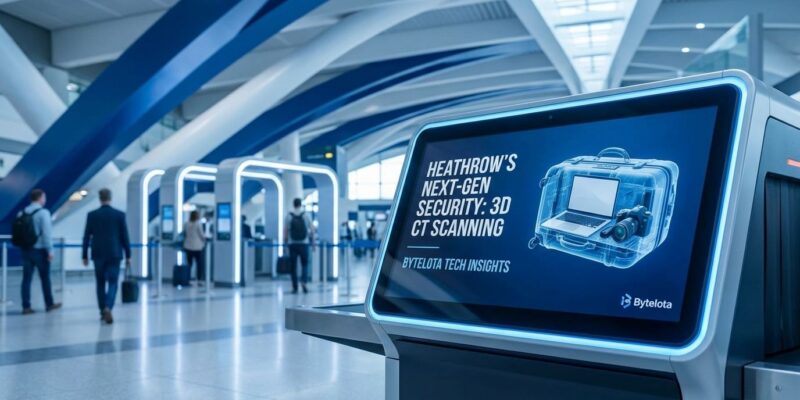
By Heathrow Airport just became the world’s largest airport to eliminate the 100ml liquid restriction—a security rule that’s been annoying travelers for nearly 20 years. The change went live in January 2026 after Heathrow completed a £1 billion CT scanner upgrade across all four terminals. Passengers can now carry up to 2 liters of liquids and keep laptops in their bags, finally ending the plastic bag ritual that’s defined airport security since 2006.
The 20-Year Journey from Terror Plot to Tech Solution
The liquid ban started in August 2006 after British security uncovered a terror plot involving hydrogen peroxide explosives disguised in drink bottles. The TSA responded by banning all carry-on liquids overnight, then softened to the infamous 3-1-1 rule in September 2006: 3.4-ounce containers, one quart-sized bag, one bag per passenger. We’ve been juggling tiny shampoo bottles and fishing out laptops ever since.
How CT Scanners Changed Airport Security
The technical solution existed for years—computed tomography (CT) scanners that create 3D volumetric images from hundreds of angles, like medical CT scans. Security operators can rotate and zoom to “digitally unpack” bags on touch-screens while automated algorithms detect threats. Passengers keep everything in their bags: liquids up to 2L, laptops, shoes, belts. The scanning process is actually slower than traditional X-ray, but overall throughput improves because passengers spend less time unpacking and fewer bags get rejected for secondary screening.
The £1 Billion Investment and Profit Impact
So why did it take 20 years? Money and deployment complexity. Each CT unit costs around $300,000—ten times the price of traditional X-ray scanners. Heathrow’s total investment hit £1 billion, and the company’s pre-tax profits plummeted 37% to £203 million in the first half of 2025, partly due to scanner costs and staff training. The rollout also faced multiple delays: Heathrow missed deadlines in 2022, 2024, and June 2025 before finally completing the upgrade in January 2026.
Was the ROI Worth It?
The ROI question is thornier than Heathrow admits. Last year, over 97% of passengers already waited less than five minutes for security. Eliminating the plastic bag step is convenient, but £1 billion for convenience feels steep when profits crater 37%. Heathrow CEO Thomas Woldbye emphasized becoming “the largest airport in the world to roll out the latest security scanning technology,” framing it as competitive positioning rather than passenger benefit. The environmental upside is real—16 million plastic bags eliminated annually—but that’s an expensive way to go green.
The automation story is more compelling. CT-equipped lanes reduce screening staff from 12 operators down to 5, and advanced systems can process up to 750 passengers per hour compared to 250-400 for traditional setups. That’s where the long-term ROI hides: labor savings and capacity for passenger growth.
The Asymmetric Security Problem
But here’s the catch that most coverage misses: asymmetric security. Heathrow allows 2L liquids outbound, but return flights from airports without CT scanners still enforce the 100ml rule. Buy duty-free liquids at Heathrow, and they might get confiscated at your return airport. This distributed system problem will persist until global adoption, and deployment timelines vary wildly. The EU aims to equip all major airports with CT scanners by 2026, but TSA estimates full US coverage may not happen until 2042 absent incremental funding. Dublin, Amsterdam, Berlin, Rome, and several US cities (Atlanta, Chicago, New York) have deployed CT scanners, but tier-2 airports can’t afford the ten-fold cost increase.
Developer Takeaway: Infrastructure Tech Debt on a 20-Year Timeline
For developers, Heathrow’s story hits familiar notes. This is infrastructure tech debt on a 20-year timeline: a known problem with a known solution that required massive capital investment to fix. Regulated industries move slower than software, but the pattern is the same—sometimes the only path forward is ripping out legacy systems and paying the price. The asymmetric security issue mirrors version migration problems in distributed systems: components upgrade at different rates, creating inconsistent behavior until everyone’s on the new stack.
The environmental and automation wins make this more than security theater, but £1 billion is hard to justify when 97% of passengers were already through security in five minutes. Heathrow bet big on competitive differentiation and long-term operational efficiency. Whether that pays off depends on how fast competitors adopt CT scanners and whether passengers actually care enough to choose airports based on liquid rules.
Twenty years to solve the liquid ban. Maybe the real lesson is that infrastructure changes in highly regulated industries happen on geological timescales, and the first mover pays the premium.