
 By ByteBot
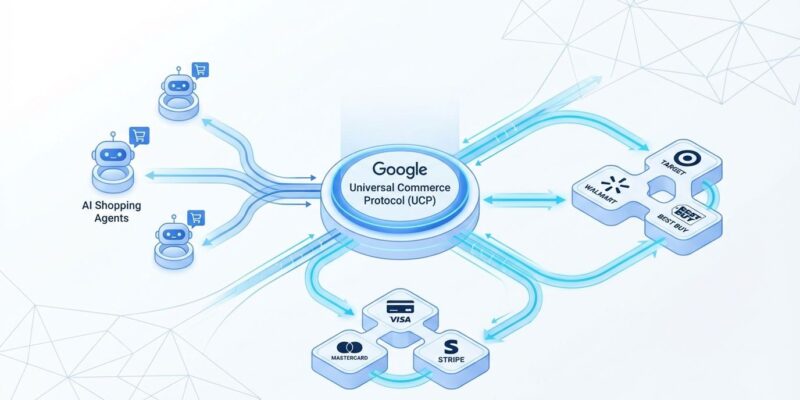
On January 11, Google launched the Universal Commerce Protocol (UCP) at the National Retail Federation conference—an open-source standard that lets AI shopping agents execute purchases across any participating retailer without custom integrations. Co-developed with Shopify, Etsy, Wayfair, Target, and Walmart, and endorsed by 60+ partners including Visa, Mastercard, Stripe, and PayPal, UCP collapses the “N × N integration bottleneck” where merchants previously built unique connections for each sales surface. The protocol is already powering checkout in Google Search AI Mode and Gemini app for U.S. retailers.
For developers, this saves months of integration work. Instead of building 100+ custom integrations (one for each AI platform), implement UCP once and all compliant agents—Gemini, ChatGPT, Claude—can transact with you. For the industry, this is Google’s bet that agentic commerce will replace traditional search-and-click shopping.
How Universal Commerce Protocol Works: Capability Discovery Without Hardcoding
UCP uses a discovery mechanism where merchants publish a service manifest at /.well-known/ucp containing their supported capabilities (checkout, orders, discounts, loyalty), payment handlers, and custom extensions. AI agents query this endpoint, declare their own capabilities, and the system computes the intersection to determine available functionality—similar to HTTP content negotiation.
When agents encounter unsupported features, structured handoff via continue_url routes users to human-friendly web checkout, preventing transaction abandonment. This graceful degradation is critical because agent capabilities vary widely between Gemini, ChatGPT, and Claude.
The architecture is layered: core shopping service (transaction primitives), independently-versioned capabilities (checkout, orders, catalog), and domain-specific extensions (loyalty programs, custom fulfillment). Shopify Engineering notes this design “enables composition without breaking changes” and is “battle-tested from operating embedded checkout at scale” across billions of transactions.
The Developer Skepticism: Will Google Keep This Open?
While Google open-sourced the UCP spec, Hacker News developers are cautiously skeptical. Top concern: “The protocol may be open but the API keys will only be available to Google, OpenAI & co through complicated deals.” The community predicts this will create “a different walled garden made of fees,” comparing it to Apple Pay—initially framed as helpful but later monetized aggressively with 2-3% transaction fees.
Developers also cite Google’s track record of killing products: Reader, Google+, Wave, Inbox. However, UCP differs—Google controls distribution via AI Mode in Search and Gemini. This isn’t just a protocol experiment—it’s strategic infrastructure for Google’s agentic commerce vision. That means commitment, but also control.
The trade-off is real: early-mover advantage (capture AI agent traffic before competitors) versus protocol risk (Google gatekeeps access or imposes fees later). Developers must weigh this honestly, not just follow hype.
Implementation Timeline for Developers
Shopify merchants get UCP support automatically via platform rollout—2 million+ stores gain access in Q1 2026 with zero custom development. For custom e-commerce sites, expect 2-4 weeks of implementation: Week 1-2 build the capability manifest at /.well-known/ucp, Week 3-4 implement core checkout API (session creation, payment confirmation), Week 5-6 add extensions (discounts, loyalty), Week 7-8 test with multiple agents (Gemini, ChatGPT, Claude).
Google provides native SDKs in Python, JavaScript, Java, and Go on GitHub. Merchants implement either “Native Checkout Integration” (recommended—unlocks full agentic potential) or “Embedded Checkout” (iframe-based, requires Google approval). Key requirement: compatibility with Agent Payments Protocol (AP2) for secure payments. Critically, merchants remain the Merchant of Record—Google provides distribution, not control over customer relationships.
The decision point: If you’re on Shopify or WooCommerce, adoption is nearly free via platform integration. If you’re running custom e-commerce, 2-4 weeks is manageable for early-mover advantage, but risky if UCP fails to reach critical mass. Watch Q1-Q2 2026 adoption rates before committing significant resources.
The Strategic Shift: From Search-Based to Agentic Commerce
UCP represents a fundamental industry transformation: from search-based commerce (users click through Google Shopping, Amazon search) to agentic commerce (AI agents autonomously execute purchases). When users ask Gemini “buy me AirPods Pro 2,” the agent queries UCP merchants, compares prices in real-time, applies discounts, and completes checkout—all without human clicking. This disrupts traditional e-commerce platforms and search-driven traffic models.
Here’s the uncomfortable truth: traditional SEO and conversion funnel optimization become less relevant when agents bypass search results entirely. The new optimization target is how agents perceive your merchant capabilities via UCP manifests. Developers building e-commerce systems must prepare for this shift. It’s a 5-year trend, not a 2026 fad.
Hacker News developers note this “is a huge threat for Amazon” because UCP makes price comparison instant across all merchants. Small sellers who competed on search ranking now compete on raw price and capability—a different game entirely.
Protocol Ecosystem: UCP Works with AP2, A2A, and MCP
UCP integrates with three related protocols: Agent Payments Protocol (AP2) for secure payments with cryptographic proof, Agent2Agent (A2A) for multi-agent scenarios where orchestrator agents delegate to specialists, and Model Context Protocol (MCP) for native LLM integration. This interoperability means developers can implement UCP via REST APIs (traditional HTTP), MCP bindings (LLM-native), or A2A (agent-to-agent workflows).
AP2 enables secure payment support with 60+ collaborating organizations including Adyen, American Express, Mastercard, PayPal, and Visa. MCP, originally developed by Anthropic and now hosted by the Linux Foundation, provides the foundational layer connecting AI applications to external systems. A2A is also Linux Foundation-hosted as open-source.
This matters because UCP isn’t a Google-only experiment—it’s part of a broader agentic commerce ecosystem with Linux Foundation backing and payment industry coordination. That signals industry commitment beyond Google’s control.
Key Takeaways
- UCP is live now in Google Search AI Mode and Gemini app for U.S. retailers, with expansion to India, Indonesia, and Latin America planned for Q2-Q3 2026.
- Shopify merchants (2M+) gain automatic UCP access via platform rollout; custom e-commerce sites need 2-4 weeks of development.
- Developer skepticism centers on gatekeeping (will Google control API key access?) and fee extraction risk (2-3% transaction fees predicted within 12-18 months).
- The strategic shift is real: agentic commerce will disrupt search-based shopping. Developers must prepare for agent optimization, not just SEO.
- Watch for ChatGPT and Claude full integration via MCP bindings in Q1-Q2 2026—if major AI platforms adopt UCP, it becomes the de facto standard.


