 By ByteBot
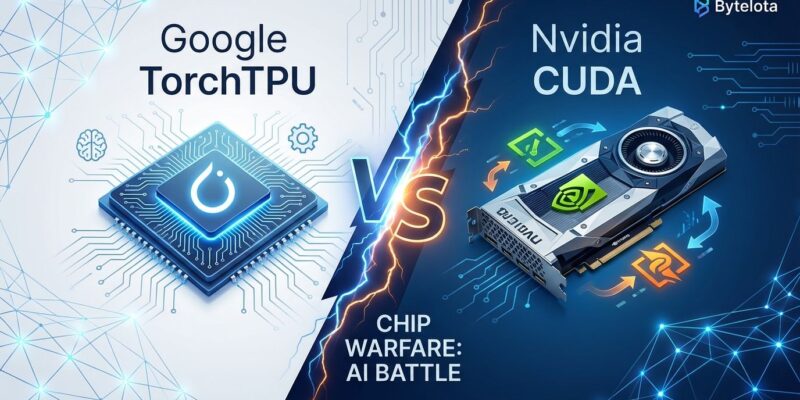
Google launched TorchTPU this week to make its TPU chips fully compatible with PyTorch, the world’s most widely used AI framework. Per Reuters reporting on December 18: “weaken Nvidia’s longstanding dominance” of the AI chip market. What makes this newsworthy isn’t just Google competing with Nvidia—it’s that Meta, which created and maintains PyTorch, is actively helping Google optimize TPUs for the framework. Both companies share a strategic objective: break Nvidia’s CUDA software lock-in to gain chip supplier diversity and pricing leverage.
This is a direct assault on Nvidia’s strongest competitive moat. Nvidia holds 80-95% of the AI chip market, but that dominance isn’t primarily about faster hardware—it’s about CUDA, the proprietary software ecosystem that has locked developers into Nvidia GPUs for nearly 20 years. If Google and Meta succeed in making PyTorch feel “native” on TPUs, the 63% of AI developers using PyTorch for training workloads would finally have a credible alternative. The stakes are enormous: Morgan Stanley estimates that if TPUs capture just 10% of Nvidia’s market share, it could add 3% to Google’s 2027 EPS. Moreover, Nvidia’s stock fell 3% on rumors of Meta potentially switching to TPUs.
The CUDA Moat: Software Lock-In, Not Hardware Superiority
Here’s what most people miss about Nvidia’s dominance: it’s not primarily about building faster chips. It’s about CUDA, the proprietary parallel computing platform Nvidia has developed over nearly two decades. Wall Street analysts call CUDA “Nvidia’s strongest shield against competitors,” and they’re right. The ecosystem creates a self-reinforcing lock-in loop: PyTorch and TensorFlow are deeply optimized for CUDA, which means they run best on Nvidia hardware, which drives more GPU sales, which encourages more CUDA optimization. Rinse and repeat for 18 years.
Moreover, the switching costs are brutal. Developers describe CUDA as “both a blessing and a burden”—you get unmatched performance and a mature ecosystem, but migrating away requires rewriting codebases, retraining teams, and rebuilding CI/CD pipelines. That’s not a weekend project. Consequently, even when competitors offer cheaper or more efficient chips, most companies stick with Nvidia as the “safe choice.” The lock-in is so effective that it’s maintained Nvidia’s 80-95% market share despite aggressive challenges from AMD, Intel, and now Google.
Meta’s Strategic Alliance: Why PyTorch’s Creator Helps Google
Meta created PyTorch in 2016 to compete with Google’s TensorFlow. Nine years later, Meta is actively collaborating with Google to make PyTorch work better on Google’s chips. This isn’t altruism or open-source charity—it’s cold strategic calculation. Meta depends heavily on Nvidia GPUs for all its AI infrastructure: content recommendation, computer vision, and text analysis that process billions of interactions daily. By helping Google make TPUs PyTorch-compatible, Meta gains something more valuable than short-term advantage: negotiating leverage with chip suppliers.
Indeed, the logic is straightforward. If Meta can credibly switch between Nvidia GPUs and Google TPUs, it dramatically strengthens its pricing negotiations with both vendors. As Open Source For You reports, “diversifying AI infrastructure suppliers would reduce dependence on Nvidia and strengthen negotiating positions for future chip purchases.” Meta’s exploration of TPU switching was enough to knock 3% off Nvidia’s stock price—that’s real leverage in action. Furthermore, Google gets PyTorch adoption on TPUs (critical for external GCP customers), Meta gets supplier diversity and pricing power, and Nvidia faces the first serious threat to its moat in years.
The Compatibility Challenge: “Exists” vs “Feels Native”
PyTorch support on TPUs isn’t new—it’s existed for years. However, as developers bluntly put it, “‘exists’ and ‘feels native’ are wildly different universes.” The experience of running PyTorch on TPUs has historically felt like “duct-taping two ecosystems together” rather than seamless integration. The core problem: Google designed TPUs for Jax, its internal ML framework. Migrating from PyTorch to Jax, or using PyTorch on non-native TPUs, requires “significant engineering effort, retraining, and changes to existing workflows.” Additionally, that friction has constrained TPU adoption despite compelling economics—TPUs are approximately 2x cheaper than Nvidia GPUs at scale and deliver 25-30% to 2x better performance per watt depending on the workload.
Furthermore, TorchTPU represents Google’s most serious attempt yet to solve this problem. According to DigiTimes, Google has “devoted more organizational focus, resources and strategic importance to TorchTPU” compared to earlier efforts. Moreover, the company may even open-source parts of the software to accelerate integration. The goal is making TPUs “fully compatible and developer-friendly” for PyTorch users—removing the “key barrier that has slowed adoption” and creating a native experience instead of a bolted-on hack. If they succeed, that 2x cost advantage becomes accessible to PyTorch developers without painful migration. However, if they fail, it’s just another half-baked solution developers will ignore.
The Stakes: Market Impact and Reality Check
The financial stakes justify the attention. Morgan Stanley’s estimate that a 10% market share shift from Nvidia to Google could add 3% to Google’s 2027 EPS translates to billions in annual revenue. Furthermore, for developers, the implications are equally significant: real alternatives to vendor lock-in, substantially lower infrastructure costs (2x savings at scale), and competitive pressure driving innovation across the AI chip market. That’s not theoretical—at 9,000-chip scale, the cost difference between TPUs and Nvidia GPUs is massive enough to reshape infrastructure decisions.
However, temper expectations. TorchTPU was just announced this week. Google hasn’t provided a launch date, performance benchmarks, or production-readiness timeline. The challenge isn’t trivial: Nvidia has spent nearly 20 years optimizing CUDA, and PyTorch’s history has been “closely tied to Nvidia’s CUDA development.” Catching up to years of co-optimization while competing with an incumbent developers trust for production-critical workloads is a multi-year effort, not a quick fix.
Nevertheless, what makes this attempt credible where others failed is the strategic alignment. When the two companies that built the dominant AI framework (Meta) and the leading cloud TPU platform (Google) collaborate to weaken a competitor’s moat, markets pay attention. Nvidia’s 3% stock drop on Meta-TPU switching rumors wasn’t irrational—it’s recognition that this alliance represents the most serious challenge to Nvidia’s dominance yet.
Key Takeaways
The Google-Meta alliance attacking Nvidia’s CUDA moat is significant, but success depends on execution:
- Strategic alignment is real: Both Google and Meta benefit from breaking Nvidia’s monopoly—Google gets PyTorch adoption on TPUs, Meta gets chip supplier diversity for better pricing leverage.
- Economics favor disruption: TPUs are 2x cheaper at scale with comparable or better performance per watt. If TorchTPU achieves CUDA-level PyTorch compatibility, the value proposition becomes compelling for cost-sensitive AI workloads.
- Software moat remains formidable: Nvidia’s 20-year CUDA advantage and tight PyTorch integration won’t evaporate overnight. TorchTPU must deliver more than compatibility—it needs performance parity, ecosystem maturity, and developer trust.
- Watch for proof points: Performance benchmarks comparing TorchTPU vs CUDA+PyTorch, production case studies from early adopters, Meta’s actual commitment to switching workloads (currently just “exploring”), and potential open-source release of TorchTPU components.
- Broader trend matters: This isn’t isolated. AMD’s ROCm now runs production workloads for 7 of the 10 largest AI model builders (including Meta, OpenAI, and xAI). Intel’s oneAPI and the UXL Foundation’s open-source CUDA alternative add to the pressure. The industry is collectively pushing back against Nvidia’s lock-in.
For now, TorchTPU is a strategic long-term bet, not an immediate solution. However, the combination of Google’s resources, Meta’s strategic collaboration, and compelling unit economics makes this the most credible challenge to Nvidia’s AI chip dominance in years. Developers should watch closely—the AI infrastructure market could look very different by 2027.