
 By ByteBot
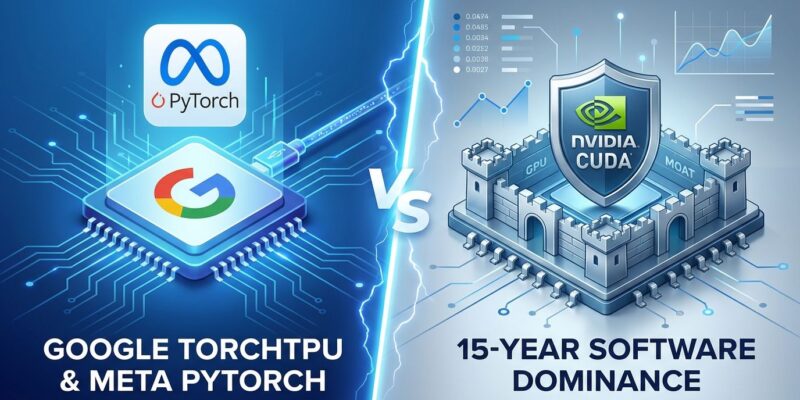
Google launched TorchTPU on December 18, 2025—an internal initiative to make its Tensor Processing Units natively compatible with PyTorch, partnering with Meta to challenge Nvidia’s $5 trillion software moat. This isn’t just another hardware vs hardware battle. It’s Google’s most serious attempt to break the CUDA ecosystem lock-in that keeps 90% of AI workloads running on Nvidia GPUs, despite Google TPUs offering 4-6x cost advantages at scale.
Nvidia’s Real Advantage Isn’t the Hardware
Nvidia’s dominance stems not from superior chips but from CUDA—a 15-year software ecosystem with 500 million deployed GPUs, thousands of specialized libraries, and deep PyTorch integration. Moreover, companies that try to switch face what Google calls “significant extra engineering work”: rewriting codebases, retraining teams, rebuilding tooling.
The numbers tell the story. CUDA has been in continuous development since 2006. It spans linear algebra, image processing, deep learning, and graph analytics through the CUDA-X library collection. PyTorch developers inherit 15 years of Nvidia’s optimization work built directly into the framework. Consequently, this creates what Semi Analysis describes as “profound vendor lock-in”—a moat worth more than Nvidia’s $5 trillion market cap.
This explains why Google, AWS, and AMD have all failed to dent Nvidia’s market share despite offering cheaper or faster hardware. The battle is software, not silicon. Therefore, if TorchTPU succeeds in making PyTorch run natively on TPUs, it removes the single biggest barrier to adoption.
Why Meta Is Helping Google Fight Nvidia
Meta—PyTorch’s creator—is actively collaborating with Google on TorchTPU, getting expanded TPU access to test and refine the integration. This partnership is unusual. Meta and Google compete in AI research and development. However, Meta has strong incentive to reduce Nvidia’s pricing power, and unlike AWS or Azure, Meta doesn’t sell cloud services that compete with Google Cloud.
According to Reuters, the companies “discussed arrangements for expanded Meta access to TPUs so Meta can help test and refine the software bridge.” This adds credibility Google’s previous attempts lacked. Furthermore, having PyTorch’s creator as an active testing partner signals serious commitment and increases odds of production-quality integration. Meta uses PyTorch for all AI research and production—if TorchTPU works for Meta, it works for everyone.
Related: AWS Trainium4 Adopts Nvidia NVLink: Smart Strategy or Surrender?
The $251K Monthly Savings That Require a Leap of Faith
Google TPUs deliver 4.7x better performance-per-dollar than Nvidia GPUs and 67% lower power consumption. Nevertheless, real companies have achieved massive cost reductions by migrating from Nvidia to TPUs—but only those willing to rewrite for Google’s JAX framework.
A Series C computer vision startup sold 128 H100s and moved to TPU v6e. Their monthly inference bill dropped from $340,000 to $89,000—a 74% savings. Similarly, Midjourney achieved 65% cost reduction post-migration. Training Llama 3.1 on TPUs runs roughly 30% cheaper than Nvidia hardware, though that requires using JAX.
The pricing gap is real. Nvidia A100 on-demand costs $2.93 per hour. In contrast, TPU v6e starts at $1.375 per hour on-demand, dropping to $0.55 per hour with 3-year commitments. For companies running inference at scale—where costs become 15x more expensive than training over time—these savings matter.
This proves the economic incentive exists. Companies want to switch for cost reasons. As a result, the barrier isn’t hardware performance or pricing; it’s the PyTorch-to-JAX rewrite requirement that TorchTPU directly attacks.
Google Has Failed Before – Why This Time Might Be Different
Developers are skeptical because Google has failed multiple times to challenge Nvidia’s ecosystem. OpenCL never gained traction against CUDA. TensorFlow lost to PyTorch, partly due to what Hacker News developers call Google’s “insane and badly documented APIs.” Additionally, the existing PyTorch/XLA solution is, in developers’ words, “clunky,” has “missing libraries,” and produces “cryptic errors.”
One developer reported “endless problems with the official pytorch TPU notebooks.” Another noted that “developer tooling for non-NVIDIA chipsets is lacking.” These aren’t theoretical concerns—PyTorch/XLA exists today but hasn’t driven significant TPU adoption because the developer experience falls short of CUDA’s polish.
What’s different with TorchTPU? Reuters reports that “compared with earlier attempts to support PyTorch on TPUs, Google has devoted more organizational focus, resources and strategic importance to TorchTPU.” Furthermore, Google may also open-source parts of the project to accelerate community adoption. The Meta partnership signals top-level strategic commitment rather than a side project.
But announcements are cheap. Google needs to deliver production-quality, feature-complete PyTorch integration—not another half-baked developer experience. Developer trust must be earned, not assumed. Indeed, Google’s track record of abandoning projects doesn’t help.
More Resources, But Can Google Execute?
The increased organizational commitment matters. Previous attempts like PyTorch/XLA were underfunded and underprioritzed. TorchTPU appears to have senior leadership buy-in, evidenced by the Meta partnership and potential open-source strategy. Moreover, the timing also aligns with Nvidia hitting a $5 trillion valuation—a clear signal of how dominant the CUDA moat has become.
However, “more resources” doesn’t guarantee success. AMD’s ROCm has been available for years as a CUDA alternative with minimal adoption. Recently, AWS Trainium4 adopted Nvidia’s NVLink protocol, acknowledging CUDA’s entrenched position. A 15-year moat doesn’t fall in months, even with increased resources.
The real test comes when TorchTPU reaches general availability. Will it support the full PyTorch feature set? Or just core operations with edge cases lagging? Will debugging and profiling tools match Nvidia’s mature Nsight suite? Will third-party ML tools integrate smoothly? These execution details determine success or failure.
Key Takeaways
- Too early to declare a winner—TorchTPU was just announced with no public timeline for general availability
- Watch Meta’s actual TPU adoption as the credibility signal; if Meta migrates production workloads, the integration is real
- The 15-year CUDA moat won’t fall quickly even if TorchTPU delivers on its promises
- Cost savings are compelling (74% in real examples) but require taking execution risk on unproven technology
- Nvidia will respond—expect pricing pressure, tighter PyTorch integration, and hardware advances to defend the moat
This is Google’s most credible CUDA challenge yet. But credible doesn’t mean certain. The software moat Nvidia built over 15 years represents one of tech’s most valuable competitive advantages. Breaking it requires flawless execution, sustained commitment, and developers willing to bet their infrastructure on Google’s track record. We’ll know within 12-18 months whether TorchTPU is a genuine threat or another failed attempt to challenge CUDA’s dominance.




[…] ha sacudido a Wall Street, Google y Meta han formalizado una alianza técnica bajo el nombre clave Project TorchTPU. El objetivo es claro: hacer que PyTorch —el framework de IA más popular del mundo, creado por […]