 By ByteBot
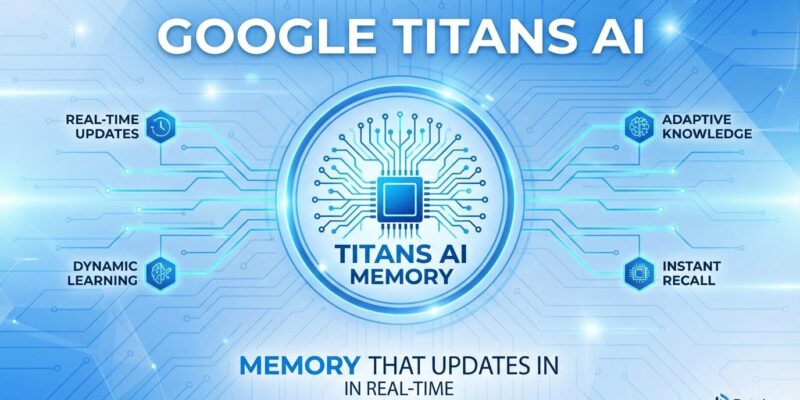
Google Research announced the Titans architecture on December 4, 2025, introducing “test-time memorization”—AI models that update their own memory while running, not just during training. Unlike transformers that freeze knowledge at training time, Titans uses a gradient-based “surprise metric” to selectively store novel information during inference, scaling to 2+ million token contexts while outperforming GPT-4 despite significantly fewer parameters. This challenges the transformer monopoly that has dominated AI since 2017.
Memory That Updates Itself: The Surprise Metric
Titans works fundamentally differently from transformers. It uses a gradient-based “surprise metric” that measures how unexpected incoming information is. Low-surprise inputs—routine patterns the model expects—are skipped to save compute. High-surprise inputs—novel or anomalous data—trigger immediate memory updates. The system considers both “momentary surprise” (the current token) and “accumulated surprise” (recent context patterns), mimicking how human memory retains surprising events while routine ones fade.
The architecture has three components: short-term memory via attention mechanisms with limited window, neural long-term memory using a deep multi-layer perceptron that encodes historical information, and persistent memory with learnable task-specific parameters. The Memory as Context (MAC) variant performs best, letting attention decide when to use memory versus immediate context. This is fundamentally different from static transformers—models evolve during use, not just during training.
Beating GPT-4 at 2 Million Tokens
On BABILong benchmarks (requiring reasoning across facts distributed in extremely long documents), Titans outperformed GPT-4 and all baselines despite having substantially fewer parameters. It scales effectively to 2+ million token contexts with higher accuracy in needle-in-haystack tasks. On standard language modeling datasets like C4 and WikiText, Titans consistently demonstrated lower perplexity than Mamba-2 and Gated DeltaNet.
Deeper memory modules maintain lower perplexity as sequence length increases—transformers degrade, Titans improve. The proof is in concrete benchmarks: BABILong for reasoning over long contexts, C4/WikiText for language modeling, and HellaSwag/PIQA for zero-shot reasoning. This isn’t just theoretical—it works in practice and beats state-of-the-art models on challenging long-context tasks.
Related: OpenAI Rushes GPT-5.2 After Gemini 3 Leaderboard Dominance
Solving the Quadratic Cost Problem
Transformers face quadratic computational complexity: doubling token count requires roughly 4x the compute. This creates an infrastructure cost crisis as context windows race to 1M+ tokens. The industry has pushed from 4K to 128K to 2M tokens, but quadratic scaling hits budget limits at enterprise scale.
Titans avoids this by combining RNN efficiency (linear scaling) with transformer accuracy, selectively updating memory only on high-surprise inputs rather than processing every token with full attention. This makes long-context AI economically viable. Developers can build applications requiring full document understanding—legal contracts, codebase analysis, conversational AI with true memory—without the cost explosion that has blocked adoption.
As VentureBeat notes, Google’s approach “separates memory components to control exploding costs,” addressing the real pain point limiting LLM applications.
Reality Check: Research vs Production
The Hacker News discussion (293 points, 95 comments) shows mixed sentiment: excitement about architectural innovation challenging transformer monopoly, but skepticism about production viability. Key debates revolve around whether this is a fundamental breakthrough or incremental improvement, and how to debug models that change during inference.
Production readiness, safety mechanisms, and deployment timeline remain unclear. The research paper doesn’t address deployment infrastructure, API latency, cost per token, or fine-tuning procedures. Developers are asking the right questions: How does this compare to RAG? Will this replace transformers? What about catastrophic forgetting or drift? When can we actually use this?
This is a research paper, not a product launch. The gap between research innovation and production deployment is real. Developers should watch this space but not expect immediate availability.
Key Takeaways
- Test-time learning, not just training: Titans enables continuous memory updates during inference—a breakthrough that transformers can’t match
- Beats GPT-4 despite fewer parameters: Outperforms on 2M+ token long-context tasks (BABILong benchmarks), proving the architecture works in practice
- Solves the quadratic cost crisis: Linear scaling with selective storage makes long-context AI economically viable for applications transformers can’t handle
- Production timeline unknown: This is research-stage work—temper expectations about when you can build with it
- Challenges transformer monopoly: First viable alternative for long-context tasks since 2017, opening the path to continuously learning AI systems